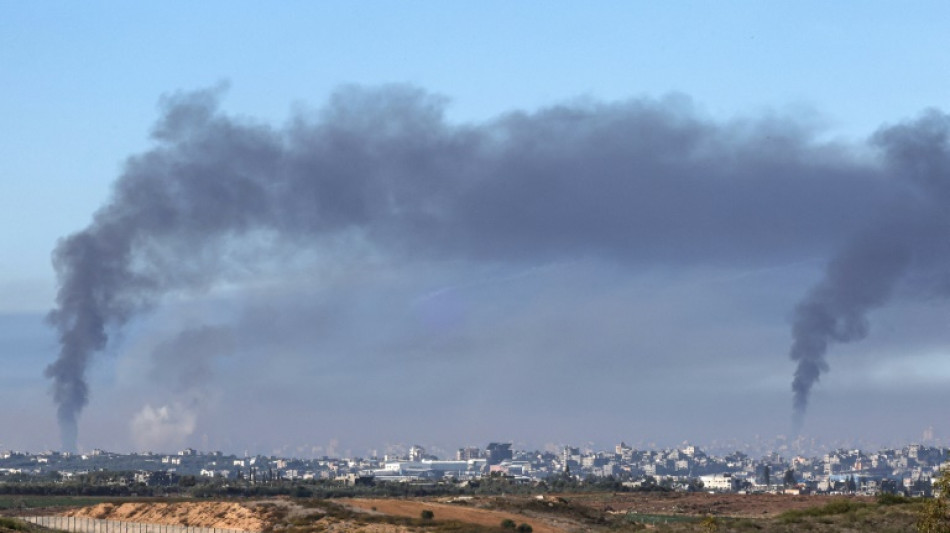
Israel reopens Gaza aid crossing as US pushes for restraint / Photo: JACK GUEZ - AFP
Israel reopened an aid crossing into Gaza on Friday as staunch ally the United States urged more restraint in its all-out offensive against Hamas.
The Israeli army said its troops had shot and killed three hostages after mistaking them for a "threat" while Jerusalem came under rocket fire from Gaza for the first time since late October.
The war began after Hamas launched an unprecedented attack on Israel on October 7 that Israeli officials say killed around 1,200 people, mostly civilians.
Vowing to destroy Hamas and bring home an estimated 250 hostages abducted by militants to Gaza, Israel launched a massive offensive that has left much of the besieged territory in ruins.
The Hamas government says the war has killed at least 18,800 people, mostly women and children.
Fierce fighting continued on Friday, with Hamas claiming they had blown up a house containing Israeli soldiers in the southern city of Khan Yunis.
Further south in Rafah near the Egyptian border, crowds of Palestinians used flashlights to search the rubble of buildings for survivors following Israeli strikes.
"This is a residential neighbourhood, women and children live here, as you can see," said resident Abu Omar. "Three missiles on a residential neighbourhood that has nothing to do with any militant activities."
Under pressure to do more to spare civilians, Israel approved a "temporary measure" allowing aid to be delivered directly to Gaza through its Kerem Shalom border crossing, the prime minister's office said.
Israel had faced weeks of pressure from aid agencies and Western allies to reopen Kerem Shalom as Egypt's Rafah crossing struggled to cope with the scale of need inside Gaza, where 1.9 million of the 2.4 million population have been displaced, according to UN figures.
US National Security Advisor Jake Sullivan, who was wrapping up a trip to Israel and the West Bank, called the decision a "significant step".
The United States hopes "this new opening will ease congestion and help facilitate the delivery of life-saving assistance", Sullivan added.
A World Health Organization representative said the announcement was "very good news".
Aid distribution had largely stopped in most of Gaza, except on a limited basis in the Rafah area, according to the UN.
In Khan Yunis, satellite news channel Al Jazeera reported that one of its journalists had been killed and another wounded by "shrapnel from an Israeli missile attack".
More than 60 journalists and media staff have died since the Israel-Hamas war began, according to the Committee to Protect Journalists.
- 'Deep remorse' -
The Israeli army said its troops shot and killed three hostages after "mistakenly" identifying them as a threat.
"During combat in Shejaiya (a battleground neighbourhood of Gaza City), the IDF (army) mistakenly identified three Israeli hostages as a threat. As a result, the troops fired toward them and they were killed," the army said in a statement.
"Immediate lessons from the event have been learned, which have been passed on to all IDF troops in the field," it added, expressing "deep remorse over the tragic incident".
Netanyahu called the hostage deaths an "unbearable tragedy".
Army spokesman Daniel Hagari said the military "bears responsibility for everything that happened".
"We believe that the three Israelis either escaped or were abandoned by terrorists who held them captive," he said, adding: "We still don't know these details."
The body of a French-Israeli dual national who was among the hostages seized on October 7, was meanwhile returned to Israel after being recovered by troops inside Gaza.
Sirens warning of incoming rockets from Gaza sounded in Jerusalem for the first time since October 30, sending residents scurring for cover.
The rockets all hit open ground or were intercepted by air defences, the army said.
- 'Be more careful' -
The United States, which provides billions of dollars in military aid to Israel, has strongly backed its response to Hamas's attacks, but has voiced increasing concern over civilian casualties and the long-term plan for Gaza.
"We do not believe that it makes sense for Israel, or is right for Israel, to... reoccupy Gaza over the long term," Sullivan said after meeting Israeli leaders.
In Washington, Biden reiterated calls for greater care for Gazan civilians.
"I want them to be focused on how to save civilian lives -- not stop going after Hamas, but be more careful," said Biden.
Sullivan also travelled to the West Bank to meet Palestinian president Mahmud Abbas, who said Gaza must remain an "integral part" of the Palestinian state.
Abbas's Palestinian Authority has partial administrative control in the Israeli-occupied West Bank, but is deeply unpopular with Palestinians and has been further weakened by the war.
However, Washington still hopes that in a revived form it can resume control of Gaza as part of a renewed push for a two-state solution to the Israeli-Palestinian conflict.
Multiple Western governments issued a joint statement demanding that Israel "take concrete steps to halt unprecedented violence by Israeli settlers" in the West Bank.
Attacks by extremist settlers since early October have killed eight Palestinians and wounded 83, they said.
Israel's police force said it had suspended several officer after they severely assaulted a journalist for Turkish news agency Anadolu as he was trying to take photos of Palestinians praying in annexed east Jerusalem.
- Red Sea shipping disrupted -
Fears of a wider regional conflagration persist.
Global shipping lines Maersk and Hapag-Lloyd announced they were halting voyages through the Red Sea following attacks on vessels by Yemeni rebels allied with Hamas.
The rebels later said they fired missiles at two other ships in the Red Sea.
burs/kir/it
E.Celis--LCdB