Congolese vote amid 'chaos', delays, conflict in east / Photo: JOHN WESSELS - AFP
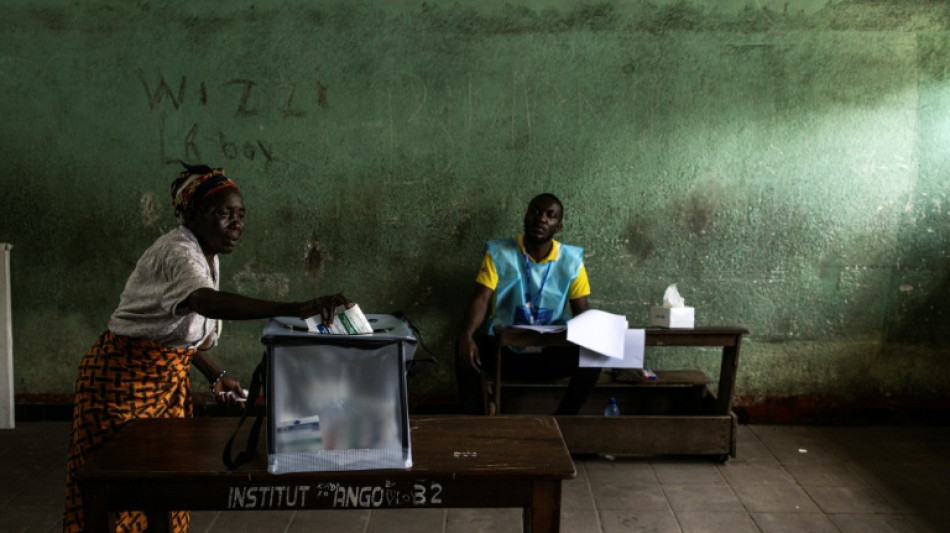
People in the Democratic Republic of Congo voted Wednesday in a high-stakes election pitting the incumbent President Felix Tshisekedi against a fragmented opposition, whose leaders denounced "chaos" and "irregularities".
The first polling stations in the east of the vast central African nation, which straddles two time zones, opened almost on time, shortly after 6:00 am (0400 GMT).
At around midday, however, voting was still not under way in some polling booths in various regions of the country, which is the size of continental western Europe.
Centres "have problems with machines, batteries," the archbishop of Kinshasa, Fridolin Ambongo, told reporters after voting.
"Solutions need to be found quickly, otherwise the elections are going to go on for several days."
AFP reporters in the capital Kinshasa and the cities of Goma, Beni, Lubumbashi and Tshikapa witnessed delays and other problems.
"There's terrible disorder in the organisation," teacher Jean Claude Nzine Cokola grumbled, having still not cast his ballot after waiting four hours in South Kivu province.
Leading opposition candidates Moise Katumbi, Martin Fayulu and Denis Mukwege all blasted what they described as chaos during the vote.
"It's total chaos, there's no organisation," said Fayulu, a 67-year-old former oil executive, who claims to have won the 2018 election.
Mukwege, 68, the 2018 Nobel Peace Prize winner for his work helping rape victims, and 58-year-old business magnate Katumbi, both complained of irregularities.
"If we find that these irregularities are huge, we are not going to accept that the population is placed in a position" of not being able to elect its leaders, Mukwege said, also at a Kinshasa polling station.
The DRC is Africa's top copper producer and the world's largest producer of cobalt -- a key component of batteries used in electronics and electric vehicles.
But it remains one of the poorest countries in the world, with little wealth trickling down.
- Logistical challenge -
People still waiting in line at 5:00 pm when polls are scheduled to close will be given tokens and polling booths will stay open until they cast their votes, an official at the electoral commission told AFP.
The government declared a bank holiday for Wednesday, and as in previous elections, has closed the borders and suspended domestic flights.
Around 44 million Congolese -- in a nation of 100 million -- are registered to choose their president as well as lawmakers in national and provincial assemblies, and local councillors.
More than 100,000 candidates are running for various positions.
Several observer missions including a union of Catholic and Protestant churches will be watching the voting process.
Results are not expected for several days.
- 'Foreign candidates' -
Tshisekedi, 60, who took office in 2019 and is running for a second five-year term, faces 18 challengers.
He is considered the front-runner in the single-round presidential vote, although his record, as he himself has acknowledged, is mixed.
He has presided over years of economic growth but little job creation and soaring inflation.
He is asking for another term to "consolidate his gains".
Throughout the campaign, he also poured scorn on what he termed "foreign candidates" -- suggesting that his opponents have dual loyalties and lack the will to stand up to Rwanda, which the DRC accuses of funding rebel groups on its soil.
Katumbi, who is a former governor of mineral-rich Katanga province and chairman of the country's leading football club, Tout Puissant Mazembe, is the main target of such attacks.
- Violence-wracked east -
Armed conflict in eastern DRC overshadowed much of the electoral campaign.
Tensions have resumed since the M23 group, which is allegedly backed by Rwanda, began capturing swathes of territory in late 2021.
Clashes with M23 fighters have subsided in recent weeks but the rebels continue to hold sway over large parts of North Kivu province.
Citizens living in those areas will not be able to vote.
In conflict-torn Ituri province, in the east, a group of protesters stormed a polling booth.
"There's the war, there's a lack of jobs, young people are really being neglected, forgotten," Desire Abedi Mubwana, 28, from the eastern city of Goma, said.
"But we're here to vote in the right leaders who will still think about young people and who will also think about the security of our region."
C.Timmermans--LCdB