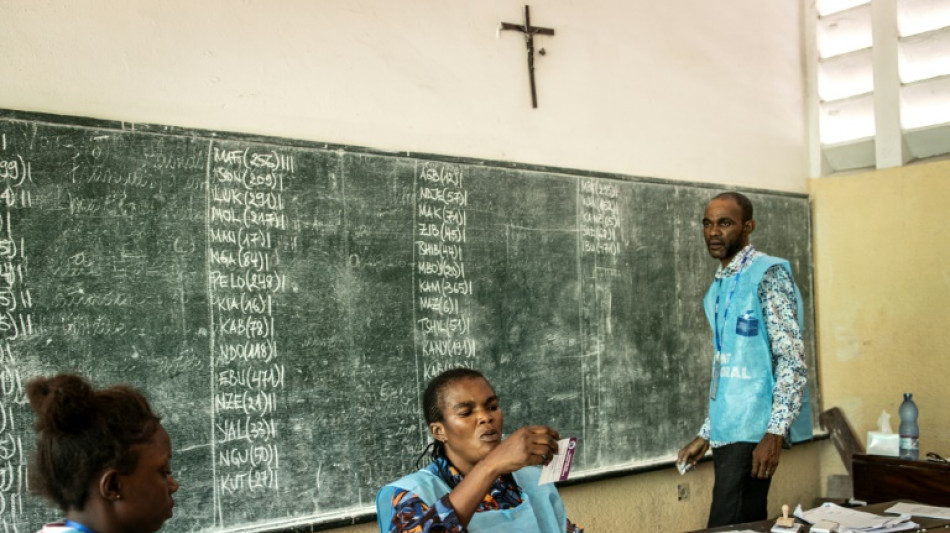
DR Congo in second day of voting after chaotic start / Photo: JOHN WESSELS - AFP
Voting in the Democratic Republic of Congo extended into Thursday, after general elections that began the day before saw some polling stations never open due to logistical problems.
And even as people in some parts of the country were finally voting, elsewhere the count had already begun, with the first results expected to be announced on Friday.
The impoverished but mineral-rich central African nation held four concurrent elections on Wednesday -- to pick a president, national and regional lawmakers, as well as local councillors.
President Felix Tshisekedi, 60, is running for a second term in office against a backdrop of years of economic growth but little job creation and soaring inflation.
Wednesday's voting was marked by massive delays nationwide, as the electoral commission struggled to deliver materials to voting stations long after polls were meant to have opened.
In some cases, polling stations never opened.
Denis Kadima, the head of the electoral commission, Ceni, declared on Wednesday night that people in places where casting ballots had proved impossible would vote on Thursday.
It was not clear how many polling stations that involved, but AFP reporters witnessed voting in cities in eastern Democratic Republic of Congo, in the southeastern city of Lubumbashi, and in the capital Kinshasa.
- Final result January -
In Goma, an eastern commercial hub, a young woman with a baby swaddled to her back had left a polling station the previous evening without being able to vote.
"This morning I came to vote. I returned because I am Congolese," said Clarice Bintu. "By voting I hope for change".
Problems and delays affected polling booths nationwide, Ceni chief Kadima told reporters on Wednesday. He estimated that 70 percent of voters had been able to cast ballots.
The DRC is one of the poorest countries in the world despite its vast reserves of copper, cobalt and gold.
Around 44 million Congolese in the nation of 100 million are registered to vote, and more than 100,000 candidates are running for various positions.
Ceni will begin to publish initial results from the presidential election on Friday, one of its top officials said.
The Constitutional Court is then expected to announce definitive results on January 10.
- Logistical problems -
Staging elections in a country roughly the size of continental western Europe, with very few roads, posed a daunting logistical challenge.
There had long been concerns that the electoral commission was unprepared, which proved valid on polling day.
By Wednesday afternoon, an influential election observer mission by a union of Congolese Catholic and Protestant churches indicated the scale of the voting problems.
Nearly a third of polling booths in the country had not opened, they said, and about 45 percent of voting machines had suffered technical problems.
There was little sympathy from leading opposition politicians, who described the process as chaotic.
The main opposition candidates -- gynaecologist Denis Mukwege, 68, the 2018 Nobel Peace Prize laureate; 58-year-old business magnate and ex-provincial governor Moise Katumbi; and 67-year-old ex-oil executive Fayulu -- all complained of irregularities.
Five opposition presidential candidates, including Fayulu and Mukwege, later rejected the vote extension, arguing that it was illegal.
In a joint statement, they called for fresh elections.
- 'Foreign candidates' -
Tshisekedi, who took office in 2019 and faces 18 challengers, says he wants a second term to "consolidate his gains".
He is considered the frontrunner in the single-round presidential vote, though his record, as he himself has acknowledged, is mixed.
Throughout the campaign, Tshisekedi also poured scorn on what he termed "foreign candidates" -- suggesting that his opponents had dual loyalties and lacked the will to stand up to Rwanda, which the DRC accuses of funding rebel groups on its soil.
Katumbi, a former governor of mineral-rich Katanga province and chairman of the country's leading football club, Tout Puissant Mazembe, was the main target of such attacks.
- Violence-wracked east -
Armed conflict in eastern DRC also overshadowed much of the electoral campaign.
Tensions have ratcheted up further since the M23 group began capturing swathes of territory in late 2021.
Rwanda has been accused of supporting the rebels, which Kigali denies.
Clashes with M23 fighters have subsided in recent weeks but they continue to hold sway over large parts of North Kivu province, where voting was impossible.
U.Laurent--LCdB