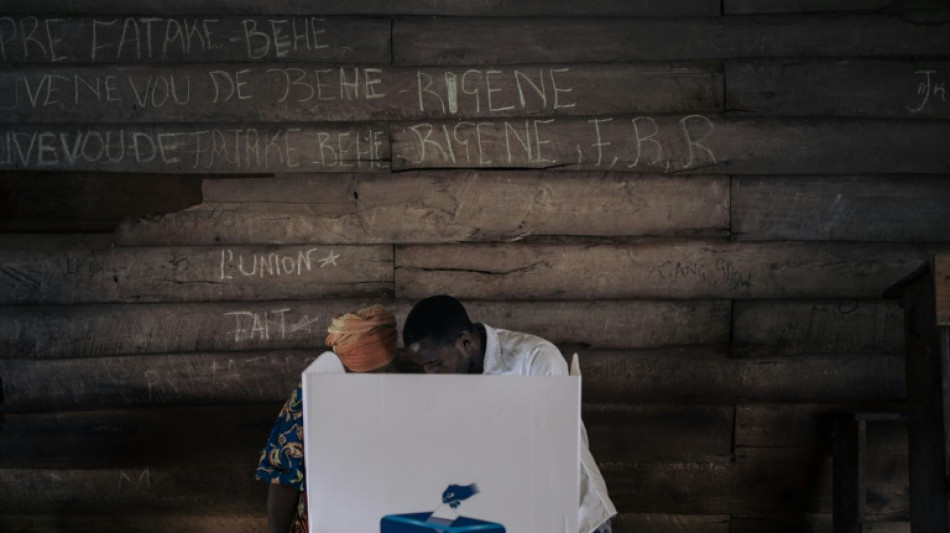
DR Congo awaits results after chaotic vote / Photo: ALEXIS HUGUET - AFP
Initial results from a presidential poll in DR Congo were expected Friday after shambolic elections spread over several days which the authorities deemed successful.
The poor but mineral-rich central African nation held four concurrent polls on Wednesday to elect the president, lawmakers for national and provincial assemblies as well as local councillors.
President Felix Tshisekedi is running for a second term against 18 opposition candidates, many of whom blasted chaotic conditions on polling day.
Massive delays and bureaucratic chaos marred the vote and some polling booths were unable to open at all.
The Democratic Republic of Congo's electoral commission, Ceni, extended voting in some areas until Thursday.
"The last day is today," said leading Ceni official, Didi Manara, on Thursday, adding that voting would continue "until the end of the queues".
In a statement, the electoral commission also said that "no polling or counting station" would be authorised to open on Friday.
Voting nevertheless continued in some places on Friday, according to officials, especially in the more remote areas of the vast country the size of western Europe.
People were casting votes in Kilembwe, in the Fizi territory of South Kivu province, in the east, for example, after voting materials only arrived late on Thursday.
"Everything should be finished by (the afternoon) at the latest," the territory's administrator Sammy Kalonji told AFP.
Didi Manara, from the Ceni, said that "at least 97 percent" of the roughly 75,000 polling stations in the DRC had been able to open.
Given the size of the country, he said, this represented a "miracle". DR Congo is roughly the size of continental western Europe.
In a preliminary statement on Friday, the Carter Center -- which observed the election -- said there had been "serious irregularities" at 21 out of 109 polling stations it visited. The ballot had proceeded "relatively well" in the other 88.
In 24 polling stations, its observers identified technical problems with electronic voting devices, the US-based group added.
- Tensions feared -
While the Congolese government acknowledged delays late on Wednesday, it hailed the efforts of voters and the electoral commission.
Ceni official Manara told local radio the following day that initial results from the presidential election would be released on Friday in a special centre set up in the capital Kinshasa.
Around 44 million Congolese in the nation of 100 million were registered to vote, and more than 100,000 candidates were running for various positions.
Tshisekedi, 60, is considered the front-runner in the first-past-the-vote presidential vote, especially given that he is facing a divided opposition.
The main opposition candidates are gynaecologist Denis Mukwege, 68, the 2018 Nobel Peace Prize laureate; 58-year-old business magnate and former provincial governor Moise Katumbi; and 67-year-old ex-oil executive Martin Fayulu.
They have all criticised the election's disarray, and warned against the potential for electoral fraud.
The DRC is a turbulent country with a long history of authoritarian rule and conflict.
On Thursday, the United States repeated a call for transparent and fair elections in the country.
"We will not hesitate to call out irregularities," said a US State Department spokesman.
G.Wouters--LCdB