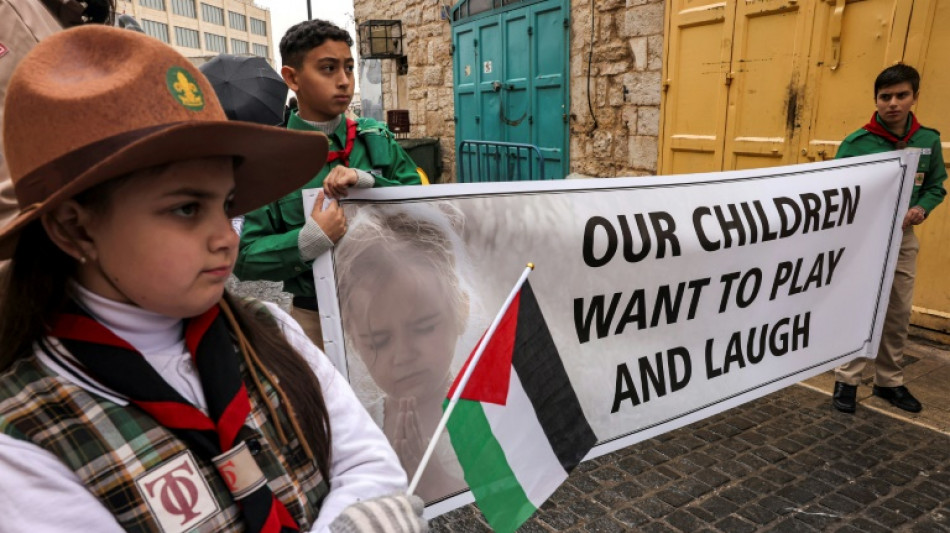
Grim Christmas Eve in Bethlehem as war rages in Gaza / Photo: HAZEM BADER - AFP
Gaza's deadliest ever war cast a pall of gloom over Bethlehem on Christmas Eve Sunday, as the death toll spiralled and Israel shifted its efforts against Hamas to the besieged territory's south.
Christmas celebrations were effectively cancelled in the occupied West Bank city celebrated as the birthplace of Jesus Christ, where the Latin patriarch offered a message of peace and solidarity with the Palestinians of Gaza.
US President Joe Biden stressed the "critical need" to protect civilians, in a call with Prime Minister Benjamin Netanyahu, who vowed Israel would "continue the war until all of its goals have been achieved", according to official statements.
As heavy fighting raged on, the Israeli army said 154 troops had died in Gaza since it launched its ground invasion on October 27.
Ten soldiers were killed in battles on Saturday, one of the deadliest days for the Israeli side.
"The war is exacting a very heavy price... but we have no choice but to keep fighting," said Netanyahu.
The army said soldiers had raided a northern Gaza compound near schools, a mosque and a clinic and found "explosive belts adapted for children, dozens of mortar shells, hundreds of grenades and intelligence documents".
The war broke out when Hamas fighters attacked southern Israel on October 7 and killed about 1,140 people, mostly civilians, and seized 250 hostages, according to an AFP tally based on Israeli figures.
Israel's withering military campaign, including massive aerial bombardment, has killed 20,424 people, mostly women and children, according to the Hamas-run territory's health ministry.
- Christmas 'cancelled' -
As the war rages on, Christians around the world mark Christmas Eve.
Festivities are usually held in Bethlehem, where faithful believe Jesus was born, but this year the city is almost deserted, with few worshippers around and no Christmas tree erected, after church leaders decided to forego "any unnecessarily festive" celebrations in solidarity with Gazans.
The Latin patriarch of Jerusalem, Pierbattista Pizzaballa, arrived Sunday at the Church of the Nativity, clad in the traditional black and white keffiyeh.
"Our heart goes to Gaza, to all people in Gaza but a special attention to our Christian community in Gaza who is suffering," he said.
"We are here to pray and to ask not only for a ceasefire, a ceasefire is not enough, we have to stop these hostilities and to turn the page because violence generates only violence."
Sister Nabila Salah from the Catholic Holy Church in Gaza, where two Christian women were killed by an Israeli sniper earlier this month accord to the Latin Patriarchate of Jerusalem, struck a sombre tone.
"All Christmas celebrations have been cancelled," she told AFP. "How do we celebrate when we are... hearing the sound of tanks and bombardment instead of the ringing of bells?"
Hamas on Sunday thanked Palestinian Christians, saying "we value the honourable national position of our Christian Palestinian people, to... stand united with our people in the Gaza Strip who are being subjected to brutal Zionist aggression".
At a hospital in Khan Yunis, where much of the fighting has been concentrated recently, Fadi Sayegh, whose family has previously received permits to travel to Bethlehem for celebrations, said he would not be celebrating Christmas this year.
"There is no joy. No Christmas tree, no decorations, no family dinner, no celebrations," he said, while undergoing dialysis. "I pray for this war to be over soon."
The UN agency for Palestinian refugees said on social media that "it's hard to wish those celebrating 'Merry Christmas', with ongoing loss, grief and destruction."
Vast areas of Gaza lie in ruins and its 2.4 million people have endured dire shortages of water, food, fuel and medicine due to an Israeli siege, alleviated only by the limited arrival of aid trucks.
Eighty percent of Gazans have been displaced, according to the UN, many fleeing south and now shielding against the winter cold in makeshift tents.
Two Palestinian men who had been held by the Israeli army in Gaza and a medic alleged that detainees have been subjected to torture in Israeli custody, including beatings and food deprivation --- charges the army has denied.
- 'More hatred, less peace' -
Israeli military spokesman Jonathan Conricus indicated that forces were close to gaining control in northern Gaza and that now "we focus our efforts against Hamas in southern Gaza".
Fighting has raged in the main southern city of Khan Yunis, the birthplace of Yahya Sinwar, Hamas's leader in Gaza and the man Israel holds most responsible for the October 7 attack.
Near the southern Gaza city of Rafah, Umm Amir Abu al-Awf, 27, suffered wounds to her hand and legs in a strike on her house early Sunday.
"Nothing has been achieved except killing civilians," she said. "They keep saying Rafah is safe. It is not safe. Nowhere is safe. Every house has a martyr and injured."
The head of the UN refugee agency, Filippo Grandi, urged an end to the suffering in the third month of the war.
"A humanitarian ceasefire in Gaza is the only way forward," he wrote on X, formerly Twitter. "War defies logic and humanity, and prepares a future of more hatred and less peace."
And World Health Organization chief Tedros Adhanom Ghebreyesus similarly renewed calls for a ceasefire, saying: "The decimation of the Gaza health system is a tragedy."
On Friday, the United States allowed the passage of a UN Security Council resolution that effectively called on Israel to allow "immediate, safe and unhindered" deliveries of life-saving aid to Gaza "at scale".
World powers had wrangled for days over the wording and, at Washington's insistence, toned down some provisions -- including removing a call for a ceasefire.
Separately, a senior member of Islamic Jihad -- which has been fighting alongside Hamas -- said the group's chief Ziad Nakhaleh arrived in Cairo for talks on a truce and hostage exchange, after the Hamas chief visited last week.
The Gaza war has heightened tensions across the Middle East. Yemen's Huthi rebels have fired at cargo vessels in the Red Sea, leading the United States to build a naval taskforce to deter the missile and drone strikes.
The US military said four drones had targeted the USS Laboon, but had been shot down, and that an Indian-flagged tanker was hit and sent out a distress call.
burs-jd/jsa/ami
Q.Martens--LCdB