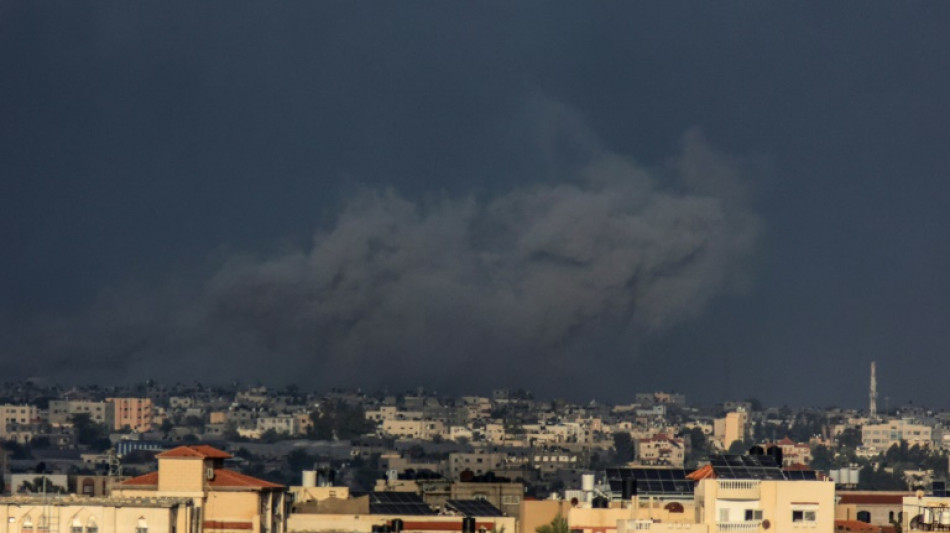
Palestinians feel 'no joy' as Israel bombs Gaza on Christmas / Photo: SAID KHATIB - AFP
Palestinians said they felt "no joy" this Christmas as Israel bombed the besieged Palestinian territory on Monday, with no end in sight to the war that Hamas says has claimed more than 20,000 lives.
Festivities were effectively scrapped in the occupied West Bank city of Bethlehem, revered as the birthplace of Jesus Christ, with few worshippers or tourists on the usually packed streets.
In the Gaza Strip, the Hamas militant group reported 50 strikes in central areas early on Monday, including in the Nuseirat refugee camp.
At a hospital in the southern city of Khan Yunis, the centre of recent fighting, Fadi Sayegh -- whose family has previously received permits to travel to Bethlehem for celebrations -- said he would not be celebrating Christmas this year.
"There is no joy. No Christmas tree, no decorations, no family dinner, no celebrations," he said while undergoing dialysis. "I pray for this war to be over soon."
Sister Nabila Salah from the Catholic Holy Church in Gaza -- where two Christian women were killed by an Israeli sniper earlier this month according to the Latin Patriarchate of Jerusalem -- struck a sombre tone.
"All Christmas celebrations have been cancelled," she told AFP. "How do we celebrate when we are... hearing the sound of tanks and bombardment instead of the ringing of bells?"
The war broke out when Hamas fighters attacked southern Israel on October 7 and killed about 1,140 people, mostly civilians, and seized 250 hostages, according to an AFP tally based on Israeli figures.
Israel has vowed to eliminate Hamas in response and its military campaign, which has included massive aerial bombardment, has killed 20,424 people, mostly women and children, according to Gaza's health ministry.
Pope Francis kicked off global Christmas celebrations on Sunday with a call for peace, as the war cast a shadow over one of the world's favourite holidays.
"Tonight, our hearts are in Bethlehem, where the Prince of Peace is once more rejected by the futile logic of war, by the clash of arms that even today prevents him from finding room in the world," the Catholic leader said.
The Latin patriarch of Jerusalem, Pierbattista Pizzaballa, arrived Sunday at the Church of the Nativity, clad in the traditional black and white keffiyeh.
"Our heart goes to Gaza, to all people in Gaza but a special attention to our Christian community in Gaza who is suffering," he said.
- Christmas eve strike -
The Hamas-run health ministry said at least 70 people were killed in an Israeli air strike on Sunday at the Al-Maghazi refugee camp in central Gaza.
Health ministry spokesman Ashraf al-Qudra said the "toll is likely to rise" as many families were thought to be in the area at the time of the strike.
In a separate incident, the ministry said 10 members of one family were killed in an Israeli strike on their house in the Jabalia camp in northern Gaza.
AFP was unable to independently verify either toll.
Vast areas of Gaza lie in ruins and its 2.4 million people have endured dire shortages of water, food, fuel and medicine due to an Israeli siege, alleviated only by the limited arrival of aid trucks.
Eighty percent of Gazans have been displaced, according to the UN, many fleeing south and now shielding against the winter cold in makeshift tents.
The head of the UN refugee agency, Filippo Grandi, urged an end to the suffering in the third month of the war.
"A humanitarian ceasefire in Gaza is the only way forward," he wrote on X, formerly Twitter. "War defies logic and humanity, and prepares a future of more hatred and less peace."
And World Health Organization chief Tedros Adhanom Ghebreyesus similarly renewed calls for a ceasefire, saying: "The decimation of the Gaza health system is a tragedy."
The Jordanian army said its air force had air dropped aid to about 800 people sheltering at the Church of Saint Porphyrius in northern Gaza.
- 'No choice' -
The war was exacting a "very heavy price", Israeli Prime Minister Benjamin Netanyahu said Sunday, as the death toll of soldiers killed in the conflict continued to mount.
"But we have no choice but to keep fighting," he said, adding: "This will be a long war."
Another soldier was killed on Sunday, the army said, taking to 15 the number of troops killed since Friday and 154 since Israel's ground assault began on October 27.
Israeli military spokesman Jonathan Conricus indicated that forces were close to gaining control in northern Gaza and that now "we focus our efforts against Hamas in southern Gaza".
The two men were among hundreds detained by Israeli forces over alleged links with Hamas during Israel's ground offensive.
About 20 men released from Israeli custody "have bruises and marks of blows on their bodies", Marwan al-Hams, hospital director in the southern city of Rafah, told AFP.
I.Kusters--LCdB