Israel 'intensifying' Gaza fighting as Hamas says strikes kill dozens / Photo: Mahmud HAMS - AFP
Israel on Monday said it was "intensifying the fighting" against Hamas in Gaza, where relentless strikes across the Palestinian territory exacerbated the dire conditions for civilians in the war's 12th week.
Pope Francis decried the "desperate humanitarian situation" in Gaza. During his traditional Christmas message at the Vatican he called for an immediate ceasefire and the freeing of hostages.
As war raged, festivities in Bethlehem, which Christians consider to be the birthplace of Jesus Christ, were effectively scrapped in the Israeli-occupied West Bank. The city's usually vibrant streets had only a handful of worshippers and tourists.
The war erupted when Hamas militants broke through Gaza's militarised border and attacked southern Israel on October 7, killing about 1,140 people, mostly civilians, according to an AFP tally based on Israeli figures.
Militants also seized about 250 hostages, Israel says.
Israel vowed to crush Hamas and launched a retaliatory military campaign in Gaza, including extensive aerial bombardment and siege. The campaign has killed at least 20,674 people, mostly women and children, according to the Hamas-run territory's health ministry.
Four major Israeli strikes since Sunday killed more than 100 people, the ministry said.
But Israeli Prime Minister Benjamin Netanyahu vowed on Monday, "We're not stopping," according to a statement from his Likud party.
"We're intensifying the fighting in the coming days," he told party members.
Later, addressing parliament during a special session on the 129 hostages Israel says remain in Gaza, Netanyahu was booed by families awaiting their loved ones' return after 80 days in captivity.
"Now! Now!" relatives chanted as Netanyahu said Israeli forces needed "more time" to increase military pressure on Hamas, which he argued would help to secure the captives' release.
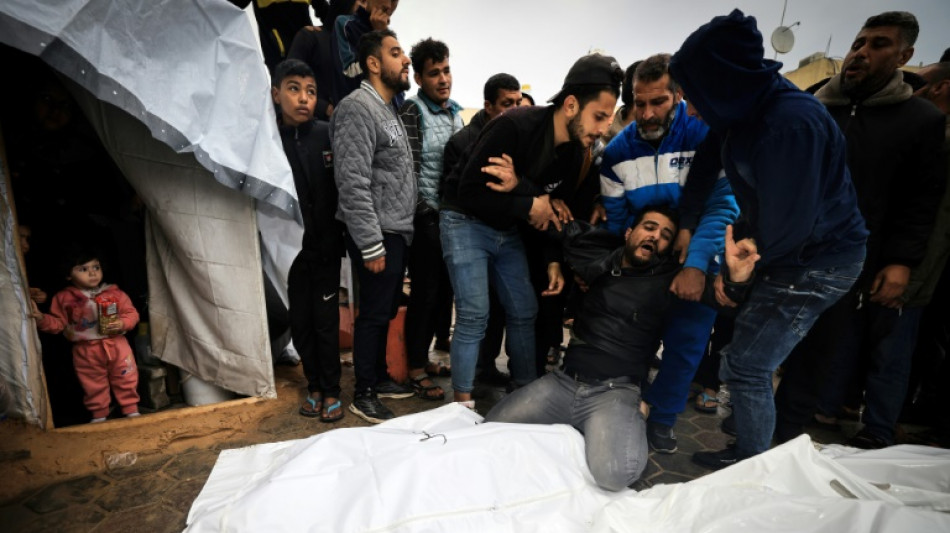
In Gaza, the health ministry said an Israeli air strike killed at least 70 people on Christmas Eve at the Al-Maghazi refugee camp established in 1949.
AFP was unable to independently verify the toll.
Rows of victims' bodies, shrouded in white bags, lined the ground at Al-Aqsa hospital in Deir al-Balah, central Gaza, ahead of a mass funeral.
The army said it was "reviewing the incident", adding it was "committed to international law including taking feasible steps to minimise harm to civilians".
Israel has been under increasing pressure from its allies to protect civilians during its military campaign.
Speaking with Netanyahu on Saturday, US President Joe Biden "emphasised the critical need" for such protection, the White House said.
Zeyad Awad, a resident of Al-Maghazi, said there was no evacuation warning before the strike that caused "extensive, enormous destruction and panic in the hearts of my children".
- 'Real hunger' -
The health ministry said 10 members of one family were killed in an Israeli strike in Jabalia camp, northern Gaza, and 18 people died in an overnight bombardment of Khan Yunis in the south.
Before dawn, an Israeli strike "targeting a house" in central Gaza's Al-Zuwaida area, near Al-Mughazi, killed at least 12 people, mostly women and children, the Gaza health ministry said.
In southern Gaza, an AFP correspondent reported heavy bombings through the night in Khan Yunis and Rafah.
Grasping empty containers, dozens of Gazans waited on a street in Rafah for food to be distributed.
"Now there is real hunger. My children are dying of hunger," said one of them, Nour Ismail.
Vast areas of Gaza lie in ruins and its 2.4 million people have endured dire shortages of water, food, fuel and medicine, alleviated only by the limited arrival of aid trucks.
An estimated 1.9 million Gazans have been displaced, according to the UN, many fleeing south and crowded into shelters or makeshift tents in the winter cold.
"A humanitarian ceasefire in Gaza is the only way forward," said the head of the UN refugee agency, Filippo Grandi.
The World Health Organization said it led missions to barely functioning hospitals in northern Gaza at the weekend. It described growing desperation and starving people stripping an aid truck of supplies.
"Everyone we speak to is hungry," said Sean Casey, a WHO emergency coordinator. "There's the risk of famine."
- Israel decries 'hypocrisy' -
Israel lashed out at the UN on Monday over its response to the war. Foreign Minister Eli Cohen accused the world body of "hypocrisy" and said its chief Antonio Guterres "legitimised war crimes".
"We will stop working with those who cooperate with the Hamas terrorist organisation's propaganda," Cohen said on X, adding that his ministry would not extend one UN employee's entry visa, and would refuse entry for another.
Pope Francis appealed for hostilities to stop.
"I plead for an end to the military operations with their appalling harvest of innocent civilian victims," he told thousands of faithful gathered in Saint Peter's Basilica.
"My heart grieves for the victims of the abominable attack of October 7, and I reiterate my urgent appeal for the liberation of those still being held hostage," he added.
Netanyahu on Sunday said the war was exacting a "very heavy price" on Israel's military.
The army on Monday announced two more deaths among its ranks, bringing to 156 the number of troops killed since Israel's ground assault began on October 27.
The war has heightened tensions across the Middle East. Cross-border fire has erupted almost daily between Israel and Lebanon's powerful Hezbollah movement.
And Yemen's Huthi rebels, also Iran-backed, have fired at cargo vessels in the Red Sea, leading the United States to build a naval taskforce to deter the missile and drone strikes.
Iran on Monday rejected US accusations that a drone strike targeting a Japanese-owned chemical tanker off the coast of India had been fired from its territory.
Iranian state media reported that an Israeli air strike in Syria had killed Razi Moussavi, a senior general with Iran's Revolutionary Guard Corps.
Israel has intensified strikes on targets in Syria since the Israel-Hamas war began.
burs-ami/it
V.Renard--LCdB