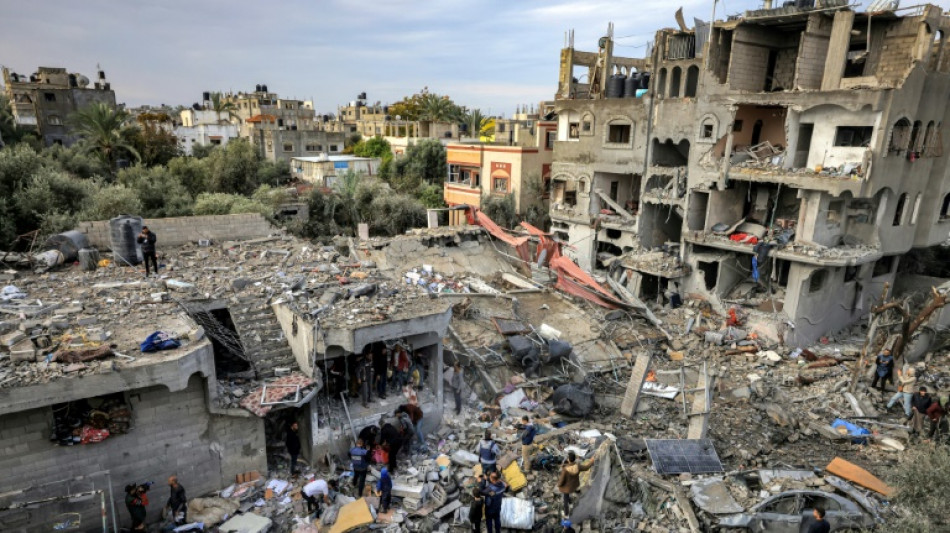
Gaza refugee camp in ruins after Israeli strike / Photo: Mahmud HAMS - AFP
Residents of Gaza's Al-Maghazi refugee camp returned to their neighbourhood on Monday only to find blocks of concrete strewn where their homes had stood just a day ago.
"These houses are destroyed. Our house was bombed," said camp resident Abu Rami Abu al-Ais amid the debris.
"There's no safe place in the Gaza Strip."
Late on Sunday three houses in the camp were hit by Israeli air strikes that killed at least 70 people, according to the health ministry in Hamas-run Gaza. AFP was unable to independently verify the information.
Israel says it issues evacuation orders and warnings so civilians can get to safety before military activity, but Zeyad Awad said there was no advisory before the strike.
"What should we do? We are civilians, living peacefully and wanting only safety and security," he said.
"Yet we are suddenly struck by Israeli warplanes without any warning."
The Israeli military said it was "reviewing the incident".
"Despite the challenges posed by Hamas terrorists operating within civilian areas in Gaza, the IDF (military) is committed to international law including taking feasible steps to minimise harm to civilians," it told AFP.
Swathes of the Gaza Strip have been razed in blistering Israeli bombardments during more than two months of war.
The conflict was triggered by an unprecedented attack by Hamas gunmen on southern Israel on October 7. They indiscriminately killed around 1,140 people, mostly civilians, according to an AFP tally based on the latest official Israeli figures.
The militants also took hostage about 250 people, Israel says.
In response, Israel launched a relentless retaliatory land, sea and air assault on the Gaza Strip, alongside a ground invasion aimed at destroying Hamas.
The offensive has killed at least 20,670 people, most of them women and children, according to Gaza's health ministry.
- 'They chased us' -
On Monday returning camp residents were shocked to see the scale of destruction, some describing how their children had panicked when the blast occurred.
"My child said to me 'Protect me. What's happening? I can't breathe.'"
AFP footage showed several residents walking through the debris, inspecting the damage caused by the night-time strike. Some hugged each other and burst into tears.
Several charred vehicles could be seen scattered on the roads, while children searched through the wreckage to find their books.
Al-Maghazi camp is one of several in Gaza and was established in 1949, according to the UN, to shelter refugees who fled hostilities at the time of Israel's creation the year before.
Many who fled Al-Maghazi camp after the strikes on Sunday were doing so again, after already escaping attacks in northern Gaza.
One of them was Rawan Manasra, originally from Beit Hanun. The strike in the camp decimated her family, she said.
"They (Israeli army) killed my five brothers. I no longer have brothers. They killed them along with their children and wives," Manasra told AFP.
"Every day there are strikes... They tell us to move from the north to the south, then they chase us and attack us."
Dozens of wounded from Sunday's strike were taken to Deir al-Balah hospital in central Gaza, one of the few hospitals still partly functioning. Some were on stretchers while volunteers carried others in their arms.
"It's a massacre," health ministry spokesman Ashraf al-Qudra said.
"Dozens of injured people are becoming martyrs due to the inability to treat them immediately," he added.
Israeli strikes in Gaza have repeatedly struck hospitals, which are protected under international humanitarian law, and desperation is growing among medical staff over their inability to treat people.
The Israeli military accuses Hamas of having tunnels under hospitals and using the medical facilities as command centres, a charge the Islamist group denies.
H.Vermeulen--LCdB