Israel army chief says Gaza war to last 'many more months' / Photo: Mahmud HAMS - AFP
Israel again pounded Gaza with air strikes and shelling on Wednesday after its armed forces chief warned the war raging with Hamas since the October 7 attacks will last "many more months".
Explosion lit up the night sky over the southern Gaza city of Khan Yunis -- a focus of heavy urban combat since the Israeli army said it had largely gained operational control over Gaza's north.
Heavy firefights however also raged again around Gaza City in the north, while an air strike wounded 11 people near Rafah, a far-southern city crowded with internally displaced people, witnesses said.
The reported deaths of almost 21,000 Palestinians and Gaza's spiralling humanitarian crisis have amplified calls for an end to the hostilities.
Israeli Prime Minister Benjamin Netanyahu has repeatedly vowed to keep up the campaign to destroy Hamas, an Islamist group blacklisted as a "terrorist" organisation by the United States and the European Union.
"This war's objectives are essential and not simple to achieve," armed forces chief Herzi Halevi said late Tuesday. "Therefore, the war will continue for many more months."
The conflict erupted when Hamas gunmen attacked southern Israel on October 7 and killed about 1,140 people, mostly civilians, according to an AFP tally based on Israeli figures.
During the deadliest attack in Israel's history, Palestinian militants also took around 250 hostages, 129 of whom remain in captivity, Israel says.
Israel retaliated with a relentless bombardment and a siege followed by a ground invasion from October 27.
The campaign has killed at least 20,915 people, mostly women and children, according to the latest toll issued by Gaza's Hamas-run health ministry.
The number of Israel soldiers killed inside Gaza has risen to 164, the military said.
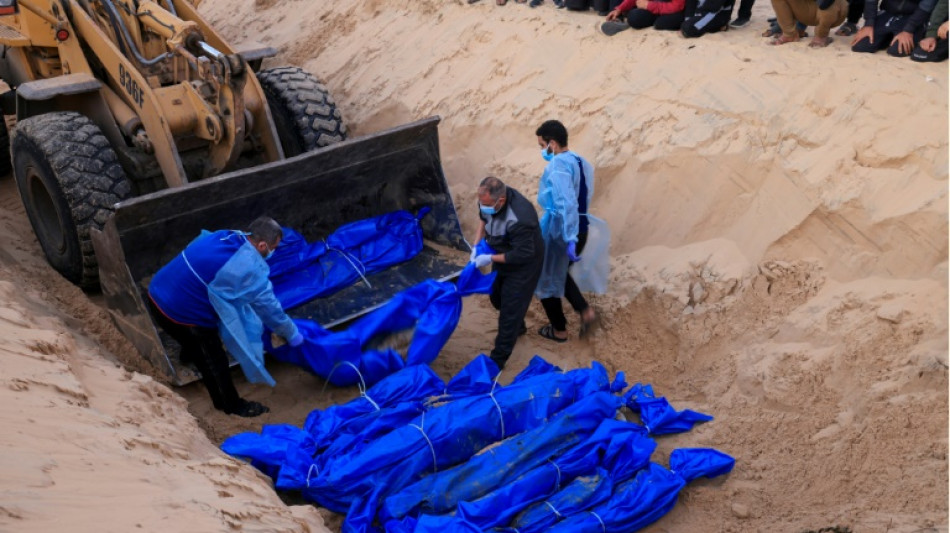
Israel on Tuesday returned the bodies of 80 Palestinians killed in Gaza, after checking there were no hostages among them, via the Red Cross, sources in the territory's health ministry said.
An AFP photographer witnessed a digger lowering the human remains in blue body bags into a mass grave in Rafah.
- 'Beyond a catastrophe' -
Gaza's 2.4 million people have been suffering severe shortages of water, food, fuel and medicines, with only limited aid entering the territory.
An estimated 1.9 million Gazans have been displaced, according to the UN.
The Gaza war "goes beyond a catastrophe and a genocide," Palestinian president Mahmud Abbas charged in an interview on Egyptian television.
The Palestinian Authority chief argued "what is happening now is much uglier than what happened" during the 1948 war that accompanied Israel's creation when 760,000 Palestinians fled or were expelled from their homes.
"Netanyahu's plan is to get rid of the Palestinians and the Palestinian Authority," Abbas said.
The UN Security Council, in a resolution on Gaza last week, called for the "safe and unhindered delivery of humanitarian assistance at scale".
It requested the appointment of a UN humanitarian coordinator to oversee and verify third-country aid to Gaza, and on Tuesday Sigrid Kaag, the outgoing Dutch finance minister, was named to the post.
The resolution, which did not call for an immediate end to the fighting, effectively leaves Israel with operational oversight of aid deliveries.
In Rafah, hundreds turned up at the Abdul Salam Yassin water company carrying baskets, pulling handcarts and even pushing a wheelchair stacked with bottles to queue for clean water.
"This was my father's cart," said Rafah resident Amir al-Zahhar. "He was martyred during the war. He used it to transport and sell fish, and now we are using it to transport fresh water."
Elsewhere in the city, people split logs and stacked kindling as the lack of fuel forced them to burn wood for cooking and to keep warm.
One woman who was washing her family's clothes by hand told AFP: "I've pleaded with people for water. I have absolutely nothing. I've borrowed everything, even the blankets, from others."
- Mideast tensions -
US National Security Advisor Jake Sullivan met Tuesday to discuss shifting "to a different phase" of the Israel-Hamas war with Israeli Strategic Affairs Minister Ron Dermer, a White House official said.
It was also meant as a chance to speak on "the transition to a different phase of the war to maximise focus on high-value Hamas targets," the official said.
Amid the Gaza war, violence has also flared across the Israel-occupied West Bank, with more than 300 Palestinians killed by Israeli forces and settlers, according to the territory's health ministry.
The impacts of the war have reverberated across the Middle East, with armed groups backed by Israel's arch-foe Iran escalating attacks.
An Israeli air strike on a Lebanon border town killed a Hezbollah fighter, the group said Wednesday, with state media reporting two of his relatives were also killed.
In Syria, an Israeli strike Monday killed Iranian general Razi Moussavi, a senior commander in the Quds Force, the foreign operations arm of the Islamic Revolutionary Guard Corps.
In Iraq, the US military launched strikes Tuesday on pro-Iran groups it has blamed for numerous attacks on US and allied forces. The strike claimed at least one life, Iraqi authorities said.
Yemen's Huthi rebels have repeatedly fired at Israel and at passing cargo ships in the Red Sea in attacks they say are in solidarity with Hamas.
US military forces shot down more than a dozen Huthi attack drones and several missiles, the Pentagon said, reporting no casualties or damage.
Israel's military said Tuesday a fighter jet had intercepted "in the Red Sea area a hostile aerial target that was on its way to Israeli territory".
burs-jd/fz/kir
B.Hendrix--LCdB