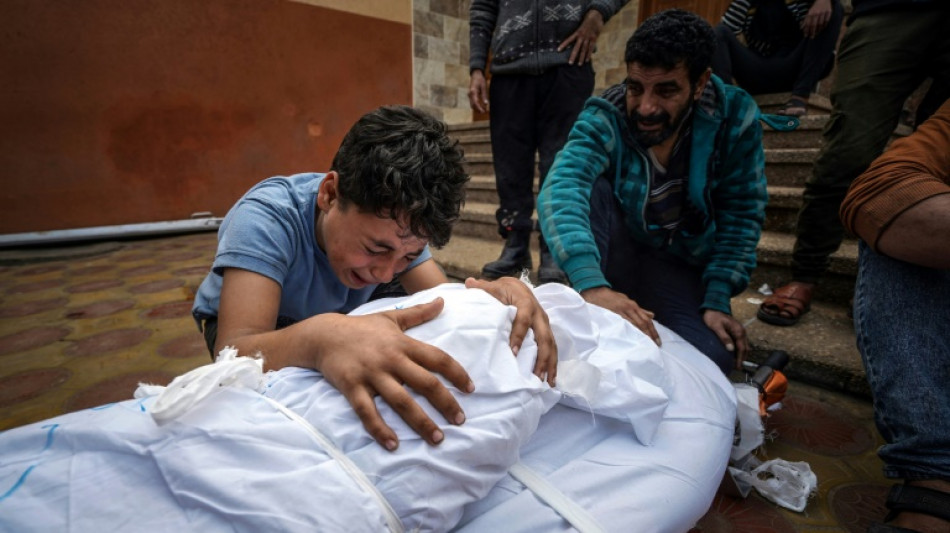
Deadly Israeli shelling reported near Gaza hospital / Photo: - - AFP
Israeli shelling near a southern Gaza hospital has killed 41 people over the past two days, the Palestinian Red Crescent said, after Israel stepped up its attacks in the centre and south of the besieged territory.
The UN humanitarian office said Thursday that an estimated 100,000 more displaced people had arrived in the already-teeming southern border city of Rafah in recent days following the intensification of fighting around Deir al-Balah and Khan Yunis.
The extra displacements came as Egyptian officials prepared to receive a high-level Hamas delegation in Cairo on Friday for talks on a new proposal aimed at putting an end to nearly three months of war that has devastated Gaza.
The Palestinian Red Crescent on Thursday condemned what it said was Israeli shelling near the Al-Amal hospital in Khan Yunis that "led to the martyrdom of ten people and the injury of at least 21 others", adding the attack followed one in front of the hospital the day before that killed 31.
"Among the casualties are individuals present in front of the hospital and displaced persons seeking shelter at the PRCS (Red Crescent) premises," the group said in a statement.
Later in the day, Gaza's Hamas-run health ministry said Israeli shelling had killed 20 people, most of them women and children, at the Shaboura camp in Rafah, on the southern border with Egypt.
AFP footage from the city showed bloodied people being rushed through the streets to the nearby Kuwaiti hospital, where medical staff raced to treat a flood of wounded patients, including children. AFP could not immediately confirm whether they were victims of the same strike.
The war in Gaza, which started with Hamas's October 7 attack on Israel, has left much of the territory's north in ruins, while the battlefront has shifted ever further to the south.
Israel has vowed to destroy Hamas in retaliation for the attack, which left about 1,140 people dead, mostly civilians, according to an AFP tally based on Israeli figures.
Around 250 hostages were also taken during the attack, more than half of whom remain captive -- a source of intense anxiety for their families, who protested in Jerusalem on Thursday with the demand to "bring them home".
Israel's relentless aerial bombardment and ground invasion in Gaza have killed at least 21,320 people, mostly women and children, according to the Hamas-run health ministry.
The Israeli army says 167 of its soldiers have been killed inside Gaza in its fight against Hamas, which Israel, the United States and the European Union consider a "terrorist" group.
- 'My daughters were screaming' -
The Israeli army recently said it had deployed an additional brigade to Khan Yunis, hometown of Hamas's Gaza leader Yahya Sinwar, where AFP correspondents reported sustained air and artillery strikes.
"The missions that our forces are carrying out in Khan Yunis are unprecedented -- our forces reach areas that we have never been before, taking over control rooms and eliminating terrorists," Israeli Minister of Defense Yoav Gallant told soldiers on Thursday.
Israel has repeatedly said that one of the chief goals of the war is the return of the hostages.
On Thursday a kibbutz announced that a 70-year-old US-Israeli national thought to be the oldest woman held captive had died in the October 7 attacks.
US President Joe Biden said he was "devastated" by the news that Judith Weinstein Haggai was dead, and pledged that Washington would "not stop working" with its ally Israel to bring the remaining hostages home.
More than 80 percent of Gaza's 2.4 million people have been driven from their homes, the UN says, and many now live in cramped shelters or makeshift tents in the far south around Rafah.
Residents there combed through rubble for survivors on Thursday after an air strike that one witness said left "several casualties".
"We were sitting [at home] peacefully and all of a sudden we heard a loud explosion and debris started falling on us. The apartment was completely destroyed and my daughters were screaming," said Tayseer Abu Al-Eish.
An Israeli siege imposed after October 7, following years of crippling blockade, has deprived Gazans of food, water, fuel and medicine.
The severe shortages have been only sporadically eased by humanitarian aid convoys entering primarily via Egypt.
Israel said Thursday it had given preliminary approval to the Mediterranean island nation of Cyprus for a "maritime lifeline" to ship aid to Gaza.
- Ceasefire plan -
A Hamas delegation was due in Cairo on Friday to give its "observations" about an Egyptian plan for a ceasefire recently put to officials from Hamas and Islamic Jihad, which is also battling Israeli forces in Gaza.
Sources close to Hamas say Cairo's three-stage plan provides for renewable ceasefires, a staggered release of hostages held by Hamas in exchange for Palestinian prisoners in Israel, and ultimately a ceasefire to end the war.
It also provides for a Palestinian government of technocrats after talks involving "all Palestinian factions", which would be responsible for governing and rebuilding in post-war Gaza.
Diaa Rashwan, who heads Egypt's State Information Services, said the plan was "intended to bring together the views of all parties concerned, with the aim of ending the shedding of Palestinian blood".
R.Lacroix--LCdB