Gazans 'exhausted' as Israel-Hamas war rages on / Photo: - - AFP
Fighting raged Saturday across Gaza, where displaced Palestinians are "exhausted" with no end in sight to war between the besieged territory's Hamas rulers and Israel, now in its 13th week.
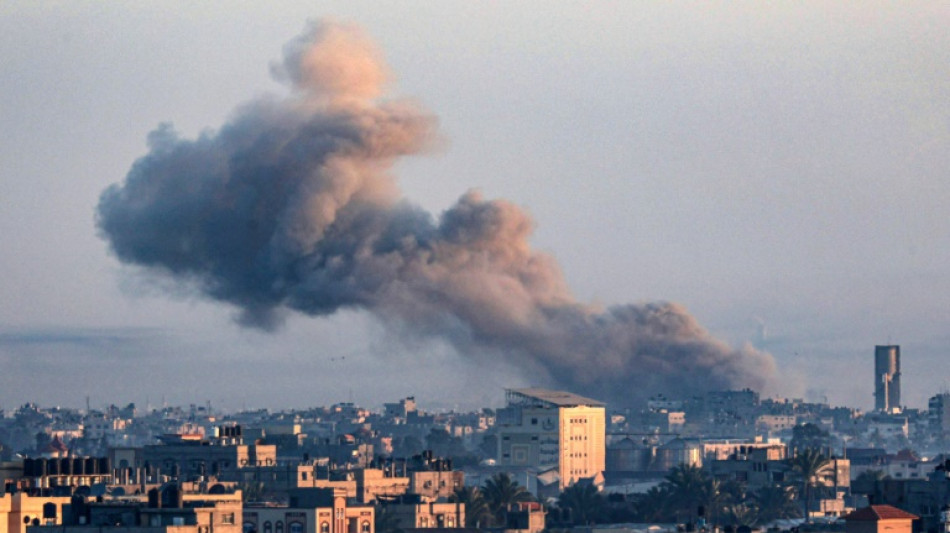
Smoke billowed over the Gaza Strip's southern city of Khan Yunis, the focus of recent fighting in the grinding war, which was triggered on October 7 by Hamas attacks on Israel.
Further south, the border city of Rafah near Egypt was teeming with Gazans seeking safety from Israel's relentless bombardment in its fight against Palestinian militants.
"Enough with this war! We are totally exhausted," said Umm Louay Abu Khater, a 49-year-old woman who had fled her home in Khan Yunis, taking refuge in Rafah.
"We are constantly displaced from one place to another in cold weather," she said. "The bombs keep falling on us day and night."
An AFP correspondent reported continuous artillery shelling overnight in Rafah and Khan Yunis.
The Israeli army kept up its campaign in the face of mounting international pushback, reporting "fierce battles" and air strikes across the narrow Palestinian territory.
In Beit Lahia in north Gaza, "two Hamas military compounds were dismantled by the troops," a military statement on Saturday said, and dozens of "terrorists" were killed in Gaza City.
UN chief Antonio Guterres on Friday reiterated his call for "an immediate humanitarian ceasefire", while the World Health Organization (WHO) warned of the growing threat of the spread of infectious diseases among Gazans.
The fighting began with Hamas's bloody October 7 attacks, which left about 1,140 people dead in Israel, mostly civilians, according to an AFP tally based on official figures.
Militants also took about 250 people hostage, and Israel says 129 of them remain in Gaza.
Hamas-run Gaza's health ministry says the Israeli military campaign since then has killed at least 21,507 people, mostly women and children.
Israel's army says 168 soldiers have been killed in combat inside the territory.
As 2023 draws to a close, Ahmed al-Baz, a 33-year-old Palestinian displaced from Gaza City, said this year had been "the worst in my life".
"It was a year of destruction and devastation," he said in Rafah, surrounded by tents in a makeshift camp.
"We just want the war to end, and start the new year at home, with a ceasefire declared."
- Mediation efforts -
International mediators -- who last month brokered a one-week truce that saw more than 100 hostages released and some aid enter Gaza -- continue in their efforts to secure a new pause in fighting.
US news outlet Axios and Israeli website Ynet, both citing unnamed Israeli officials, reported that Qatari mediators had told Israel that Hamas was prepared to resume talks on new hostage releases in exchange for a ceasefire.
And a Hamas delegation was in Cairo on Friday to discuss an Egyptian plan proposing renewable ceasefires, a staggered release of hostages for Palestinian prisoners, and ultimately an end to the war, sources close to Hamas say.
Israel has yet to formally comment on the Cairo plan, but Prime Minister Benjamin Netanyahu told families of hostages on Thursday that "we are in contact" with the Egyptian mediators.
Netanyahu told the families of captives that "we are working to bring them all back".
Mia Shem, an Israeli-French hostage abducted from the site of a desert rave and released under November's truce agreement, told Israeli media her "biggest fear" in captivity was rape.
"There was a fear of rape, fear of dying," Shem said in an interview with Israel's Channel 13 which aired on Friday.
During her captivity, the 21-year-old said she remained locked up "in a dark room" and was "forbidden" from talking.
Wounded by a gunshot during her kidnapping, she said she had "no painkillers".
Israeli officials and rights groups have repeatedly said the October 7 attacks included sexual violence, but its scale has been difficult to assess. Hamas denies accusations of rape.
- 'Emergency' munitions sale -
An Israeli siege imposed after October 7, following years of crippling blockade, has led to dire shortages of food, safe water, fuel and medicine in Gaza, with aid convoys offering only sporadic relief.
The UN says more than 85 percent of Gaza's 2.4 million people have fled their homes, with many now going hungry and braving the winter rains in tents.
WHO chief Tedros Adhanom Ghebreyesus said Friday on social media that "as people continue to be massively displaced across the south of Gaza... I remain very concerned about the increasing threat of infectious diseases".
The UN health agency said that close to 180,000 people were suffering from upper respiratory infections, while 136,400 cases of diarrhoea have been recorded -- half among children aged under five.
South Africa on Friday filed an application at the International Court of Justice to start proceedings against Israel for what it said were "genocidal acts against the Palestinian people in Gaza".
Israel rejected the accusations, with foreign ministry spokesman Lior Haiat decrying "the blood libel spread by South Africa".
Key Israeli ally the United States, meanwhile, announced the approval of a $147.5 million sale of 155mm high-explosive artillery munitions and related equipment to Israel from US Army stocks.
"An emergency exists that requires the immediate sale" of the weaponry, the US Defense Security Cooperation Agency said in a statement, thereby waiving the normal requirement for review by Congress.
Israel has traded regular cross-border fire with Lebanon's powerful Iran-backed Hezbollah movement, and early Saturday the army said it had struck in Syria following rocket launches.
J.Jaspers--LCdB