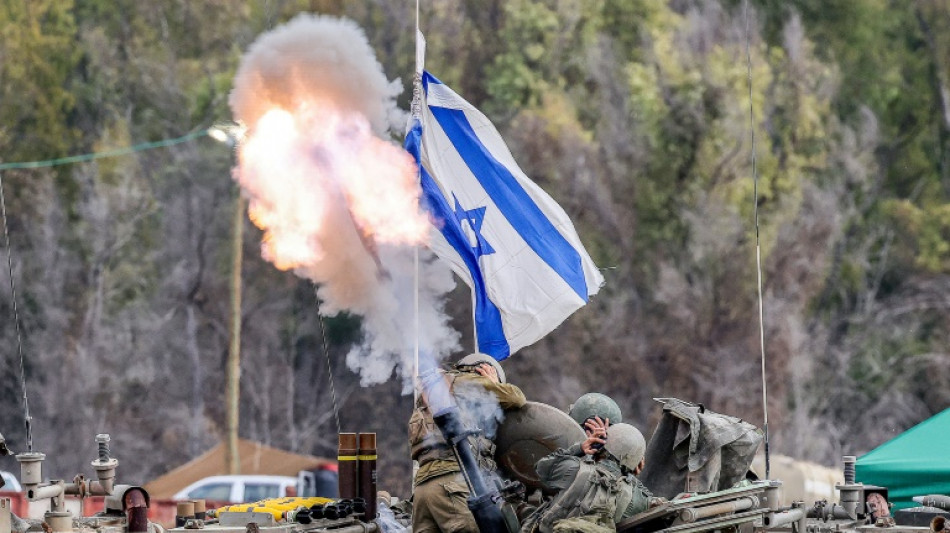
Blinken set for Israel visit as regional war fears mount / Photo: JACK GUEZ - AFP
US Secretary of State Antony Blinken will head Thursday to the Middle East as fears mount that Israel's war in Gaza will spread across the region, following deadly blasts in Iran and the killing of a Hamas leader in Lebanon.
A US official speaking on condition of anonymity confirmed the trip -- Blinken's fourth to the region since the start of Israel's war against Hamas in the Gaza Strip -- but declined to offer any details on the itinerary apart from a stop in Israel.
The announcement came after at least 95 people were killed and more than 200 wounded in Iran by twin explosions near the grave of a slain Revolutionary Guards general, with Hamas backer Tehran quickly blaming the United States and Israel for the attack.
Washington rejected suggestions of either nation's involvement.
But a US official told AFP that an unclaimed strike the night before that claimed the life of Hamas's number two in a Beirut suburb had been the work of Israel.
Ahead of the announcement of Blinken's visit, State Department spokesman Matthew Miller echoed the fears of many across the Middle East about the Israel-Hamas war expanding.
"It is in no one's interest -- not in the interest of any country in the region, not in the interest of any country in the world -- to see this conflict escalated any further than it already is," Miller said.
In a visit Wednesday to the Lebanese border, where Israeli forces have regularly traded fire with Iran-backed Hezbollah, Israeli army chief Herzi Halevi said troops were "in very high readiness".
Hostilities also threatened to expand to Yemen after the United States and its allies jointly warned the country's Huthi rebels of unspecified consequences unless they immediately halted attacks on Red Sea shipping carried out in solidarity with Hamas.
"I would not anticipate another warning," a senior US official said, calling the message "very clear".
The war against Hamas in the Gaza Strip was triggered by its bloody October 7 attack on Israel, which resulted in the death of around 1,140 people, most of them civilians, according to an AFP tally based on official Israeli figures.
Fighters also took around 250 hostages back to Hamas-run Gaza, 129 of whom remain in captivity, according to Israel.
In response, Israel vowed to destroy the group, launching a relentless bombardment and ground invasion that has reduced swathes of Gaza to rubble and claimed at least 22,313 lives, according to the territory's health ministry.
The United Nations estimates 1.9 million Gazans are displaced, and the World Health Organization has warned of the risk of famine and disease, with only a minimal amount of aid entering the territory.
- Bitter enemies -
Wednesday's blasts in Iran struck mourners commemorating slain Revolutionary Guards general Qasem Soleimani on the fourth anniversary of his death in a US drone strike, official media said.
Iran's Supreme leader Ayatollah Ali Khamenei blamed "evil and criminal enemies of the Iranian nation" for the bombings, and said: "This disaster will have a harsh response, God willing."
An Israeli military spokesman declined to comment on the explosions, while the State Department's Miller called any suggestion of US involvement "ridiculous", adding that Washington had "no reason to believe that Israel was involved" either.
Regional tensions had already been soaring following Tuesday's strike in Lebanon on Hamas number two Saleh al-Aruri, the most high-profile figure to be killed since the start of Israel's war against the group.
Israel and Iran have long been bitter enemies, and violence involving Iran-backed groups in Lebanon, Iraq, Syria and Yemen has spiked since the start of the war.
Tehran also blames Israel for a December strike in Syria that killed Razi Moussavi, a senior commander in the Quds Force, the same branch of the Revolutionary Guard Corps that Soleimani once headed.
While intense wider warfare has so far been avoided, the latest blasts in Iran rattled global markets, sending oil prices up by more than three percent.
Hezbollah, meanwhile, has vowed that the killing of Aruri and six other Hamas operatives on its home turf will not go unpunished, labelling it "a serious assault on Lebanon... and a dangerous development".
Hezbollah leader Hassan Nasrallah warned Israel against all-out war on its northern neighbour on Wednesday.
But in a televised speech he also said Israel had sent "messages" that it was "settling scores" with Hamas leaders and did not intend to target Lebanon or Hezbollah.
- 'There must be a war' -
In Israel's northern coastal city of Nahariya, near the border with Lebanon, many people could be seen carrying weapons Wednesday, with residents saying they feared Aruri's killing could bring the war to their part of the country.
"Now, definitely something will happen. Either Israel will react strongly before they (Hezbollah) respond, or they will act and force us to respond," said a 54-year-old resident who gave his name only as David.
"There must be a war... It's a question of time."
In Gaza, Israel on Wednesday kept up its punishing campaign against Hamas, with the military reporting strikes in the north around Gaza City, and fighting in the south in and around Khan Yunis.
In central Deir al-Balah, residents rushed bloodied people to treatment while firefighters tried to extinguish the flames from a strike that hit a house near the Al-Aqsa hospital, AFP footage showed.
Fires were also burning in the central Al-Maghazi refugee camp following strikes there.
"All of a sudden their houses fell on them... What have these children done? What have these women done to be taken out of the rubble in pieces?"
burs-smw/kma
A.Louis--LCdB