Top US diplomat lands in Israel on regional tour as Gaza war rages / Photo: - - AFP
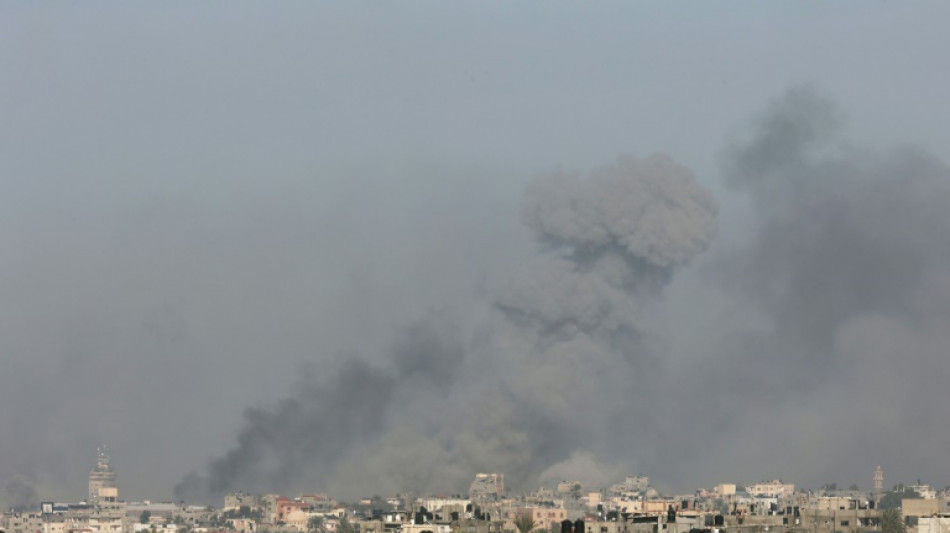
Top US diplomat Antony Blinken arrived in Tel Aviv late Monday as part of a regional tour seeking to avert regional escalation as Israel pounded Hamas-ruled Gaza and Lebanon's Hezbollah said an Israeli strike killed a top commander.
Palestinian militants reported fierce ground combat in southern Gaza, where Israel says its focus has shifted along with the territory's centre three months into its war with Hamas.
Sirens sounded Monday in central and southern Israel to warn of incoming rocket fire. And while battles raged in the besieged Gaza Strip, the situation to Israel's north has also caused increasing regional and global concern.
Israel and Iran-backed Hezbollah, a Hamas ally, have engaged in regular cross-border fire during the war that began on October 7 with Hamas's unprecedented attack against Israel.
On Monday, Hezbollah announced the killing of a "commander" for the first time since October, naming him as Wissam Hassan Tawil.
A security official in Lebanon, requesting anonymity for security reasons, said Tawil "had a leading role in managing Hezbollah's operations in the south", and was killed there by an Israeli strike targeting his car.
The Israeli military said it struck Hezbollah "military sites" in Lebanon on Monday, but did not immediately comment on Tawil's death.
His is the second high-profile killing in Lebanon this month, following a strike in a Beirut stronghold of Hezbollah last week which killed Hamas deputy leader Saleh al-Aruri, heightening fears of the conflict spreading.
On Monday the Israeli army also said it had killed a "central figure" in Syria responsible for Hamas rocket attacks, naming him as Hassan Akasha.
The October 7 attack by Hamas which triggered the war resulted in about 1,140 deaths in Israel, mostly civilians, according to an AFP tally based on official figures.
Hamas, considered a "terrorist" group by the United States and European Union, also took around 250 hostages, 132 of whom remain captive, Israel says. At least 25 are believed to have been killed.
Israel has responded with relentless bombardment and a ground invasion that have killed at least 23,084 people, mostly women and children, according to the Gaza health ministry.
- 'Help Gaza recover' -
US Secretary of State Blinken, on his fourth regional trip since the war began, met on Monday with Saudi Crown Prince Mohammed bin Salman after talks in the United Arab Emirates and ahead of his visit to Israel.
Before leaving Al Ula in Saudi Arabia, Blinken said: "We agreed to work together and coordinate our efforts to help Gaza stabilise and recover... and to work toward long term peace and security and stability."
Washington, Israel's main ally and arms supplier, has grown increasingly concerned over the war's civilian death toll.
US President Joe Biden said Monday he was working to get Israel to cut its military presence in Gaza, after protesters calling for a ceasefire disrupted him during a campaign speech.
"I've been quietly working with the Israeli government to get them to reduce and significantly get out of Gaza," Biden said.
The Al-Quds Brigades, the armed wing of militant group Islamic Jihad, reported "fierce clashes" on Monday, involving machine guns and rocket-propelled grenades, with Israeli troops in the southern city of Khan Yunis.
Islamic Jihad, which has fought alongside Hamas in Gaza, later released a video it claimed showed an Israeli hostage alive in its custody.
Israel's military reported its forces have "been working in recent days to expand" operations around Khan Yunis and said troops and warplanes struck 30 "significant" targets in the major city overnight Sunday-Monday.
The United Nations on Monday said it was "very concerned by the high death toll of media workers", a day after Qatar-based Al Jazeera network said an Israeli strike had killed two of its journalists, including the son of Gaza bureau chief Wael al-Dahdouh.
The UN rights office called for the deaths to be "thoroughly and independently investigated".
- 'Everyone going hungry' -
The Israeli military on Monday showed journalists what a spokesman described as a cluster of weapons factories and tunnels in central Gaza used by Hamas to manufacture rockets.
Soldiers leading a media tour in Bureij said that what looked like cement factories and other industrial facilities were in fact used to make missiles and shells stored in deep shafts.
Palestinian president Mahmud Abbas was in Cairo on Monday to meet with President Abdel Fattah al-Sisi of Egypt, a mediator in the conflict.
Most of Gaza's population has been displaced, according to the United Nations, leaving people in overcrowded shelters or tents in the winter chill.
Many have fled to Rafah in Gaza's far south, where a strike on Monday ripped open a car killing two of Dahdouh's nephews. He was recently wounded himself in a strike, and lost his wife and two other children in an Israeli bombardment in the initial weeks of the war.
"They say Rafah is safe, but we don't see it is safe in Rafah. No place is safe," said Mohammad Hejazy, overlooking the blood-soaked road.
The World Health Organization (WHO) has warned of the risk of famine and disease, with only minimal aid entering the besieged territory.
Washington has said Blinken will press Israel on its compliance with international humanitarian law and ask for "immediate measures" to boost aid to Gaza.
C.Adam--LCdB