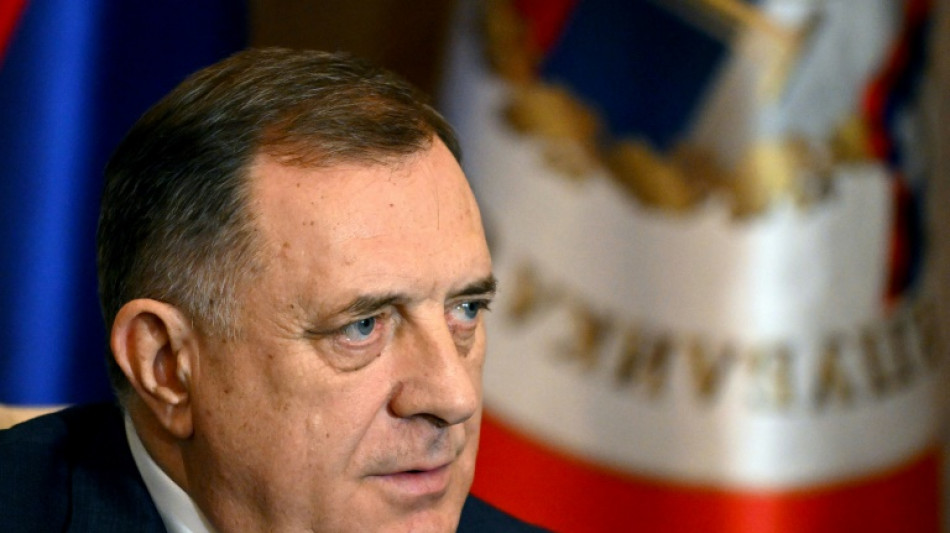
Bosnian Serbs mark controversial 'national day' / Photo: ELVIS BARUKCIC - AFP
Bosnian Serbs marked on Tuesday their self-proclaimed "national day", disregarding condemnations and warnings that the holiday violated Bosnia's constitution and put peace at risk.
The January 9 anniversary observes Bosnian Serbs 1992 declaration of their own republic in Bosnia, just three months before the outbreak of the war that claimed 100,000 lives.
"If we forget what Republika Srpska (RS) means, we will also disappear," pensioner Mara Radjen told AFP in the RS administrative centre of Banja Luka. "We know why our fighters died, why blood was shed, and we must mark that, in the name of God and all Serbs."
Several thousand people, many of whom waved small RS flags, braved cold weather on Tuesday evening and gathered at Banja Luka's main square to watch a special parade.
Around 3,000 people marched in the parade, including police, war veterans as well as students and representatives of the entity's public sector.
Bosnian Serb President Milorad Dodik attended the event along with other RS officials and Russian ambassador to Bosnia.
Celebrations were held although the "holiday" was deemed anti-constitutional by both Bosnia's constitutional court and the Organisation for Security and Cooperation in Europe (OSCE).
The European Union on Tuesday emphasised the need to respect the "sovereignty, territorial integrity, constitutional order, including decisions by the constitutional court by all actors in Bosnia and Herzegovina".
"Any action going against these principles will lead to serious consequences," the bloc's foreign affairs spokesman Peter Stano said.
But Dodik insisted that for Bosnian Serbs "this is a day when the republic started its life, to celebrate its freedom.
"Its people have to right to mark it in such a way", he told the crowd in Banja Luka and added that the RS was "looking up to Russia and Serbia".
Since the 1992-1995 war, Bosnia and Herzegovina has been split along ethnic lines into two semi-independent entities -- the Serb-run Republika Srpska and a Muslim-Croat Federation.
Dodik has been threatening his entity's secession ever since he started to dominate Bosnian Serb politics in 2006.
- 'Peaceful separation' -
The two Bosnian halves are linked by weak central institutions.
Nearly a third of Bosnia's 3.5 million people live in Republika Srpska, whose territory makes up nearly half the Balkan country.
Dodik was among the 83 ethnic Serb lawmakers who decided to create Republika Srpska.
The 64-year-old has little regard for the decisions taken by Bosnia's central institutions and does not recognise the authority of the country's constitutional court.
In recent months, he announced that RS was on course to organise its own elections and take over state property on its territory.
He also said that Bosnia is moving towards a "peaceful separation".
"We are mentally integrated with Serbia. Of course, we are part of Bosnia now, but that's because we have to be," he told AFP.
Dodik claimed to have no doubts that Bosnian Serbs want independence, but due to "still fresh memories of the war" are hesitant to make the move.
"We must celebrate (January 9) to know when and how Republika Srpska was founded," said war veteran Oliver Milakovic.
"Perhaps one day the time will come for it to be independent."
But Dodik, who is under US and British sanctions, said he was "proud" to be able to regularly meet the Russian president whom he labels a "great leader".
On last year's "Day of Republika Srpska" Dodik decorated Putin with his entity's highest medal of honour. This year he awarded the same medal to Hungary's Prime Minister Viktor Orban.
Dodik is also a close ally of Serbian President Aleksandar Vucic who sent him a congratulatory message for the "holiday" on Monday.
Later on Tuesday there will be fireworks in several Bosnian Serb towns and in the Serbian capital Belgrade.
I.Mertens--LCdB