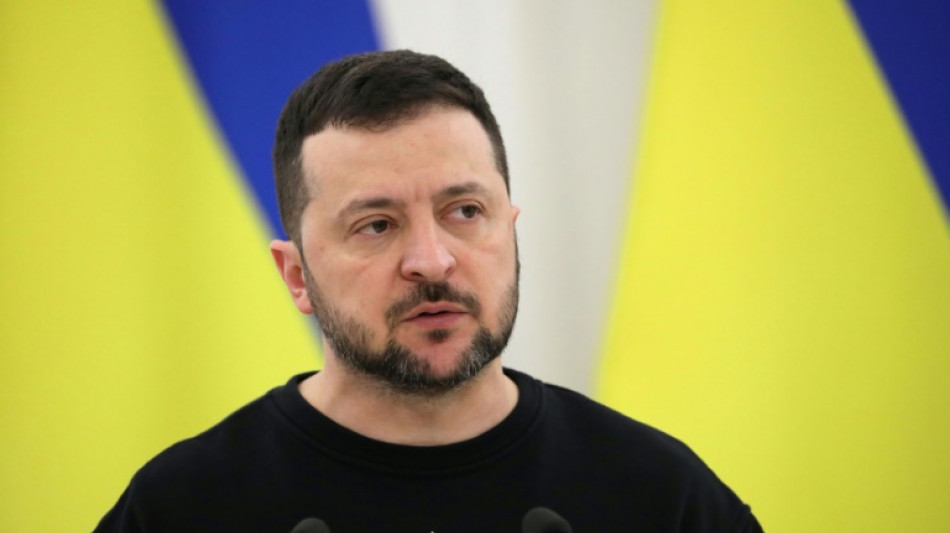
Zelensky says Western hesitation on Ukraine aid emboldens Putin / Photo: PETRAS MALUKAS - AFP
Ukraine's President Volodymyr Zelensky appealed for badly needed air-defence systems at the start of a tour of Baltic states Wednesday, warning that Western hesitation on aid for Ukraine was emboldening Russia.
Russian President Vladimir Putin will not stop at Ukraine, he said, during an unannounced visit to the Lithuanian capital Vilnius.
Zelensky was on the first stage of a tour of staunch Baltic allies Lithuania, Latvia and Estonia, as he seeks to bolster wavering support among other Western backers.
All three nations are former Soviet republics that are now EU and NATO members.
Ukraine was "sorely lacking" modern air-defence systems amid renewed aerial attacks from Russia nearly two years after Moscow's invasion, said Zelensky.
Putin "is not going to stop," he said. "He wants to occupy us completely.
"And sometimes, the insecurity of partners regarding financial and military aid to Ukraine only increases Russia's courage and strength.
"He (Putin) won't finish this (war), until we all finish him together," Zelensky said, adding "Lithuania, Latvia, Estonia, Moldova may be next".
The Baltic tour marks Zelensky's first official trip abroad this year.
Ukraine has come under intense Russian shelling in recent weeks, retaliating with strikes on Russia's border city of Belgorod.
"In recent days, Russia hit Ukraine with a total of 500 devices: we destroyed 70 percent of them," Zelensky said.
"Air-defence systems are (the) number one (thing) that we lack."
- 'Until victory' -
Zelensky has urged allies to keep military support flowing and held in-person talks with officials from the United States, Germany and Norway last month.
But an EU aid package worth 50 billion euros ($55 billion) has been stuck in Brussels following a veto by Hungary, while the US Congress remains divided on sending additional aid to Ukraine.
Lithuanian President Gitanas Nauseda on Wednesday vowed to support Ukraine "until victory".
He said the Baltic state would send M577 armoured vehicles to Ukraine next month, part of a previously announced 200-million-euro package of military aid.
Lithuania is the biggest donor to Ukraine in terms of GDP, according to the German-based Kiel Institute for the World Economy.
The Baltic state has earmarked government support amounting to nearly 1.4 percent of its GDP, Kiel's Ukraine aid tracker showed.
Estonia and Latvia were ranked in second and fifth place, with aid committed totalling 1.3 and 1.1 percent of GDP.
- 'Crucial times' -
In Estonia, Prime Minister Kaja Kallas said Wednesday: "We must support Ukraine as long as it is needed. These are crucial times, and we need to keep our focus."
Estonian Foreign Minister Margus Tsahkna has said Tallinn was ready "to allocate 0.25 percent of its GDP to military aid to Ukraine" over the next four years.
Latvian Defence Minister Andris Spruds said last week that Riga was committed to "continuously" providing military equipment and training for Ukrainian soldiers.
Latvia trained around 3,000 Ukrainian troops last year, its defence ministry said.
Zelensky last visited Vilnius for a NATO summit in July, where he secured promises of unwavering support to Kyiv from Western leaders including US President Joe Biden.
"The outlook is unclear, since the largest pending aid commitment -- by the European Union -- has not been finally approved, and aid by the US has been on the decline," the institute said.
F.Cornelis--LCdB