Blinken says Abbas 'committed' to reform as Gaza war rages / Photo: - - AFP
US top diplomat Antony Blinken on Wednesday said Mahmud Abbas was committed to reforming the Palestinian Authority to potentially reunite war-torn Gaza and the occupied West Bank under its leadership.
Blinken laid out Gaza's possible future after meeting Palestinian president Abbas in Ramallah and Bahrain's King Hamad in his fourth Middle East tour aimed at preventing the Israel-Hamas war from escalating.
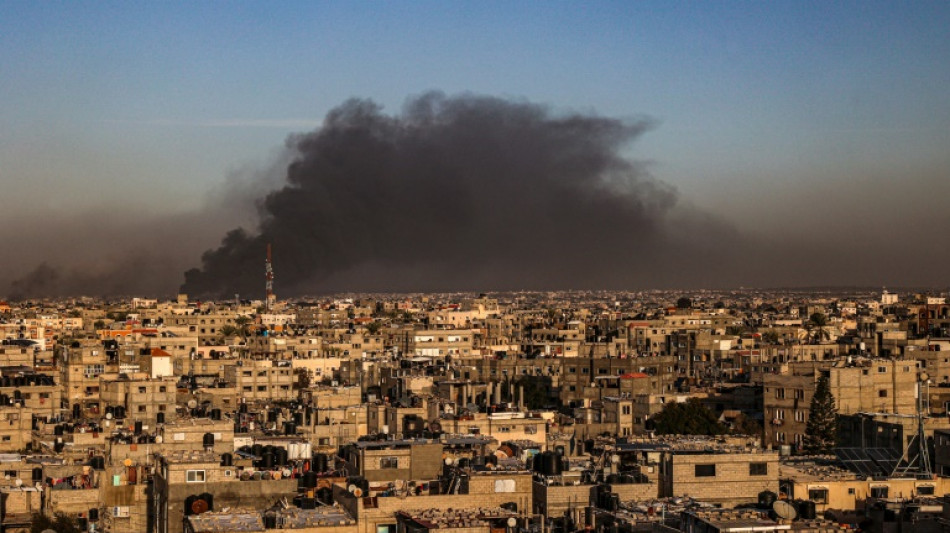
The bloodiest ever Gaza war has raged since the unprecedented Hamas attacks against Israel on October 7 and killed more than 23,000 people in the besieged Palestinian territory, according to its health ministry.
Abbas raised with Blinken the need "to stop the Israeli aggression against Palestinian people" in Hamas-ruled Gaza and the occupied West Bank, where deadly unrest has also surged, said the official Palestinian news agency Wafa.
Blinken told Abbas that Washington supports "tangible steps" towards the creation of a Palestinian state -- a long-term goal which Israeli Prime Minister Benjamin Netanyahu's hard-right government has opposed.
Blinken reiterated the US position that a Palestinian state must stand alongside Israel, "with both living in peace and security", said State Department spokesman Matthew Miller.
As Blinken arrived under tight security at Abbas's headquarters in Ramallah, protesters held up signs reading "Stop the genocide", "Free Palestine" and "Blinken out". Some scuffled with Palestinian security forces in riot gear.
In Bahrain, Blinken said Abbas was "committed" to reforming the Palestinian Authority "so that it can effectively take responsibility for Gaza, so that Gaza and the West Bank can be reunited under a Palestinian leadership".
Washington sees a future in Gaza for the PA, whose ruling Fatah faction is a Hamas rival. But Netanyahu has long sought to weaken the semi-autonomous body.
- Red Sea clashes spike -
Hamas, an Islamist movement designated as "terrorist" by the United States and the European Union, seized control of the Gaza Strip in 2007, ousting Abbas's Fatah party, with which it had shared power after sweeping parliamentary elections.
Hamas's Qatar-based chief Ismail Haniyeh said last week he was "open to the idea" of a single Palestinian administration in Gaza and the West Bank.
A post-war plan outlined by Defence Minister Yoav Gallant envisions local "civil committees" governing Gaza after Israel has dismantled Hamas.
King Hamad emphasised the need for a ceasefire, releasing hostages and detainees and delivering aid to Gazans in his talks with Blinken, according to Bahrain's news agency.
Blinken is due to visit Egypt after stops in Turkey, Saudi Arabia and the United Arab Emirates.
Jordan's King Abdullah II, Egyptian President Abdel Fattah al-Sisi and Abbas called to "maintain pressure" for a ceasefire and to protect Palestinian civilians following discussions in the Jordanian city of Aqaba, the royal palace said.
Fears have soared of a widening conflict between Israel and Iran-backed armed groups, especially Lebanon's Hezbollah but also groups in Syria, Iraq and Yemen.
The United States has set up a multinational naval task force to protect shipping from the attacks, which Blinken on Wednesday said were "aided and abetted" by Iran and would bring "consequences".
On Tuesday, the rebels "launched a complex" attack, US Central Command said, adding that US and British forces had shot down 18 drones and three missiles, with no casualties or damage reported.
The Huthis later said they had fired a "large number" of missiles and drones at a US ship, with an adviser telling AFP it was the largest such attack since their campaign started.
- 'Heartbroken' -
The war erupted when Hamas launched its unprecedented October 7 attack, which resulted in about 1,140 deaths in Israel, mostly civilians, according to an AFP tally based on official figures.
Militants also took around 250 hostages, of whom Israel says 132 remain in Gaza including at least 25 believed to have been killed.
Israel has responded with a relentless military campaign that has killed at least 23,357 people, mostly women and children, according to the Gaza health ministry.
The Israeli army says 186 of its soldiers have been killed inside Gaza in its campaign to destroy Hamas.
It said it killed dozens of "terrorists" and hit another 150 targets in Gaza, where the health ministry said 147 people had been killed over the previous 24 hours.
The Palestinian Red Crescent Society said an Israeli strike on an ambulance in central Gaza killed four medics and two other passengers on Wednesday.
Israel's military did not immediately comment on the incident when contacted by AFP.
Silvia Cunio, whose sons David and Ariel have been held hostage by Hamas in Gaza, said the war had done no good for any of the captives.
"For them, every day, every second, every minute, every hour they suffer," the 63-year-old told AFP. "I'm heartbroken."
- 'Indescribable' humanitarian crisis -
The United Nations estimates 1.9 million Gazans have been displaced inside the territory that had already endured years of blockade and poverty.
The war triggered an acute humanitarian crisis as Israel's siege sparked shortages of food, water, fuel and medicine.
UN aid chief Martin Griffiths posted on X, formerly Twitter, that besieged Gaza's health sector "is being slowly choked off".
The World Health Organization called the humanitarian situation "indescribable" on Wednesday and pleaded Israel to allow more aid deliveries.
Blinken -- while voicing continued US support for top regional ally Israel -- has urged steps to reduce the suffering.
One of the many displaced Palestinians, Hassan Kaskin, 55, said: "We have lost our money, our houses, our jobs. We are losing our youths as well.
"We've sacrificed our children for our homeland."
V.Renard--LCdB