Gaza ministry says dozens killed in Israeli strikes on 99th day of war / Photo: - - AFP
Health officials in Hamas-ruled Gaza said Saturday that Israeli strikes overnight killed at least 60 people in the besieged territory, which was also grappling with a telecommunications blackout on the war's 99th day.
Fears of the conflict widening intensified after US and British forces struck pro-Hamas Huthi rebels in Yemen following attacks on Red Sea shipping, with the US military announcing a fresh air strike on Saturday.
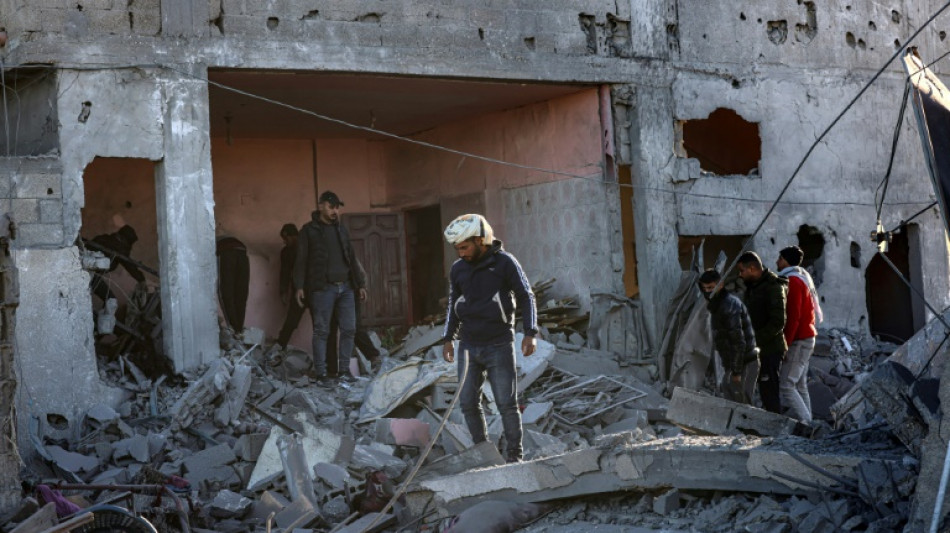
Witnesses in the Gaza Strip reported Israeli bombardment in the early morning. An AFP correspondent said intense shelling and air strikes hit the Palestinian territory's south overnight.
"I was visiting my sister, and when I returned I found my house was bombed," said 60-year-old Samir Qashta, a resident of Rafah in southern Gaza, where many people have fled.
"Is my house hurting Israel in any way?"
The Israeli army said its forces had struck dozens of rocket launchers that were "ready to be used" in central Gaza, and eliminated four "terrorists" in air strikes on Khan Yunis, Gaza's major southern city, near Rafah.
Ashraf al-Qudra, spokesman for the health ministry in the Hamas-run territory, reported "more than 60 martyrs" in Israeli air strikes and artillery fire, with dozens more wounded.
Israel's relentless bombardment of Gaza since Hamas's October 7 attack has killed at least 23,843 people, mostly women and children, according to an updated toll on Saturday from the territory's health ministry.
The war, in which Israel has vowed to destroy Hamas, began when the militants launched their unprecedented attack on Israel that resulted in about 1,140 deaths, mostly civilians, according to an AFP tally based on official figures.
At Rafah's Al-Najjar hospital, mourners gathered and prayed around the bodies of slain relatives. One man held the body of a child, wrapped in white cloth, ahead of burial.
Internet and telecommunications services were cut Friday as a result of Israeli bombardment, the main operator Paltel said, reporting the latest such disruption.
The Palestinian Red Crescent posted that the outage was increasing the challenges in "reaching the wounded and injured promptly".
Winter rains have exacerbated the dire humanitarian situation in Gaza, where the UN estimates 1.9 million -- nearly 85 percent of the population -- have been displaced. Many have sought shelter in Rafah and other southern areas.
"It was a harsh and difficult night," said Nabila Abu Zayed, 40, who now lives in a tent at Al-Nasser hospital in Khan Yunis.
"The rain flooded our tent... We spent the night standing with hundreds of displaced people like us in the corridors of the maternity ward," she told AFP.
"It was very cold and we had no winter clothes or blankets. All of my children are sick."
"There was bombing through the night," said Abu Zayed. "Where will we go?"
- 'Inhumanity... beyond comprehension' -
The United Nations humanitarian office, OCHA, told AFP that Israel was blocking aid convoys into northern Gaza.
"They have been very systematic in not allowing us to support hospitals," said OCHA's head for the Palestinian territories, Andrea De Domenico, decrying "a level of inhumanity... beyond comprehension."
In central Gaza, a lack of fuel forced the shutdown of the main generator of Al-Aqsa Martyrs Hospital in Deir el-Balah, the health ministry said.
Health ministry spokesman Qudra accused Israel of "deliberately targeting hospitals... to put them out of service", warning of "devastating repercussions".
Hospitals, protected under international humanitarian law, have repeatedly been hit by Israeli strikes in Gaza since the war erupted.
The Israeli military accuses Hamas of having tunnels under hospitals and using the medical facilities as command centres, a charge denied by the Islamist group.
Fewer than half of Gaza's hospitals are partly functioning, the World Health Organization says.
In Israel, concern grew for hostages held in Gaza as they approach their 100th day in captivity.
Palestinian militants on October 7 seized about 250 hostages, 132 of whom Israel says remain in Gaza, including at least 25 believed to have been killed.
On Friday, Israeli Prime Minister Benjamin Netanyahu's office said a deal had been negotiated with Qatar to get medicine to the captives.
Israeli campaign group Hostages and Missing Families Forum released a report this week saying the captives were in poor health, some with complex illnesses, others with injuries.
A diplomat familiar with the negotiations told AFP that both sides had expressed a willingness to allow the delivery of medicines, and a source close to Hamas said talks were ongoing.
- 'We must live' -
Israel criticised the UN human rights office for not reiterating its calls for the release of the hostages in a statement marking the looming 100th day of the conflict.
"A call for a ceasefire, without demanding the release of our hostages and the disarming of Hamas, is a call for terrorism to win," its mission in Geneva said.
The UN high commissioner for human rights, Volker Turk, has called repeatedly for the hostages to be freed.
The raging war didn't stop Gaza couple Afnan Jibril and Mustafa Shamlakh from getting married in Rafah.
"The house where the groom was supposed to live was destroyed", Ayman Shamlakh, the groom's uncle, told AFP.
"We are all living through the same tragedy. However, we must continue to live, and life should go on."
It said there had been a "terrorist infiltration" in the Adora settlement, about 20 kilometres (12 miles) west of Hebron, and soldiers had come under fire.
Palestinian news agency Wafa identified the three killed as a 19-year-old and two 16-year-olds.
The International Court of Justice this week heard arguments in a case launched by South Africa, accusing Israel of breaching the UN Genocide Convention over the Gaza war.
Both Israel and its ally the United States have dismissed the case as groundless, and the court is likely to make an initial ruling within weeks.
burs-ami/it
Q.Ceulemans--LCdB