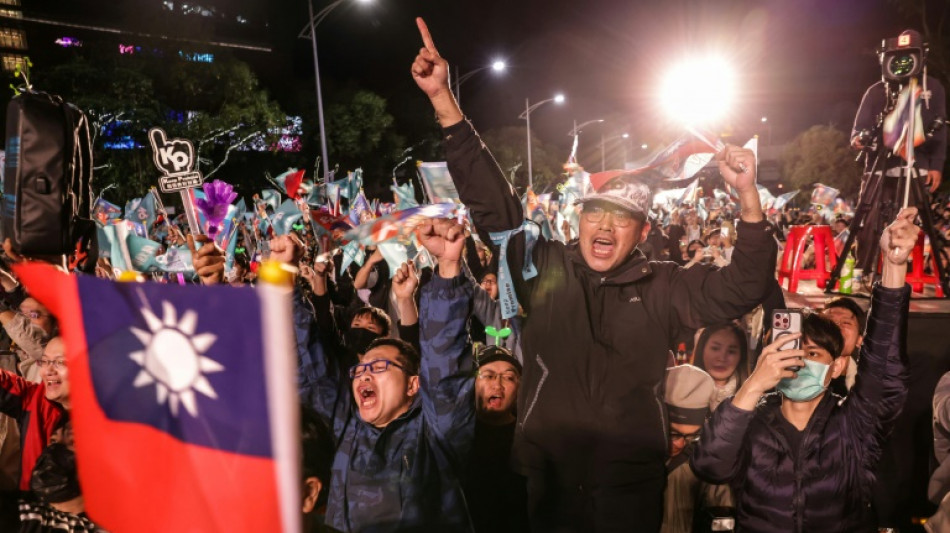
Taiwan tells China to 'face reality' after election / Photo: I-Hwa CHENG - AFP
Taiwan on Sunday told China to "face reality" and respect its election result, after voters defied Beijing's warnings and chose pro-sovereignty candidate Lai Ching-te as president.
Voters spurned Beijing's repeated calls not to vote for Lai, delivering a comfortable victory for a man China's ruling Communist Party sees as a dangerous separatist.
Beijing, which claims Taiwan as its territory and has never renounced force to bring it under its control, responded to Lai's victory saying it would not change the "inevitable trend of China's reunification".
Lai, of the ruling Democratic Progressive Party (DPP), vowed to defend the island from China's "intimidation" and on Sunday the island's foreign ministry told Beijing to accept the result.
"The Ministry of Foreign Affairs calls on the Beijing authorities to respect the election results, face reality and give up suppressing Taiwan in order for positive cross-strait interactions to return to the right track," it said in a statement.
After a campaign marked by diplomatic pressure from Beijing and near-daily incursions by Chinese fighter jets, Lai beat his nearest rival Hou Yu-ih of the Kuomintang (KMT) on Saturday by more than 900,000 votes.
In his victory speech the 64-year-old Lai congratulated voters for refusing to be swayed by "external forces" trying to influence the election.
He said he wanted to cooperate with China -- Taiwan's biggest trade partner -- and maintain peace and stability, but pledged not to be cowed by Chinese belligerence.
"We are determined to safeguard Taiwan from continuing threats and intimidation from China," he told supporters.
Four Chinese naval vessels were seen in waters around the island on polling day, according to Taiwan's defence ministry, and one high-altitude balloon passed over.
In the days leading up the election, China warned Taiwan's voters to make the "correct choice", and that Lai would take the island closer to war.
Lai will take power on May 20 alongside his vice-presidential pick Hsiao Bi-khim, Taiwan's former representative to the United States.
Both Lai and Hsiao were the targets of disinformation efforts during the campaign that experts linked to China.
Turnout of 72 percent showed an enthusiastic electorate, and on Sunday, voter Tsai Jin-hui said Beijing should mind its own business.
"What China thinks is a matter for China. We are electing the president of our own country," the 62-year-old taxi driver told AFP.
"I believe one day the world will recognise Taiwan as an independent sovereign state."
The United States and Britain congratulated Lai on his win, while the EU welcomed the successful holding of the election.
- Continuity -
World powers are keen to see as much stability as possible between China and Taiwan, not least because of the vital role the island plays in the global economy.
The Taiwan Strait is one of the world's most important maritime trade arteries, and the island itself is a major tech manufacturer, particularly of vital semiconductors -- the tiny chips used in everything from smartphones to missile systems.
Lai and the DPP have toned down past calls for independence, saying there is no need for a formal declaration since Taiwan is effectively independent already, defending the island's sovereignty.
But China still sees them as skirting too close to the "I-word" -- a red line for the communist giant.
Beijing cut off official contact with current President Tsai Ing-wen of the DPP in 2016 and is not expected to budge with Lai, setting the stage for four more years of frosty cross-strait relations.
"The ruling party's unprecedented third consecutive presidential victory will disappoint China, but it is unlikely to spur any near-term change in Beijing's reunification strategy," Bonnie Glaser, a Taiwan-China affairs expert at the German Marshall Fund of the United States, wrote in an analysis piece.
But the question in the coming days will be whether China decides on merely a diplomatic and rhetorical response to the election -- or steps up with a big show of force.
A possible flashpoint will be the planned visit by an unofficial US delegation, announced by a senior official in President Joe Biden's administration for the days after the election.
In line with most countries, Washington does not formally recognise Taiwan but maintains close unofficial ties -- and is the island's main arms supplier.
Further ahead, Lai's presidency could be affected by the US election in November, with the possible return of Donald Trump to the White House offering a very different prospect than Biden.
C.Maes--LCdB