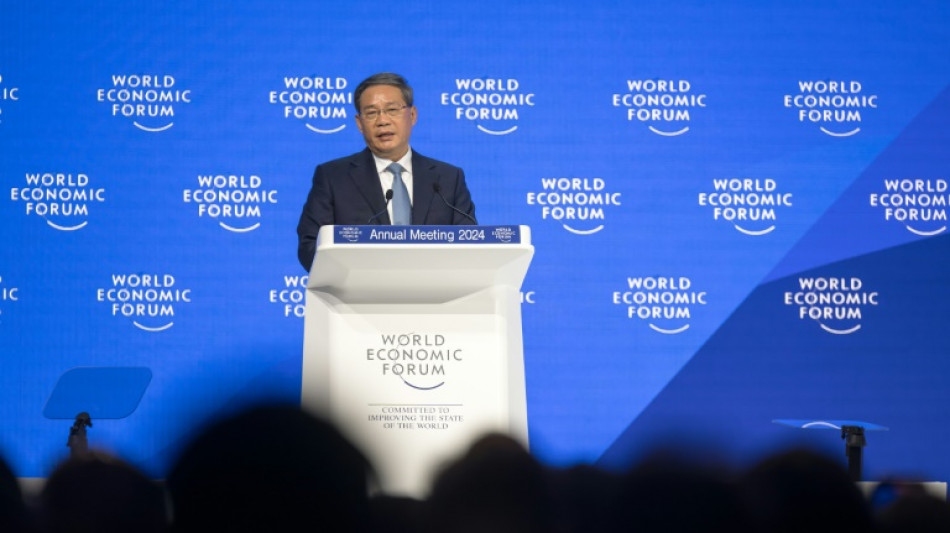
In Davos, Chinese premier takes aim at trade 'barriers' / Photo: Fabrice COFFRINI - AFP/File
Chinese Premier Li Qiang told the world's political and business elites in Davos on Tuesday that "discriminatory" trade barriers were a threat to the global economy -- in a not-so-subtle dig at the United States.
Li's remarks came as the World Economic Forum's 54th annual conference is preoccupied with a slew of global risks, including wars in Ukraine and Gaza, climate change and the rapid rise of artificial intelligence.
Ukrainian President Volodymyr Zelensky, who is attending the forum in person for the first time, will speak later as he seeks to shore up support from allies after nearly two years of war with Russia.
Li spoke just days after tense presidential elections at the weekend in Taiwan, the democratic island that Beijing claims as part of China.
But the most senior Chinese official to attend the WEF since 2017 did not address the election and instead focused on trade, his country's economy and AI.
He said "new discriminatory trade and investment measures" have been appearing every year and that "any obstacles or disruptions can slow down or block the flow of lifeblood of the world economy".
Li did not name any countries but Beijing has tussled with the United States and the European Union over trade in recent years, particularly on high-tech and clean energy.
US-China trade tensions soared under the presidency of Donald Trump and have continued under President Joe Biden.
In October, the United States announced tighter export curbs on state-of-the-art artificial intelligence chips, sparking fury in Beijing.
The EU, meanwhile, has launched a probe into Chinese electric car subsidies.
Without naming a country, Li said that "there are many examples where one side's capriciousness undermines mutual trust with others."
But US and European companies have long complained that of obstacles to doing business on a level-playing field in China.
- Ukraine support -
Li was sharing the spotlight with Zelensky, who met with the "CEOs for Ukraine" group and US Secretary of State Antony Blinken.
Kyiv is scrambling to ensure that support from allies does not waver during the biggest war in Europe since World War II, as the world's attention has swayed to the Middle East amid fears of a spillover from the conflict in Gaza.
"We are determined to sustain our support for Ukraine," Blinken said after the talks.
Republicans in the US Congress are blocking a renewal of US military assistance for Ukraine, and Kyiv and its allies worry about reduced support if Donald Trump wins the US presidential election later this year.
European Union leaders will hold talks next month in a bid to approve a 50-billion-euro ($55 billion) aid package for Ukraine that was vetoed in December by Hungary.
In a speech, European Commission president Ursula von der Leyen said Ukraine's allies need to guarantee stable backing for Kyiv.
"Ukraine can prevail in this war. But we must continue to empower their resistance," she said.
Wearing a dark sweater and olive green trousers, Zelensky was greeted with a standing ovation as he entered a closed-door meeting of "CEOs for Ukraine".
Australian mining magnate Andrew Forrest told AFP executives expressed "complete" support for Zelensky.
"Lock, stock and barrel, from every country, doesn't matter if you're India, South Africa, China. The guy has support,” Forrest said.
- AI fears -
Artificial intelligence also dominated discussions after last year's flurry of examples demonstrating the technology's dizzying advances.
Despite the excitement, there are worries about the threats posed by AI.
Misinformation and disinformation driven by AI ahead of elections in countries, including the United States, are the biggest global risks this year and next, the WEF said last week.
Li said a "red line" must be drawn in the development of AI to ensure that the technology benefits society and not just "small group of people".
Von der Leyen warned that "Europe must up its game" on the technology and "show the way to responsible use of AI".
D.Jacobs--LCdB