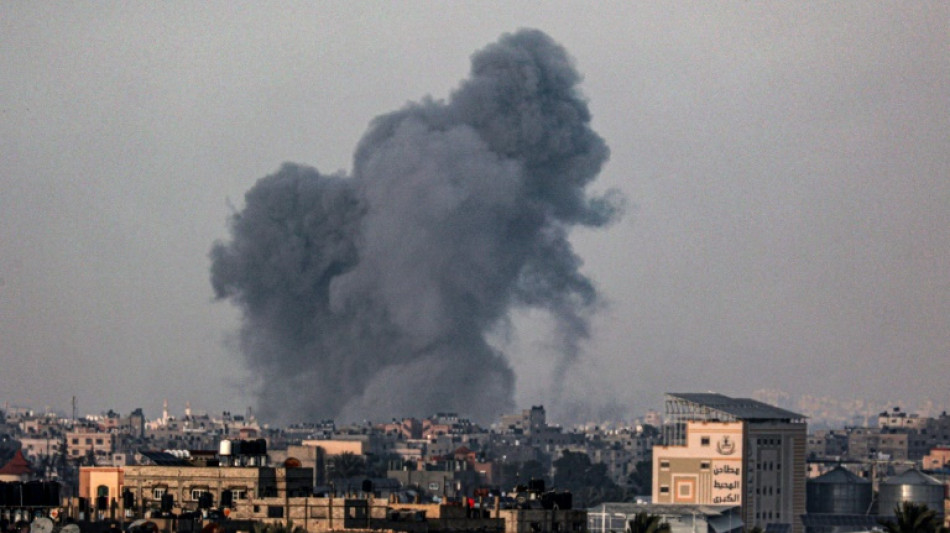
Israel says troops reach farthest south in Gaza so far / Photo: - - AFP
The Israeli army said troops reached the southernmost point of their ground invasion of Gaza so far on Thursday as they intensified operations across the south of the Palestinian territory.
As fears rise that the Israel-Hamas war will escalate, tensions flared in the wider region following Pakistani strikes in Iran and new US military action targeting Iran-backed Yemeni rebels.
In Khan Yunis, southern Gaza's main city, the army said its Givati Brigade was "fighting in the southernmost area that ground troops have operated in so far".
"The soldiers eliminated dozens of terrorists in close-quarters combat and with the assistance of tank fire and air support," it said.
Soldiers raided the "Martyr's Outpost" of Hamas's Khan Yunis brigade and the offices of its commanders, seizing a weapons cache including AK-47 assault rifles and rocket-propelled grenades, it added.
Live footage from AFPTV showed smoke rising over central-southern Gaza in the afternoon.
Gaza's Hamas authorities reported 93 deaths overnight, including 16 in a strike on a house in the southern city of Rafah, where many people have fled.
Umm Walid al-Zamli said she lost her children and her house.
"The oldest was a second-grade girl," she said in a choked voice. "What did they do wrong?"
Israeli Defence Minister Yoav Gallant has said the army is hitting Khan Yunis particularly hard to dismantle the Hamas leadership, which the military says has already been achieved in northern Gaza.
- 'Moment of relief' -
Fighting has ravaged Gaza since Hamas's unprecedented October 7 attacks on Israel that resulted in the death of about 1,140 people, mostly civilians, according to an AFP tally based on official figures.
Vowing to destroy Hamas, Israel has been conducting a relentless air and ground offensive that has killed at least 24,620 Palestinians, around 70 percent of them women, children and adolescents, according to health ministry figures.
The war has displaced roughly 85 percent of Gaza's 2.4 million population, the UN says. Many have crowded into shelters where they struggle to get food, water, fuel and medical care.
UN agencies say improved aid access to Gaza is urgently needed as famine and disease loom.
In Gaza City in the north, displaced Palestinian Ibrahim Saada struggled to come to terms with the scene of destruction around him.
"We are not part of this war and can't bear it. We are being destroyed, dying from hunger," he told AFP.
Officials from both sides confirmed a shipment of aid, including medicines for hostages, had entered Gaza under a deal mediated by France and Qatar.
The International Committee of the Red Cross said it played no role in implementing the deal, which also comprises humanitarian aid for Gazan civilians, but welcomed it as "a much-needed moment of relief".
- Baby Bibas -
Militants also seized about 250 hostages during the October 7 attacks, around 132 of whom Israel says remain in Gaza.
At least 27 hostages are believed to have been killed, according to an AFP tally based on Israeli figures.
Families of the captives have spearheaded a campaign to get them home, pressuring the government which has said their return is one of its war aims.
A group of hostage relatives protested at Israel's Kerem Shalom border crossing with Gaza on Thursday demanding that aid deliveries be blocked until their loved ones are released.
In November, Hamas broadcast a video announcing the death of the baby, his brother and mother. But there has been no confirmation from Israeli officials, and relatives have since clung to the hope that they are not dead.
Thursday would have been the first birthday of Israel's youngest hostage and hundreds of people gathered in Tel Aviv to mark the occasion, releasing bunches of balloons.
- West Bank violence surges -
In the West Bank, violence has escalated to a level not seen since the second Palestinian intifada, or uprising, of 2000-2005.
Israeli troops and settlers have killed more than 360 Palestinians in the West Bank since October 7, according to the territory's health ministry.
Palestinian health officials reported a sixth death in a two-day Israeli operation in the northern city of Tulkarem and its refugee camp.
The man shot dead in the camp was a civilian not involved in fighting between Israeli forces and militants, local official Rami Elyan told AFP.
The Israeli army said troops had killed "at least eight terrorists" in Tulkarem and returned fire while they were working to "uncover roads where explosive devices were planted".
In the latest flare-up to unsettle the Middle East, Iranian state media said Pakistani strikes on a border region killed nine people on Thursday. Pakistan said it had targeted militants.
This followed a rare Iranian air strike late on Tuesday, that Iranian media said targeted a jihadist group which has claimed repeated deadly attacks on security forces in recent months.
burs-imm/kir
F.Cornelis--LCdB