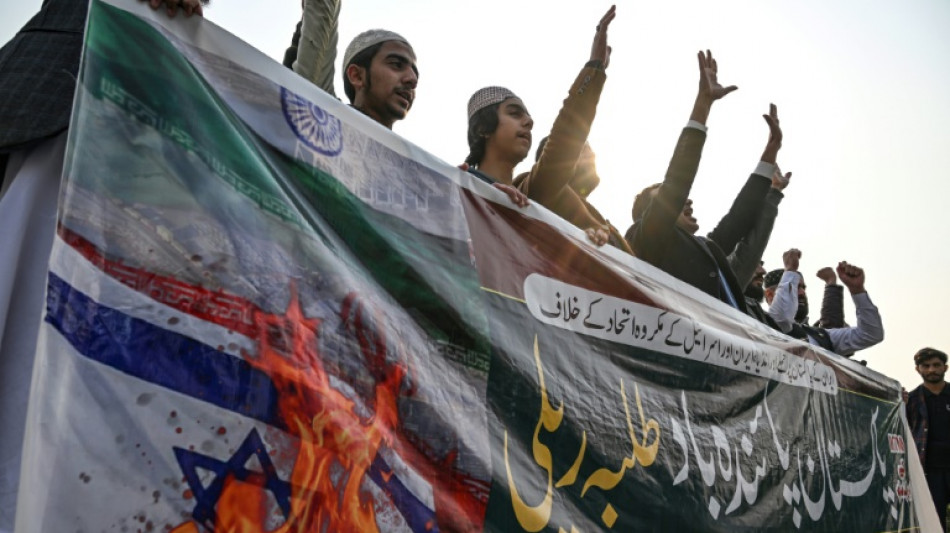
Calls for calm after Iran, Pakistan trade strikes on militants / Photo: Farooq NAEEM - AFP
The United Nations and the United States appealed for restraint on Thursday after Iran and Pakistan traded deadly air strikes on militant targets on each other's territory.
The rare military action across the porous border between the heavily armed neighbours has further stoked tensions already enflamed by the Israel-Hamas war.
Pakistan's strikes against militant targets in Iran early on Thursday came two days after similar Iranian strikes on its territory, and prompted Tehran to summon Islamabad's envoy.
At least nine people were killed in the strikes in restive Sistan-Baluchistan province, most of them women or children, Iran's official IRNA news agency reported.
They came after Iran carried out raids on what it described as "terrorist" targets in Pakistan on Tuesday, killing at least two children.
While Iran and nuclear-armed Pakistan often accuse each other of allowing militants to operate from the other's territory, cross-border operations by government forces have been rare.
UN chief Antonio Guterres called on the two governments to "exercise maximum restraint".
"The secretary general is deeply concerned about the recent exchange of military strikes between Iran and Pakistan, which have reportedly caused casualties on both sides," his spokesman Stephane Dujarric said.
White House National Security Council spokesman John Kirby said the United States was monitoring the situation "very, very closely" and was in touch with Pakistani officials.
"These are two well-armed nations and again we don't want to see an escalation," Kirby told reporters.
US State Department spokesperson Matthew Miller echoed his comments.
“We don't believe this should escalate in any way, shape or form. Pakistan is a major non-NATO ally of the United States, that will remain the case, but we would urge restraint in this case."
Kirby said he was "not aware" that Islamabad had notified Washington before striking Iran. He would not comment when asked if the United States would provide support for Pakistan.
Pakistan's foreign ministry described Thursday's raids as a "series of highly coordinated and specifically targeted precision military strikes against terrorist hideouts" in Sistan-Baluchistan.
The strikes took place at around 4:30 am (0100 GMT), with three drones destroying four houses in a village near the city of Saravan, IRNA said, citing Alireza Marhamati, deputy governor of the province.
Iranian media carried images showing severely damaged homes, with one video showing people gathered around a crater.
All of those killed were Pakistanis, and investigations were under way to determine why they were in the Iranian village, Marhamati said.
The raids targeted Baluch separatists, according to the Pakistani army. The military has been waging a decades-long fight against separatist groups in its sparsely populated border region.
- 'Spiral of violence' -
Iran condemned the action, and summoned Pakistan's charge d'affaires "to protest and request an explanation from the Pakistani government", foreign ministry spokesman Nasser Kanani said.
The ministry described Pakistan's strikes as "unbalanced and unacceptable", and said Iran expects Pakistan "to adhere to its obligations in preventing the establishment of bases and armed terrorist groups in Pakistan".
Jihadist group Jaish al-Adl (Army of Justice) has carried out repeated deadly attacks on Iranian security forces in recent months, and Tehran has long alleged that it operates out of rear bases across the border.
Pakistan delivered a strong rebuke to Iran over its strikes, recalling its ambassador from Tehran and blocking Iran's envoy from returning to Islamabad.
China offered to mediate between the neighbours, both close economic partners of Beijing.
The European Union expressed concern about the "spiral of violence in the Middle East and beyond".
- Restive province -
Rising Iran-Pakistan tensions add to multiple crises in the region, with Israel waging a war against Hamas in Gaza and Huthi rebels in Yemen attacking commercial vessels in the Red Sea.
Meanwhile Afghanistan -- which borders both Iran and Pakistan, and is home to a small Baluch minority -- said the violence between its neighbours was "alarming" and urged them to "exercise restraint".
On Thursday, Pakistan's foreign ministry said Prime Minister Anwar-ul-Haq Kakar would cut short his visit to the World Economic Forum in Davos, Switzerland, "in view of the ongoing developments".
Sistan-Baluchistan province is one of the few mainly Sunni Muslim provinces in Shiite-dominated Iran and has seen persistent unrest involving cross-border drug-smuggling gangs and rebels from the Baluchi ethnic minority as well as jihadists.
C.Maes--LCdB