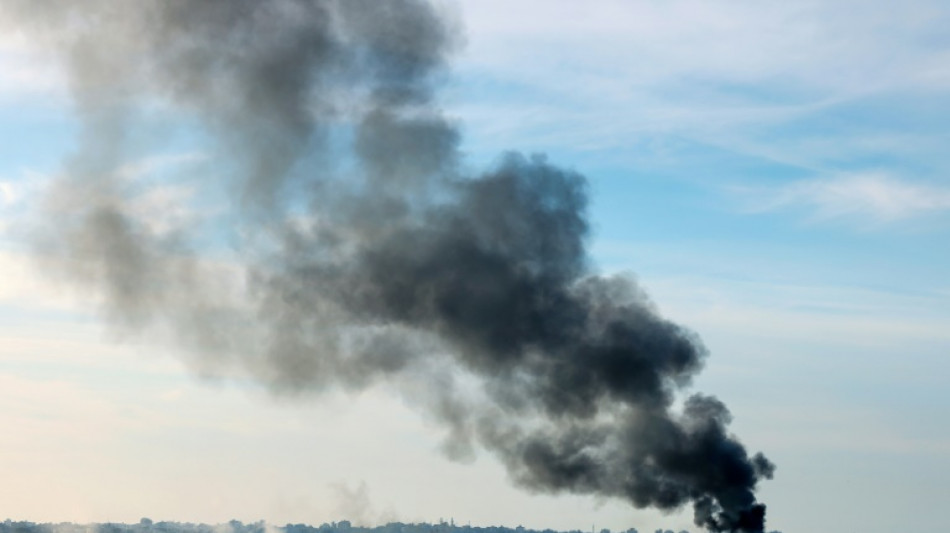
Israel bombs Gaza as disagreements with US simmer / Photo: JACK GUEZ - AFP
Israel bombarded southern Gaza on Friday after it publicly sparred with its main ally the United States over the possibility of a Palestinian state, the creation of which Washington sees as the only pathway to a lasting peace.
Witnesses reported gunfire and air strikes early on Friday in Khan Yunis, the main city in the south of the Gaza Strip, where Israel says many members and leaders of the Palestinian Islamist movement Hamas are hiding.
The Palestinian Red Crescent reported "intense" artillery fire near the Al-Amal hospital, while Gaza's Hamas-run health ministry said 77 people were killed and dozens injured overnight.
The Israeli military said its Givati Brigade was fighting as far south as its troops had reached so far in the campaign.
"The soldiers eliminated dozens of terrorists in close-quarters combat and with the assistance of tank fire and air support," it said.
The United Nations says the war, which began with the unprecedented Hamas attacks on Israel on October 7, has displaced roughly 85 percent of Gaza's 2.4 million people.
Many are crowded into shelters where they struggle to get food, water, fuel and medical care. UN agencies say improved aid access is needed urgently as famine and disease loom.
The World Health Organization (WHO) said overnight it had counted 24 cases of hepatitis A and "thousands" of cases of jaundice likely linked to the spread of the viral liver infection.
"The inhumane living conditions -- almost no drinking water, clean toilets or ability to keep the surroundings clean -- will allow hepatitis A to spread further," WHO chief Tedros Adhanom Ghebreyesus said on X, formerly Twitter, describing the health crisis as "explosive".
Hamas's October 7 attacks resulted in the deaths of about 1,140 people in Israel, most of them civilians, according to an AFP tally based on official figures.
Militants also seized about 250 hostages during the attacks, around 132 of whom Israel says remain in Gaza. At least 27 hostages are believed to have been killed, according to an AFP tally based on Israeli figures.
Israel has vowed to "annihilate" Hamas in response and its relentless air and ground offensive has killed at least 24,620 Palestinians, around 70 percent of them women, children and adolescents, according to figures from the Hamas-run health ministry.
"We will not be satisfied with anything less than total victory," Israeli Prime Minister Benjamin Netanyahu told a news conference on Thursday, warning that "victory will take many months".
Total victory meant "the elimination of terrorist leaders, the destruction of Hamas's operational and military capabilities, the return of our hostages to their homes", as well as the demilitarisation of Gaza, he said.
- A Palestinian state? -
Washington supports Israel's campaign in Gaza, but despite otherwise close ties, the two allies publicly aired differences again this week over the way forward.
US Secretary of State Antony Blinken used the World Economic Forum in Davos, Switzerland, to renew his call for a "pathway to a Palestinian state".
But Netanyahu again flatly rejected the suggestion on Thursday.
"Israel must have security control over the entire territory west of the Jordan River," he said. "This is a necessary condition, which contradicts the idea of (Palestinian) sovereignty."
Netanyahu maintained that "a prime minister in Israel should be able to say no, even to our best friends".
Washington believes that the creation and recognition of a viable Palestinian state is necessary to achieve security for Israel.
"We obviously see things differently," National Security Council spokesman John Kirby said when asked about Netanyahu's comments.
Responding to Netanyahu's remarks, the official spokesperson for Palestinian president Mahmud Abbas, said that without an independent Palestinian state "there will be no security and stability in the region".
"The entire region is on the verge of a volcanic eruption due to the aggressive policies pursued by the Israeli occupation authorities against the Palestinian people and their legitimate rights," Nabil Abu Rudeineh said, according to the official Wafa news agency.
Abbas's Palestinian Authority exercises limited rule in the occupied West Bank, where the Israeli army also carried out raids overnight, notably in Tulkarem.
The Palestinian Ministry of Health has counted at least six deaths in the city since Wednesday.
- Huthi attacks -
The international community already fears that the war in Gaza could spill over into the wider region, with daily exchanges of fire on the Israeli-Lebanese border, an increase in attacks by Huthi rebels on merchant ships in the waters around Yemen and the subsequent intensification of US strikes there in response.
The Iran-backed Huthis have launched attacks against what they deem Israeli-linked vessels in the vital shipping lanes of the Red Sea and Gulf of Aden in support of Palestinians in Gaza.
They have also said US- and British-linked ships were fair game since the two countries launched air strikes against targets in Yemen over the past week.
The Huthis claimed responsibility early on Friday for another attack on a US-owned and operated ship in the Gulf of Aden.
While vowing the rebels would continue such attacks, a senior Huthi official promised safe passage through the Red Sea for Russian and Chinese vessels in an interview published by the Russian outlet Izvestia on Friday.
J.Hermans--LCdB