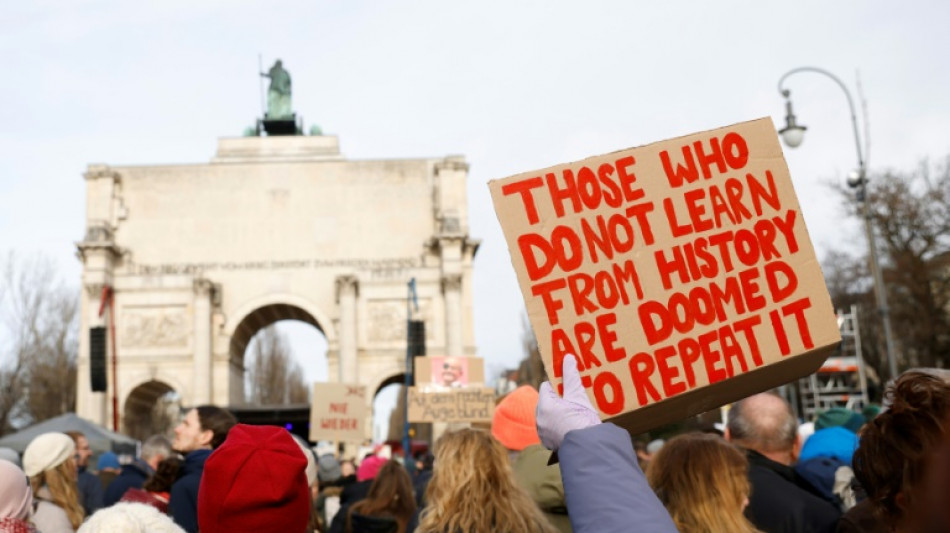
Tens of thousands flood protests against far right in Germany / Photo: MICHAELA STACHE - AFP
Tens of thousands gathered across Germany again on Sunday to protest the far-right AfD, after it emerged that party members discussed mass deportation plans at a meeting of extremists.
The influx of demonstrators was so large in Munich that organisers were forced to cancel a planned march and ask people to disperse for safety reasons.
Organisers said some 50,000 people had turned up to the demonstration, twice as many as were registered for the event.
An earlier estimate announced to the crowd had put the figure at 200,000, according to an AFP journalist.
Police estimated a figure somewhere in the middle, around 100,000, according to the German daily Sueddeutsche Zeitung.
Those who made it to the site of the planned protest carried signs saying "Nazis out" and "never again is now".
Some 250,000 people had already gathered in cities across the country on Saturday, according to ARD estimates.
Demonstrations were called in some 100 locations across Germany from Friday through the weekend, including in Munich, Berlin and cities in the east of the country where the AfD has its strongholds.
- 'Take a stand' -
The wave of mobilisation against the far-right party was sparked by a January 10 report by investigative outlet Correctiv, which revealed that AfD members had discussed the expulsion of immigrants and "non-assimilated citizens" at a meeting with extremists.
Among the participants at the talks was Martin Sellner, a leader of Austria's Identitarian Movement, which subscribes to the "great replacement" conspiracy theory that claims there is a plot by non-white migrants to replace Europe's "native" white population.
News of the gathering sent shockwaves across Germany at a time when the AfD is soaring in opinion polls, just months ahead of three major regional elections in eastern Germany where their support is strongest.
The anti-immigration party confirmed the presence of its members at the meeting, but has denied taking on the "remigration" project championed by Sellner.
In Cologne, organisers estimated 70,000 people had joined a protest in the city on Sunday, while in Bremen, local police said 45,000 people had turned out in the centre.
Politicians, as well as church leaders and Bundesliga football managers have called on people to make a stand against the far right.
Chancellor Olaf Scholz, who joined a demonstration last weekend, said any plan to expel immigrants or citizens alike amounted to "an attack against our democracy, and in turn, on all of us".
He urged "all to take a stand -- for cohesion, for tolerance, for our democratic Germany".
- 'Huge uncertainty' -
Interior Minister Nancy Faeser went so far as to say in the newspapers of the Funke press group that the far-right meeting was reminiscent of "the horrible Wannsee conference", where the Nazis planned the extermination of European Jews in 1942.
The protests against the far right could "restore trust in democratic conduct", Josef Schuster, the head of the Central Council of Jews in Germany, told broadcaster Welt TV.
Protesters first gathered last weekend in Berlin and Potsdam, where the extremist meeting was held, and have gathered pace since.
On Saturday, around 35,000 people gathered in the centre of Frankfurt, responding to the call to "defend democracy" against the AfD.
President Frank-Walter Steinmeier said Sunday the protestors "give us all courage".
"They defend our republic and our constitution against its enemies," Steinmeier said in a video message.
C.Timmermans--LCdB