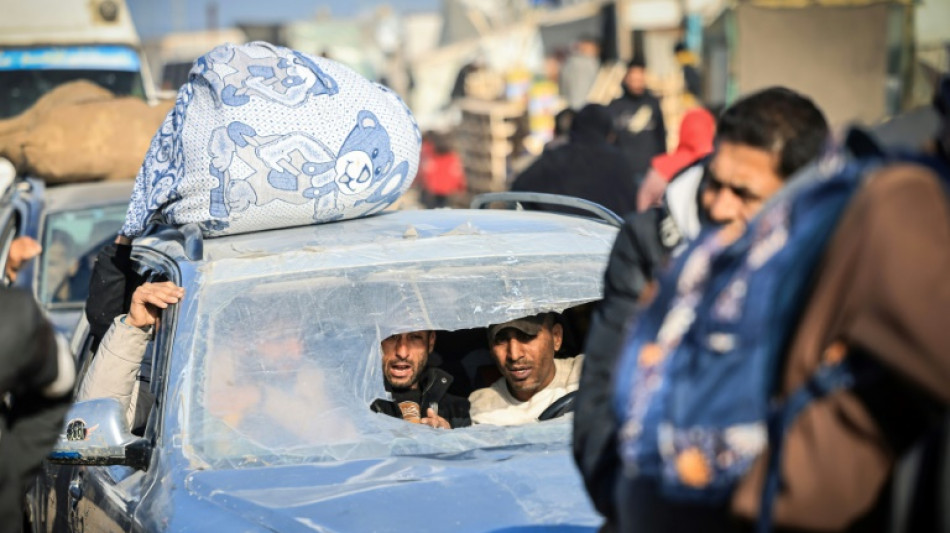
Israel pressed on two-state solution as forces hammer south Gaza / Photo: - - AFP
Gazans sheltered Monday from intense bombing and shooting in the city of Khan Yunis, as pressure built on Israel for an eventual two-state solution involving statehood long sought by Palestinians.
Witnesses reported deadly strikes and fierce fighting between Israeli soldiers and Hamas militants overnight in the southern city which has become the latest epicentre of the war.
The health ministry in Hamas-run Gaza reported on Monday that more than 120 people had been killed in the previous 24 hours.
"Artillery shelling has not stopped since 5:00 am," said Yunis Abdel Razek, 52, sheltering with his family at the city's Al-Aqsa University.
Mahdi Antar, 21, had sought refuge at Al-Nasser hospital in Khan Yunis.
"The situation is terrifying. Tonight and today are very difficult, bombing and shooting. I do not know what to do. I think they will storm the hospital," he said.
Victims of the latest Israeli strikes were brought to the hospital, at least one on a hand-pulled cart.
The Palestinian Red Crescent said Israeli forces were "besieging" their ambulance centre "and targeting anyone attempting to move in the area".
At one building that had been hit, men walked over broken concrete with only torches casting a dusty light to help them search in the darkness for survivors.
The strikes came as European Union foreign ministers held meetings in Brussels with top diplomats from the warring sides and key Arab states.
- Condemnation, defiance -
The 27 EU ministers first met Israel's Foreign Minister Israel Katz before sitting down separately with the Palestinian Authority's top diplomat, Riyad al-Maliki.
EU foreign policy chief Josep Borrell told Israel "peace and stability cannot be built only by military means".
Israeli Prime Minister Benjamin Netanyahu has drawn condemnation from the United Nations and defied the United States, which provides Israel with billions of dollars in military aid, by rejecting calls for a Palestinian state.
Maliki demanded the EU call for an immediate ceasefire and urged the bloc to consider sanctions against Netanyahu for "destroying the chances for a two-state solution".
Jordan's Foreign Minister Ayman Safadi said "the whole world" sees a two-state solution as "the only way out of this misery".
Katz told reporters he was in Brussels to discuss the need "to bring back our hostages and restore security for the citizens of Israel".
The talks came a day after Hamas issued a 16-page report, in Arabic and English, explaining the background to the October 7 attacks against southern Israel which sparked the war.
It called the attacks a "defensive act" and "necessary step" against Israeli occupation, "reclaiming the Palestinian rights and on the way for liberation and independence like all peoples".
The attacks resulted in the deaths of about 1,140 people in southern Israel, mostly civilians, according to an AFP tally based on official Israeli figures.
In response, Israel has carried out a relentless offensive that has killed at least 25,295 people in Gaza, around 70 percent of them women, young children and adolescents, according to the latest toll issued Monday by Gaza's health ministry.
- Parliamentary committee stormed -
US intelligence agencies have estimated that the Israeli campaign has killed "around 20 percent to 30 percent" of Hamas fighters and is still far from its goal of destroying the Islamist movement, the Wall Street Journal reported on Sunday.
In a video statement issued after the Hamas report, Netanyahu said "our soldiers have fallen in vain" and security would not be guaranteed if Israel accepted Hamas's demands for the release of hostages.
These included ending the war, withdrawing Israeli forces from Gaza, releasing Palestinian prisoners and guaranteeing that Hamas would stay in power, he said.
Netanyahu is under intense pressure to return the captives and account for security failings surrounding the October 7 attacks.
Hamas militants seized about 250 hostages and Israel says around 132 remain in Gaza. This includes the bodies of at least 28 dead hostages, according to an AFP tally based on Israeli data.
Relatives and supporters of the captives have held regular rallies and on Monday upped their pressure by storming a parliamentary finance committee meeting, where they shouted and brandished signs.
In a bid to secure a new hostage exchange deal, US media said the United States coordinator for the Middle East, Brett McGurk, was due to meet top officials in Cairo on Monday, followed by a trip to Qatar.
The three countries helped broker a one-week truce in late November that saw 80 hostages freed in exchange for 240 Palestinian prisoners in Israel.
Rising tensions and violence across the Middle East -- involving Iran-backed groups in Lebanon, Iraq, Syria and Yemen -- have stoked fears of a wider conflagration.
L.Moonen--LCdB