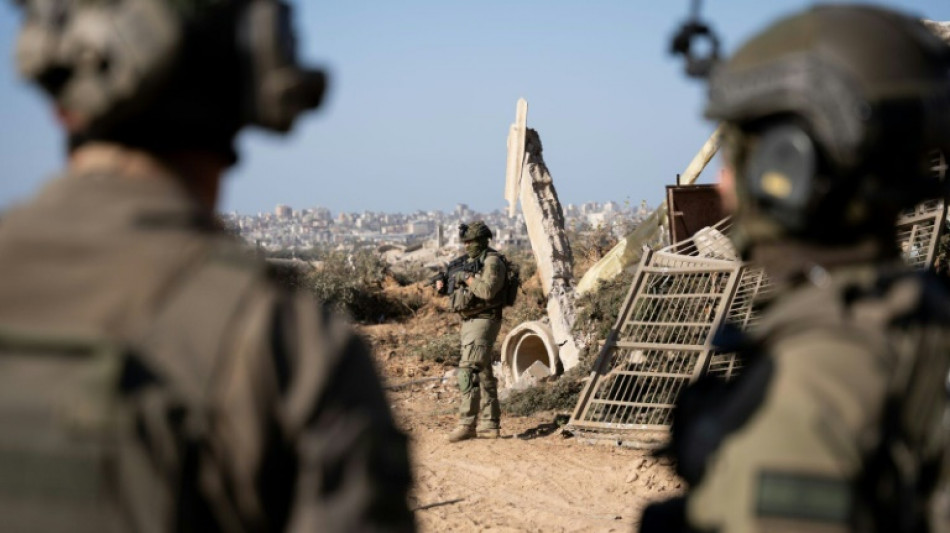
Israel suffers deadliest day of ground war as pressure mounts on government / Photo: - - Israeli Army/AFP
The Israeli army said Tuesday it had suffered its biggest single-day losses since the start of its ground war in Gaza amid growing pressure on the government to find a way to end the conflict.
The heavy clashes came as a White House official was due in the region for talks aimed at securing more hostage releases, and as US media reported a new Israeli proposal for a deal that would involve a two-month pause in fighting.
Twenty-four soldiers were killed on Monday, with military spokesman Daniel Hagari saying 21 reservists were slain when rocket-propelled grenade fire hit a tank and two buildings they were trying to blow up.
"We worked to find the victims until the last hours," Hagari said in a televised statement, pointing to the difficulty of extracting bodies buried under the rubble.
"Our reservists sacrificed what was dearest to them, so that we could all live here in complete safety."
The UN humanitarian agency OCHA said "ground operations, fighting and attacks intensified" around Gaza's main southern city of Khan Yunis.
The Israeli army said its forces had conducted multiple raids and taken control of Hamas command centres in the city.
The Palestinian Red Crescent said Israeli forces had hit its headquarters in Khan Yunis "with artillery shelling on the fourth floor, coinciding with intense gunfire from Israeli drones, resulting in injuries among internally displaced individuals who sought safety on our premises".
UN agencies and aid groups have sounded the alarm about the growing threat of disease and famine in Gaza, where 1.7 million people are estimated to have been displaced from their homes.
Abu Iyad, his belongings piled on a donkey-drawn cart, said he was moving for the seventh time, fleeing Khan Yunis for Rafah on the Egyptian border, where hundreds of thousands of displaced Palestinians have sought shelter, many in makeshift tents.
"I'm heading to the unknown," he told AFP. "They told us to go to Rafah -- where to go in Rafah? Is there any space left?"
- Hostage talks -
The war in the Palestinian territory broke out with Hamas's unprecedented October 7 attacks, which resulted in the deaths of about 1,140 people in Israel, mostly civilians, according to an AFP tally based on Israeli official figures.
In response, Israel has carried out a relentless offensive that has killed at least 25,295 people in Gaza, around 70 percent of them women, children and adolescents, according to the health ministry in the Hamas-run territory.
The Hamas attack also saw about 250 hostages seized, and Israel says around 132 remain in Gaza. That number includes the bodies of at least 28 dead hostages, according to an AFP tally based on Israeli figures.
Around 100 hostages, including foreigners, were released during a week-long truce in November, the Israelis among them in exchange for Palestinian prisoners held in Israeli jails.
Relatives of those still held captive stormed a parliamentary committee meeting on Monday demanding urgent action.
"You sit here while our children are dying over there," yelled Gilad Korngold, father of hostage Tal Shoham, an AFP correspondent reported.
US news outlet Axios reported on Monday night that Israel had proposed to Hamas, via Qatari and Egyptian mediators, a new deal to free all the hostages.
The report, citing unnamed Israeli officials, said the proposed deal would be carried out in multiple stages, and would also involve the release of an undetermined number of Palestinian prisoners.
The plan was expected to take about two months to complete.
The proposal does not include promises to end the war, but it would involve Israeli troops reducing their presence in major cities in Gaza and gradually allowing residents to return to the territory's devastated north, Axios said.
News of the proposal comes as US media said the White House's coordinator for the Middle East, Brett McGurk, was expected in Egypt and Qatar for meetings aimed at securing a new hostage exchange deal.
State Department spokesman Vedant Patel, however, said Washington still believed "a two-state solution, a creation of a Palestinian state, is the only path that gets us out of this endless cycle of violence".
- Two-state solution -
Israeli Prime Minister Benjamin Netanyahu has steadfastly rejected calls for the creation of a Palestinian state, saying Israel must maintain "security control over all the territory west of the Jordan" River, an area that includes all of the Palestinian territories.
EU foreign ministers pressed Israel to change its mind at meetings in Brussels on Monday with the top diplomats from the two warring parties and key Arab states.
"The two-state solution is the only solution, and even those who don't want to know about it have not yet come up with any other alternative," said German Foreign Minister Annalena Baerbock.
At the gathering, Israeli Foreign Minister Israel Katz ignored questions from journalists over a future two-state solution and said his country was focused on returning the hostages and ensuring its security.
Jordanian Foreign Minister Ayman Safadi, who was also in attendance, said Israel's rejection of "the two-state solution is dooming the future of the region to more conflicts".
- Yemen strikes -
The Gaza war spurred fears of a wider escalation, with a surge in violence involving Iran-backed Hamas allies across the region.
The United States and Britain later announced a fresh round of strikes on Huthi targets in response to the rebels' continued attacks on Red Sea shipping.
The US Central Command said that the targets of the strikes "included missile systems and launchers, air defence systems, radars, and deeply buried weapons storage facilities".
A.Louis--LCdB