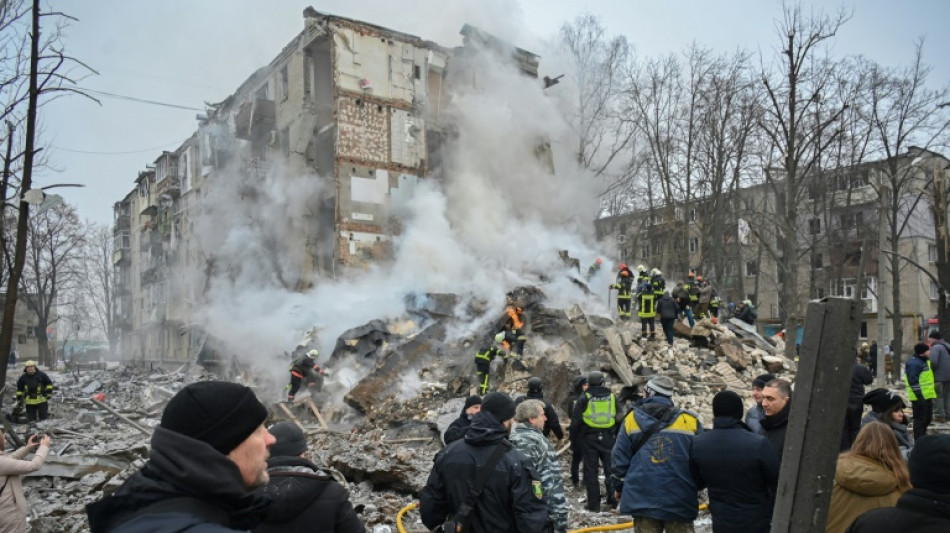
Russian strikes kill four, wound dozens across Ukraine / Photo: SERGEY BOBOK - AFP
Dozens of people were injured and least four killed after a wave of Russian missiles targeted Kyiv and other cities across Ukraine, setting residential buildings ablaze and reducing others to rubble.
Rescue workers in Kharkiv, Ukraine's second-largest city near Russia's border, hauled injured residents from the scene of an attack where smoke rose from smouldering piles of rubble, AFP journalists reported.
The regional governor said three residents were killed in the overnight barrage and another 42 had been wounded.
Medical workers treat one wounded man with blood smeared across his face, AFP saw.
AFP journalists in Kyiv meanwhile heard air raid sirens echo over the capital at night, followed by a series of loud blasts -- thought to be air defence systems responding to the incoming aerial onslaught.
Ukrainian army chief Valery Zaluzhny said Russian forces had fired 41 missiles -- including cruise, ballistic and surface-to-air missiles as part of the barrage -- adding that his forces had shot down 21.
In the capital, Mayor Vitali Klitschko said 20 people were wounded in an attack that set buildings and cars ablaze in central districts of the city.
- 'It's scary' -
Daryna Bodenchuk, a 17-year-old interior design student, said she was in her dormitory at the time of the strikes. They shook the building and blew open the door of the basement where she and others had taken shelter.
"I am very upset. It's really scary. A window was broken also in our dormitory. It was loud," she told AFP.
Iryna Zalizna, a 25-year-old resident of Kyiv, had already left home for work when the strikes hit her neighbourhood. She said rushed back to take stock of the destruction.
"All the windows and a few frames were blown out there," she told AFP.
"But thank God everything is fine with the dog and everyone is alive."
Mayor Klitschko said that 13 people had been hospitalised, including a 13-year-old boy, and that one woman was in intensive care ward.
"An unexploded munition was found in one of the apartments in a residential building in Sviatoshynskyi district," he said earlier.
"People are being evacuated from the house," he said.
In the region surrounding Kyiv, officials said four people were wounded after residential blocks, private homes and farm buildings were damaged.
Further south, in the city of Pavlograd, the Dnipropetrovsk governor said one person had been killed and another wounded.
"We must make Russia pay for the suffering and pain it has caused to Ukraine," Ukrainian Prime Minister Denys Shymgal said in response to the attack.
- Kremlin denial -
The Kremlin denied Russian forces had targeted civilian infrastructure and vowed to continue its nearly two-year invasion.
"We are continuing our special military operation, and our military does not hit social facilities and residential neighbourhoods, and does not hit civilians -- unlike the Kyiv regime," Kremlin spokesman Dmitry Peskov told reporters.
This was an apparent reference to a recent uptick in fatal drone and missile attacks that Russian forces have blamed on Kyiv, targeting cities and energy facilities near the countries' shared border.
Russian forces had aimed to wrest control of Kharkiv -- the city worst hit in the overnight strikes -- early in their invasion, launched on February 2022.
Ukrainian forces pushed back Moscow's army but it has been routinely shelling the city since.
The toll from missile barrage adds to the tens of thousands of military personnel and civilians understood to have been killed since the Russian invasion of Ukraine began in February 2022.
The real figures are likely to be considerably higher.
Ukrainian Foreign Minister Dmytro Kuleba said this month his country's priority for 2024 is to gain control over its air space, and Kyiv has urged its allies to help bolster its air defence capabilities.
F.Claes--LCdB