Fuming French farmers pile pressure on Paris / Photo: Frederick FLORIN - AFP/File
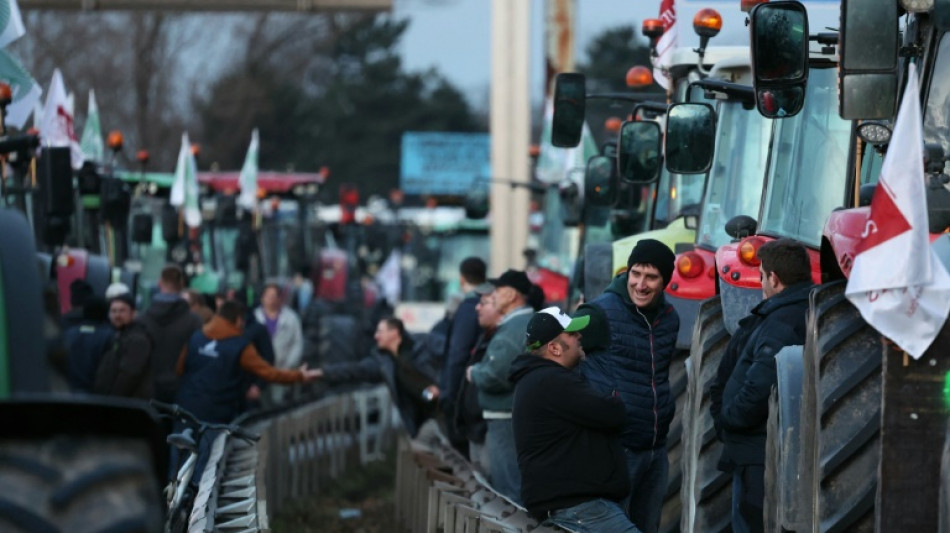
France's government scrambled on Thursday to come up with answers to farmers blocking motorways and demonstrating at public buildings across the country, after a fuel tax rise detonated long-standing resentments.
It is a first crisis for recently-installed Prime Minister Gabriel Attal, who summoned his economy, environment and agriculture chiefs for a meeting to decide on aid measures and fend off a possible blockade of the capital.
With Paris under pressure to defuse tensions just months ahead of key European Parliament polls, government sources told AFP that initial responses to rural unions' demands could be announced Thursday or Friday.
Farmers were out in force on many motorways, city ring roads and traffic roundabouts nationwide following the death Tuesday of a farmer and her daughter at a roadblock.
"We're caught in a pincer effect between rising costs and falling prices for our produce," said Dominique Kretz, a wheat, corn and beetroot farmer among several hundred blocking the M35 motorway near eastern city Strasbourg.
Some routes were blocked around southern city Avignon and towards Mediterranean port Marseille, according to traffic information website Bison Fute.
And in western city Bordeaux, around 15 tractors launched a go-slow in both directions around the ring road.
- 'Big risk' -
Farmers say they are being squeezed from multiple directions, with buyers from supermarkets and the food industry crushing their margins and complex environmental rules on issues like leaving land fallow and pesticide use.
The last straw for many was the government's move to eliminate a tax break on diesel fuel for their farm equipment -- despite an attempt to soften the blow by phasing it out between now and 2030.
A new rebate on the diesel tax could be one of the government's measures, while some lawmakers have even called for minimum prices for produce.
For the government, "it would be a big risk to wait until Friday to announce something," warned Karine Duc, co-president of the Coordination Rurale union in the western Lot-et-Garonne department.
Top farmers' union FNSEA called late Wednesday for "immediate answers on pay", including urgent assistance for "sectors worst hit by the crisis" -- and in the long term, launching "a project to reduce regulations".
"We are talking about several hundred million euros," FNSEA chief Arnaud Rousseau told AFP.
The protests have made for a rare alliance between rival farmers' unions, with left-wing Confederation Paysanne joining the heavyweight FNSEA and Coordination Rurale.
- 'No plans' to blockade Paris -
President Emmanuel Macron's government is at pains to avoid a repeat of the 2018-19 "yellow vests" protests -- also triggered by a rise in diesel prices -- that saw massive mobilisation and clashes with police.
Ministers have also eyed nervously previous mass turnouts on similar issues by farmers in Germany, Poland and the Netherlands.
In Brittany's capital Rennes, fishermen could join the farmers at a demonstration outside the region's prefecture in a sign of bubbling frustration in other sectors boiling over.
Much of fishing has been banned for a month along much of France's Atlantic coast in a measure to protect dolphins and porpoises, at an estimated cost of tens of millions of euros to the 450 ships affected.
In a sign the government hopes to keep tensions low, Interior Minister Gerald Darmanin on Wednesday ordered local authorities to exercise "great restraint" and deploy police only as a "last resort".
Union representatives in Bordeaux said Thursday their protest would be "more respectful" than Wednesday's in nearby Agen, in which tyres and straw were burned outside the prefecture.
Speaking at a blockade on the A16 motorway, FNSEA head Rousseau said "at this stage" there were no plans to blockade Paris.
Farmers driving tractors ran another go-slow operation early Thursday on the N12, a major road running west of the capital.
burs-ys/tgb/as/lth
W.Smets--LCdB