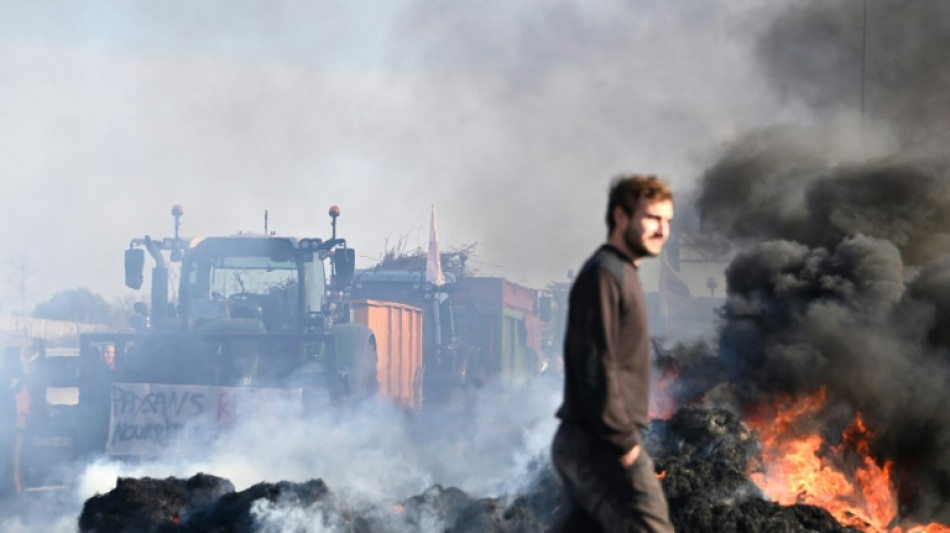
Farmers vow to besiege Paris to win govt concessions / Photo: Sylvain THOMAS - AFP
France's top farmers' union on Friday announced plans to blockade major roads around Paris, upping the pressure on the government to respond to their demands on pay, tax and regulations.
Facing his first major crisis, Prime Minister Gabriel Attal was expected to offer concessions on Friday as ministers scramble to keep discontent from spreading months ahead of European Parliament elections.
The encirclement of the capital follows days of disruption on motorways as well as tractor convoys through major cities and protests in front of government buildings.
Five toll stations on major road arteries into Paris would be blocked from 2:00 pm (1300 GMT), farmers' union FNSEA told AFP, including on the A6 and A13 motorways.
The A1 motorway heading north from Paris was already blocked on Friday morning by tractors and hay bales, causing big jams.
"We're expecting answers from the prime minister today and if we don't get them the movement will continue," said Jeremy Allard, a farming union member from northern France manning a blockade.
"Maybe we'll get some answers by bringing France to a halt this way," agreed Charles Demeyer, an endive grower also from the north.
In the south, around 400 kilometres (250 miles) of motorway were shut between the Lyon region and the Spanish border.
- 'Weighing us down' -
Attal gathered his economy, environment and agriculture ministers on Thursday, as the farmers' movement reached new heights with major protests and blockades.
The rallies mobilised around 55,000 people, according to the FNSEA.
The government has trailed "concrete proposals for simplification measures" to be announced on Friday when Attal visits the Haute-Garonne department in southwest France, scene of the first motorway roadblocks.
As well as Attal's proposals, ministers will on Friday receive an update on food purchasing talks between supermarkets and their suppliers -- designed to offer revenue relief to farmers.
Farmers have fumed at what they say is a squeeze on purchase prices for produce by supermarket and industrial buyers, as well as complex environmental regulations.
But the last straw for many was the phasing out of a tax break on diesel for farm equipment.
The agricultural fuel tax "is a real priority, a crucial cost reduction," said Thierry Cazemajou, who grows corn and green beans for a major canned-vegetables brand.
"It's weighing us down," he said.
Others have called for binding minimum prices for their farm produce, speedier aid payouts or a pause on restrictions on pesticide use.
Some of the FNSEA's 140 demands could only be met with new legislation or tricky negotiations at the European Union level.
Demonstrators have also thrown a spotlight on resented free trade agreements between the European Union and food exporters, especially a deal with South American bloc Mercosur that is still in the works.
Farmers charge that their non-EU competitors abroad do not have to meet the same standards on issues such as pesticide use.
- Police holding back -
The authorities have so far held back from intervening by force against road blockades and other forms of protest, including defacement or break-ins at government buildings and food industry sites such as supermarkets and warehouses.
"There's no cause that can justify property damage or violence... (but) at present there are unfortunately farmers who feel desperate," Young Farmers (JA) union chief Arnaud Gaillot told broadcaster Sud Radio.
"The situation mustn't be allowed to turn sour. The government can't send a message that it doesn't care or isn't living up to its responsibilities," he added.
President Emmanuel Macron's government still bears the scars of the 2018-19 "yellow vests" movement, which mobilised huge numbers of people across French society and saw ugly clashes between demonstrators and police.
C.Maes--LCdB