Farmers in France, Belgium, step up their protest campaigns / Photo: JULIEN DE ROSA - AFP
French Prime Minister Gabriel Attal promised to do more to meet the demands of angry farmers, as the government mobilised 15,000 police and gendarmes to handle a threatened "siege" of Paris from Monday.
Farm workers in neighbouring Belgium, meanwhile, stepped up their own campaign of direct action, using tractors to block a key motorway junction.
France's two main farming unions, the FNSEA and the Jeunes Agricultueurs (Young Farmers) announced late on Saturday that their members would "start a siege of the capital for an undetermined period".
Attal, during a visit to a farm in the west of the country on Sunday, tried once again to calm the growing anger of the country's farmers, after a first round of concessions announced on Friday failed to defuse the crisis.
"I want us to clarify things and see what extra measures we can take" to meet farmers' complaints that they face unfair competition, he said.
Attal agreed it was not right that French farmers were forbidden from using certain products that neighbouring countries, such as Italy, still had the right to use. One complaint by farmers is that the country's tight environmental rules prevent them from using products still legal elsewhere.
Farmers are also angry about falling wages, low pensions and the mountains of red tape they have to deal with.
Acknowledging that his first package of concessions had not met all of their demands, Attal said: "I am determined to move forward, move forward resolutely, move forward quickly."
- 'Change the software' -
FNSEA leader Arnaud Rousseau has made it clear his members expected much more from the government.
"What we need are decisions that we think are going to change the software," he told farmers as he visited a group blocking the A16 motorway north of Paris.
Although some roadblocks were lifted over the weekend, many roads across France were still barred on Sunday.
Interior Minister Gerald Darmanin, announcing the massive mobilisation to meet the farmers protests around Paris, said French President Emmanuel Macron wanted both Roissy-Charles de Gaulle airport to the north and Orly to the south of the capital kept open.
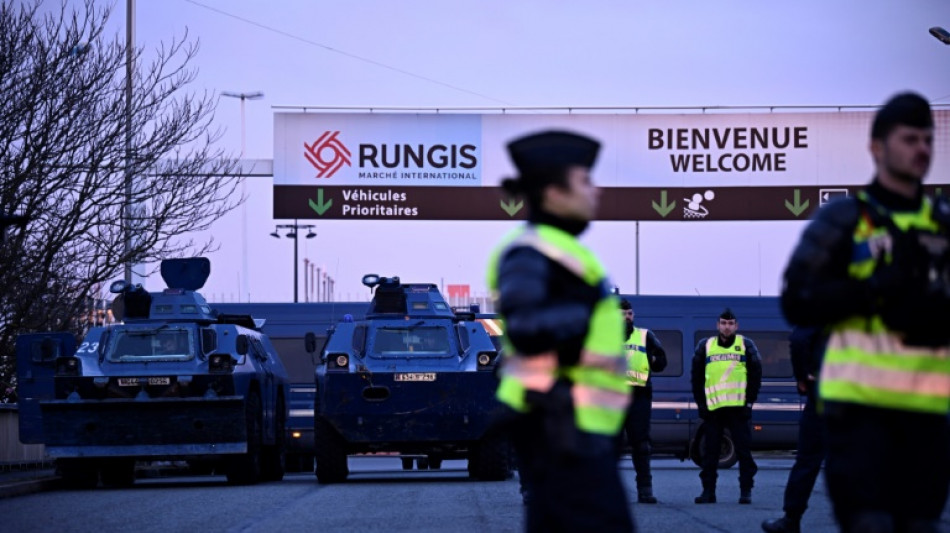
France's paramilitary gendarmes have already deployed armoured vehicles outside the Rungis international wholesale food market south of Paris to prevent any incursions there.
Police and gendarmes are also under orders to prevent any incursion into Paris itself, said Darmanin.
He repeated a call for police and gendarmes to act with "moderation", saying they should not move in on road blocks except to make them safe.
Further south, officials in the city of Lyon said they were expecting farmers to stage go-slow protests and motorway roadblocks.
- Belgian farmers mobilise -
In neighbouring Belgium, farmers on Sunday blocked a major motorway as part of their campaign of direct action for better conditions.
Dozens of tractors drove at a crawl through a key interchange, halting traffic on the E42 motorway just north of Namur in the south of the country.
Farmers protesting outside a football stadium, delayed a Belgian top flight match between FC Genk and Sint-Truiden by 30 minutes.
The grievances of the Belgian farmers are similar to those of their French colleagues.
"We are calling for a common agricultural policy that takes into account the reality on the ground," d'Hulst told AFP.
In recent weeks, farmers protests have also mushroomed in Germany, Poland, Romania, and the Netherlands, as the EU scrambles to address concerns ahead of elections this year amid a rise in far-right support.
C.Maes--LCdB