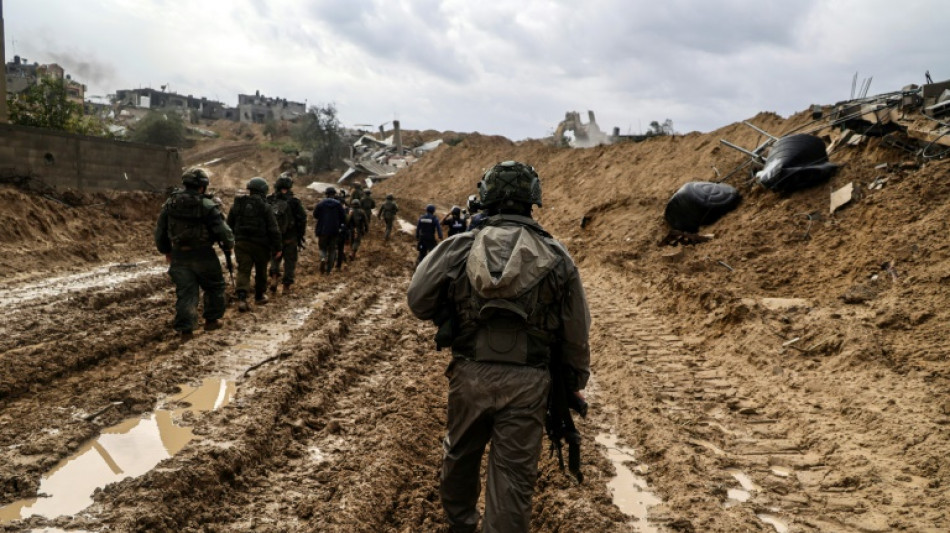
Fierce battles in Gaza as row flares over UN aid agency / Photo: Nicolas GARCIA - AFP
Deadly fighting again rocked Gaza on Monday as a bitter row flared around the UN aid agency for Palestinians over Israeli claims that some of its staff joined the October 7 attack.
Fears also grew of a widening regional conflict after Washington vowed a "very consequential" response to an attack that killed three US troops in Jordan on Monday.
The United States, Israel's top ally, blamed militants backed by their common arch enemy Iran, but also stressed that "we don't seek a war with Iran" or "a wider conflict in the Middle East".
Israeli bombing of the Gaza Strip killed 215 more people within 24 hours, including 20 members of one family, said the health ministry in the Hamas-run Palestinian territory.
The Israeli army said its troops had "encountered and killed dozens of armed terrorists in battles in central Gaza".
Ground forces backed by tanks have focused their combat operations on the main southern city of Khan Yunis, the hometown of Hamas's Gaza leader Yahya Sinwar.
An AFP journalist on a recent army-organised tour of the city witnessed tanks churning through mud amid shattered buildings, and was taken into a tunnel the army said was built by Hamas.
Rocket sirens blared in Tel Aviv for the first time in weeks. Hamas's armed wing said it had fired at the coastal city in response to "massacres against civilians" in Gaza.
- 'We would die of hunger' -
The war was sparked by the Hamas attack which resulted in about 1,140 deaths, mostly civilians, in southern Israel, according to an AFP tally of official figures.
Militants of Hamas, considered a "terrorist" group by the United States and European Union, also seized 250 hostages, of whom Israel says around 132 remain in Gaza, including the bodies of at least 28 dead captives.
Israel's relentless military offensive has killed at least 26,637 people in Gaza, most of them women and children, according to the territory's health ministry.
Millions have been displaced in Gaza and relied on scarce aid amid an Israeli siege, but there were fears of further shortages amid the intensifying rift between Israel and the UN agency.
Foreign Minister Israel Katz cancelled a meeting with UNRWA head Philippe Lazzarini scheduled for later in the week.
"Lazzarini should draw conclusions and resign," Katz wrote on X, formerly Twitter. "Supporters of terrorism are not welcome here."
UN chief Antonio Guterres has pleaded for continued financial support, saying "the dire needs of the desperate populations they serve must be met".
In the southern city of Rafah, where 1.5 million displaced people have taken refuge, Gazans told AFP that the UN support amounted to a lifeline.
"We live on aid from UNRWA," said Sabah Musabih, 50. "If it stopped, we would die of hunger."
At a school-turned-shelter in Gaza's central Maghazi refugee camp, a woman touched the sandy earth where her daughter had been buried.
She told AFP that rockets hit the school compound and ignited gas canisters, causing deadly explosions, and said that "my daughter died in my arms".
- 'Constructive' talks -
In the latest efforts to broker a new truce and hostage release deal, CIA chief William Burns met top Israeli, Egyptian and Qatari officials in Paris on Sunday.
Israeli Prime Minister Benjamin Netanyahu's office said the talks were "constructive" but pointed to "significant gaps which the parties will continue to discuss this week".
US National Security Council spokesman John Kirby, speaking to CNN on Monday, also labelled the talks constructive but said that "there's a lot of work that has to be done".
Amid the war, Israel as well as the United States have faced attacks from, and struck back at, multiple Iran-backed armed groups with violence flaring in Lebanon, Iraq, Syria and Yemen.
Lebanon's Hezbollah and Israel have traded near daily cross-border fire, and Yemen's Huthi rebels have launched attacks on Red Sea shipping, sparking US and British strikes on their bases.
On Sunday, a drone attack on a remote base in Jordan, near the borders with Iraq and Syria, killed three US troops and wounded dozens of others.
There was no claim of responsibility, although the Islamic Resistance in Iraq -- a loose alliance of Iran-linked groups -- claimed to have launched three drone attacks at bases in Syria, including near the Jordanian border.
Hamas called the Jordan attack "a message to the American administration" and warned that "the American-Zionist aggression on Gaza risks a regional explosion".
Both US and Iranian officials said they did not want to conflict to expand.
Israel meanwhile launched strikes in Syria on a base belonging to Hezbollah and Iran's Revolutionary Guards that killed seven people, said the Syrian Observatory for Human Rights.
burs-jd-fz/ami
N.Lambert--LCdB