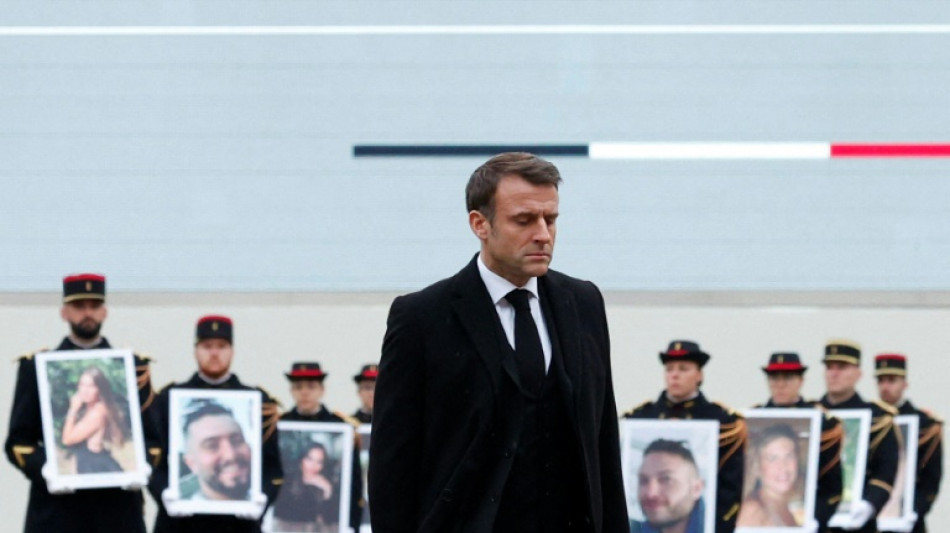
Macron remembers French victims of Hamas's 'anti-Semitic massacre' / Photo: GONZALO FUENTES - POOL/AFP
President Emmanuel Macron on Wednesday described the October 7 attack by Hamas on Israel as the "biggest anti-Semitic massacre of our century" as he hosted a ceremony paying tribute to the French victims.
Images of those killed or taken hostage by Hamas were held up by members of Macron's guard as their families looked on, in the only such state event held outside Israel so far to mark the attack.
Macron described the attack by the Palestinian militant group as "barbarism... which is fed by anti-Semitism and propagates it", vowing not to give in to "rampant and uninhibited anti-Semitism".
The ceremony at the Invalides memorial complex in Paris paid tribute to the 42 French citizens killed in the attack on Israel by Hamas and the three others still missing, believed to be held hostage.
It was the biggest single loss of life of French nationals since the July 14, 2016, truck attack by an Islamist radical in the southern city of Nice that left 86 people dead.
- 'Empty chairs' -
"It was 6:00 am and Hamas launched... the massive and odious attack that was the biggest anti-Semitic massacre of our century," Macron said.
He said an Israeli music festival that people had been attending had been marked by the "drums of hell" and the mobile phones of its participants became the "black boxes of horror".
Macron said France would work "every day" for the release of the remaining French hostages. "Their empty chairs are there," he said at the ceremony.
"Nothing can justify or excuse terrorism," he said.
The presidency also said this week that France would provide an opportunity to remember French citizens killed in the Israeli bombardments of Gaza that followed the attack by the Palestinian militant group, without giving a date.
"All lives are equal, are invaluable in the eyes of France," Macron said, describing war as a "tornado of suffering".
There is no official information on the numbers of French nationals killed inside Gaza.
Macron also vowed that France would "never allow the spirit of revenge to prosper" and that "in these challenges nothing should divide us".
A violinist played French composer Maurice Ravel's instrumental version of the Jewish Kaddish prayer as the victims' names flashed up on a screen.
- 'Aspirations of peace' -
France, which also has a large Muslim minority, has the largest Jewish community in Europe with 500,000 people, according to the European Jewish Congress, and almost 100,000 citizens in Israel, many of whom also have Israeli nationality.
He said that France would do everything to "respond to the aspirations of peace and security for everyone in the Middle East".
The bloodiest-ever Gaza war started with Hamas's unprecedented attack on Israel on October 7, which resulted in the deaths of about 1,160 people, mostly civilians, according to an AFP tally based on official Israeli figures.
Militants also seized around 250 hostages. Israel says 132 remain in Gaza, of whom 29 are believed to have died.
Israel vowed to eliminate Hamas and launched air strikes and a ground offensive that have killed at least 27,585 people, mostly women and children, in the besieged territory, according to the Gaza health ministry.
Macron met privately after the ceremony with families of the victims, some of whom had arrived from Israel on a special flight.
There has been controversy over the ceremony, with many families of French victims saying they did not want to see figures from the hard-left France Unbowed (LFI) party in attendance, accusing it of failing to sufficiently denounce the attack and to declare Hamas a terror group.
Far-right leaders Marine Le Pen and Jordan Bardella, who rushed to emphasise solidarity with Israel in the wake of the attack, were also present.
R.Lacroix--LCdB