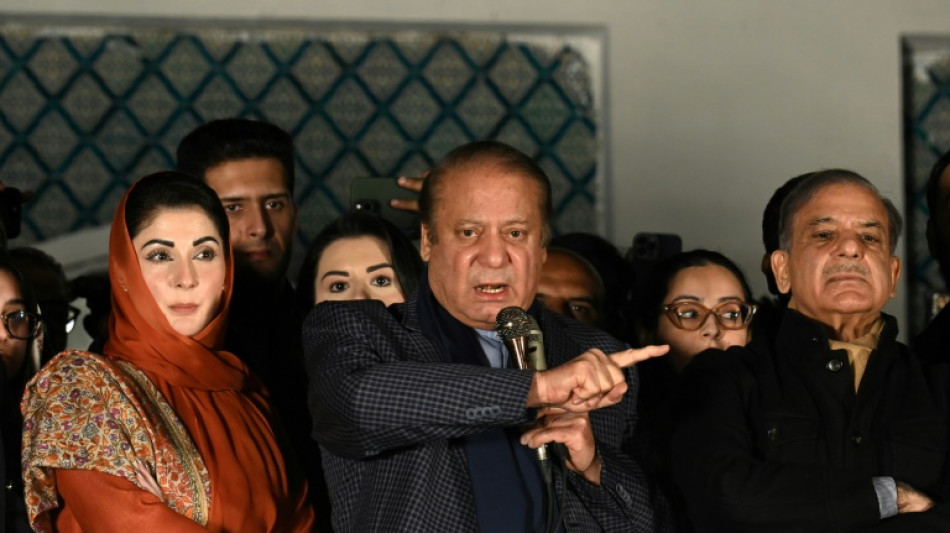
Two killed in Pakistan election protest as Khan allies lead in vote count / Photo: Aamir QURESHI - AFP
Candidates loyal to jailed former prime minister Imran Khan were ahead in Pakistan's election Friday, in front of the two dynastic parties believed favoured by the military, as the vote count entered its final leg.
Khan's Pakistan Tehreek-e-Insaf (PTI) was faring better than expected despite a crackdown targeting the party, but the next government was still likely to be formed by the Pakistan Muslim League-Nawaz (PML-N) after a spell of horse trading with other parties and independents.
"We don't have enough of a majority to run the government ourselves, therefore we invite the other parties and candidates who have been successful to work with us," PML-N founder and three-time former prime minister Nawaz Sharif said at his party headquarters in Lahore.
Latest results in a slow counting process showed independents -- most of them Khan loyalists -- had so far won around 92 of the 225 seats called for the 266-member national assembly.
PML-N had won 63 and the Pakistan Peoples Party (PPP) 50 as the count continued. The remainder of the seats decided went to minor parties.
Most of the seats won by Khan loyalists were in Khyber Pakhtunkhwa, where on Friday police said at least two PTI supporters were killed and more than 20 injured when they rioted in Shangla district -- the first serious post-election violence reported since Thursday's vote.
"Due to the intense stone-pelting by PTI workers, two protesters were hit by stones and lost their lives," local police official Sahibzada Sajjad Ahmed told AFP.
- 'Results have been changed' -
There were also protests against allegedly rigged results in Peshawar, capital of Khyber Pakhtunkhwa, and Quetta in Balochistan province.
"Our results have been changed," claimed 28-year-old shopkeeper Muhammad Saleem, who joined around 2,000 PTI supporters marching in Peshawar.
"The government should recount all of our votes."
Khan was barred from contesting the election and his party subject to a sweeping crackdown -- blocked from holding rallies and taken off the ballot, forcing candidates to run as independents.
Candidates who run as independents cannot form a government on their own, but can nominate affiliation to any party within 72 hours of victory -- a practice that frequently leads to horse-trading and deal-making in Pakistan politics, and which could dilute PTI's success.
A nationwide election day mobile telephone blackout and slow result counting led to suspicions the military-led establishment could be rigging the process to ensure success for Nawaz.
"But even if PTI is unable to form a government, the elections show there are limits to political engineering," said Bilal Gilani, executive director of polling group Gallup Pakistan.
"It shows that the military does not always get their way -- that is the silver lining," he told AFP.
- Slow process -
Sharif's PML-N had been expected to win the most seats following Thursday's vote, with analysts saying its 74-year-old founder had the blessing of the military-led establishment.
The PPP, whose popularity is largely limited to its Sindh heartland, also did better than expected, with leader Bilawal Bhutto Zardari saying early results were "very encouraging".
The PML-N and PPP joined forces with minor parties to boot Khan from office in April 2022 after his PTI had won a slender majority in the 2018 election.
The former international cricketer then waged an unprecedented campaign of defiance against the military-led establishment, which originally backed his rise to power.
Khan was convicted last week of treason, graft and having an un-Islamic marriage in three separate trials -- among nearly 200 cases brought against him since being ousted.
Allegations of poll rigging, as well as authorities' hours-long shutdown of Pakistan's mobile phone network, overshadowed election day itself.
Caretaker Interior Minister Gohar Ejaz defended the "difficult decision" to suspend mobile phone services on security grounds.
"We were fully aware that suspension of mobile services would impact the transmission of election results across Pakistan and delay the process, however, the choice between this delay and safety of our citizens was quite straightforward," he said in a statement on Friday.
Digital rights activist Usama Khilji said the mobile service blackout "strengthens the popular perception that the elections are rigged by the deep state".
Mohammad Zubair, a 19-year-old street hawker in Lahore, said PTI supporters would not accept a PML-N victory.
"Everyone knows how many seats Khan's independent candidates have won," he said. "They don't have a symbol, or a captain, or a flag, or banners, but still we have won on the field."
At least 16 people were killed -- including 10 security force members -- and 54 wounded.
N.Moens--LCdB