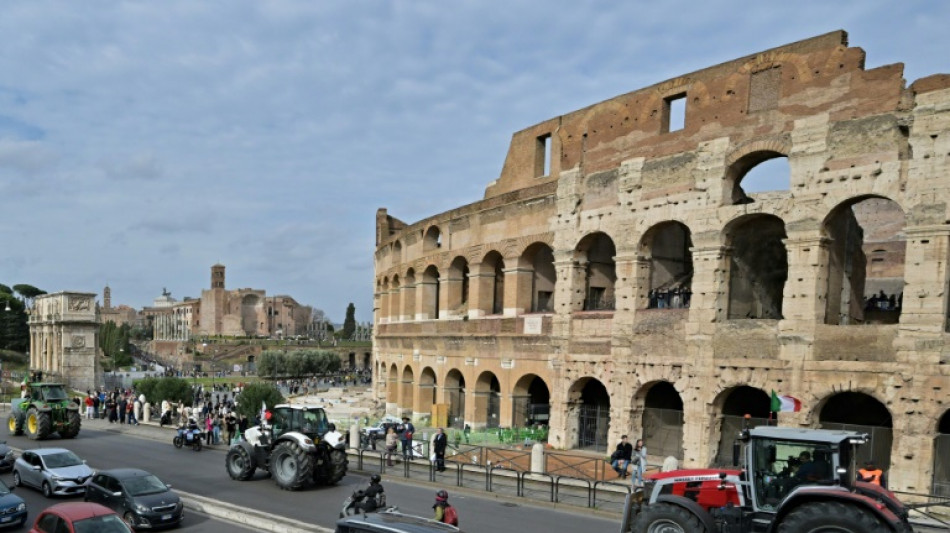
Meloni restores tax breaks after farmer protests reach Colosseum / Photo: Andreas SOLARO - AFP
Prime Minister Giorgia Meloni met with Italian farmers associations Friday after weeks of demonstrations across the country and promised to reinstate a limited tax break.
Farmers have been staging small protests from Sicily to Turin, demanding action on a range of issues.
Their grievances range from the cost of fuel to European Union environmental regulations designed to mitigate climate change but which they say are damaging their livelihoods.
Earlier Friday, the protests reached the centre of Rome, with tractors -- including one green, one white and one red, Italy's national colours -- taking a symbolic drive past the Colosseum.
Meloni who in October 2022 took office at the head of a nationalist government, has expressed sympathy with the farmers, criticising the EU's "ideological" rules.
She says her government has already acted to support the industry, diverting an extra three billion euros ($3.2 billion) -- to a total of eight billion -- from Italy's share of the EU's post-Covid recovery fund.
At Friday's roundtable with ministers and agricultural groups, including representatives of the protesters, she agreed to extend an income tax exemption for farmers in force since 2017.
But the extension will only be for those on low incomes.
- 'Serious difficulty' -
The government had initially planned to suspend the exemption all together. Meloni told the meeting this was because it was "unfair, and especially favoured large companies".
This limited version of the exemption would help "the most vulnerable", said a government source.
The tractors in Rome Friday were part of a group of more than 300 that have been parked on the northern outskirts of the capital for several days, awaiting permission to enter the city.
"EU policies are putting us in serious difficulty," Elia Fornai, a 26-year-old farmer from Tuscany, told AFP at the camp, where visiting journalists were treated to barbecues of local produce.
"We have no taste for protesting. We want to go home as soon as possible -- but with new programmes for a better future for agriculture."
The Italian farmers are not a homogenous group. They have no one clear leader.
But many complain about imports of food from outside the EU that are not subject to the same regulations, and want tax cuts, including on fuel.
The EU has pledged to be carbon neutral by 2050. Getting there implies massive adaptation by consumers and industry -- including agriculture, which emits 11 percent of the bloc's global warming emissions.
Y.Bernard--LCdB