CMSC
0.0800
Pakistan faces days of political horse-trading after the final few election results released early Saturday showed no clear majority, but a strong performance by independent candidates loyal to jailed former prime minister Imran Khan.
Khan's Pakistan Tehreek-e-Insaf (PTI) defied a months-long crackdown that crippled campaigning and forced their candidates to run as independents with a combined showing in Thursday's election that still challenged their chief rivals.
But after long delays in results that prompted further allegations that the military establishment had engaged in vote-rigging, the army-backed Pakistan Muslim League-Nawaz (PML-N) declared victory as the party with the largest number of seats.
However, to form a government, the party founded by three-time former prime minister Nawaz Sharif will be forced to cut deals with rivals and independents.
There were reports late Friday of leaders from other parties arriving in PML-N's power base of Lahore for talks.
"We don't have enough of a majority to run the government ourselves, therefore we invite the other parties and candidates who have been successful to work with us," Sharif said at his party headquarters in Lahore.
A slow counting process showed independents had won at least 98 seats -- 87 of them loyal to Khan -- by early Saturday.
PML-N had won 69 and the Pakistan Peoples Party (PPP) snapped up 51, with the final 20 or so seats of the elected 266-seat National Assembly still to be announced.
Further unelected seats will be allotted to religious minorities and female candidates at a later date.
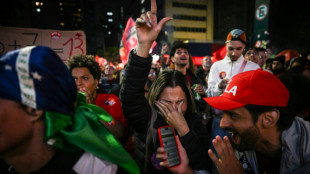
Most of the seats won by Khan loyalists were in Khyber Pakhtunkhwa, where police said at least two PTI supporters were killed Friday and more than 20 wounded when they protested in Shangla district -- the first serious post-election violence reported.
There were also protests against allegedly rigged results in Peshawar, capital of Khyber Pakhtunkhwa, and Quetta in Balochistan province.
"Our results have been changed," claimed 28-year-old shopkeeper Muhammad Saleem, who joined around 2,000 PTI supporters marching in Peshawar.
"The government should recount all of our votes."
- 'Silver lining' -
Sharif's PML-N had been expected to win the most seats, with analysts saying its 74-year-old founder had the blessing of the military-led establishment.
Khan was barred from contesting the election after being handed several lengthy prison sentences in the days leading up to the vote.
A nationwide election day mobile telephone blackout and slow result counting led to suspicions the military-led establishment was influencing the process to ensure Sharif's success.
Candidates who run as independents cannot form a government on their own, but can nominate affiliation to elected parties within 72 hours of victory.
The practice frequently leads to deal-making in Pakistan politics, which could dilute PTI's success.
"PTI as a party and political group, despite significant efforts by the civilian and military establishment, has held on to its vote bank," said Bilal Gilani, executive director of polling group Gallup Pakistan.
"It shows that the military does not always get their way -- that is the silver lining," he told AFP.
The PPP, whose popularity is largely limited to its Sindh heartland, also did better than expected, with leader Bilawal Bhutto Zardari saying early results were "very encouraging".
The PML-N and PPP joined forces with minor parties to boot Khan from office in April 2022 after his PTI had won a slender majority in the 2018 election.
The former international cricketer then waged an unprecedented campaign of defiance against the military-led establishment, which originally backed his rise to power.
Khan was convicted last week of treason, graft and having an un-Islamic marriage in three separate trials -- among nearly 200 cases brought against him since being ousted.
- UK, US concerns over vote -
Britain said it noted "serious concerns" over the vote process, while the United States said "claims of interference or fraud should be fully investigated".
Caretaker Interior Minister Gohar Ejaz defended the "difficult decision" to suspend mobile phone services on security grounds.
"We were fully aware that suspension of mobile services would impact the transmission of election results across Pakistan and delay the process, however, the choice between this delay and safety of our citizens was quite straightforward," he said in a statement on Friday.
Digital rights activist Usama Khilji said the mobile service blackout "strengthens the popular perception that the elections are rigged by the deep state".
Mohammad Zubair, a 19-year-old street hawker in Lahore, said PTI supporters would not accept a PML-N victory.
"Everyone knows how many seats Khan's independent candidates have won," he said. "They don't have a symbol, or a captain, or a flag, or banners, but still we have won on the field."
At least 16 people were killed -- including 10 security force members -- and 54 wounded.
D.Moerman--LCdB