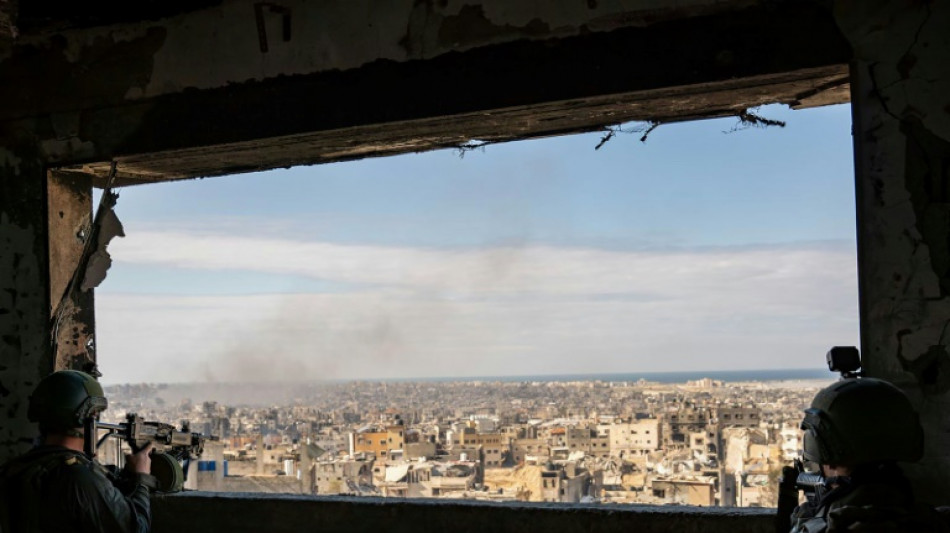
Israeli strikes on Gaza's Rafah escalate fears of ground operation / Photo: - - Israeli Army/AFP
Israeli air strikes pummelled densely crowded Rafah on Saturday after Prime Minister Benjamin Netanyahu ordered his troops to "prepare to operate" in the southern border city that has become a last refuge for displaced Palestinians.
Netanyahu's planned offensive on Rafah, where an estimated 1.3 million people have fled, has drawn condemnation from rights groups and Washington, while Palestinians have said they have nowhere left to retreat.
Witnesses reported new strikes on Rafah early Saturday, after the Israeli military intensified air raids, with fears rising among Palestinians of a coming ground invasion.
"We don't know where to go," said Mohammad al-Jarrah, a Palestinian who was displaced from further north to Rafah.
The city is the last major population centre in the Gaza Strip that Israeli troops have yet to enter and also the main point of entry for desperately needed relief supplies.
Netanyahu told military officials on Friday to "submit to the cabinet a combined plan for evacuating the population and destroying the battalions" of Hamas militants holed up in Rafah, his office said.
The US State Department said it does not support a ground offensive in Rafah, warning that, if not properly planned, such an operation risks "disaster".
The United States is Israel's main international backer, providing it with billions of dollars in military aid.
But in a sign of growing frustration, US President Joe Biden issued his strongest criticism of Israel yet, describing the retaliation for Hamas's October 7 attack as going too far.
"I'm of the view, as you know, that the conduct of the response in Gaza, in the Gaza Strip, has been over the top," the US president said.
"There are a lot of innocent people who are starving... in trouble and dying, and it's got to stop."
- 'Die in our homes' -
Displaced Palestinians have flooded into Rafah, where hundreds of thousands are sleeping in tents pushed up against the Egyptian border.
AFP images showed scenes of devastation, with people queuing for increasingly scarce water.
Rights groups have sounded alarm at the prospect of a ground incursion.
"Israel's declared ground offensive on Rafah would be catastrophic and must not proceed," Doctors Without Borders said in a statement. "There is no place that is safe in Gaza and no way for people to leave."
The Hamas-run territory's health ministry on Saturday said that at least 110 people were killed in overnight bombardment, including 25 in strikes in Rafah.
The previous day, the Palestinian Red Crescent said that three children were killed in a strike in Rafah.
"We heard the sound of a huge explosion next to our house... we found two children martyred in the street," said Jaber al-Bardini, 60.
"There is no safe place in Rafah. If they storm Rafah, we will die in our homes."
Israeli forces raided Al-Amal Hospital in Khan Yunis, southern Gaza's biggest city, on Friday after a weeks-long siege during which the Palestinian Red Crescent has reported "intense artillery shelling and heavy gunfire".
The medical organisation said Israeli forces had arrested eight of its team members at the hospital, including "four doctors, as well as four wounded individuals and five patients' companions".
UN chief Antonio Guterres has said any Israeli push into Rafah "would exponentially increase what is already a humanitarian nightmare".
But Netanyahu's office said it would be "impossible" to achieve the war's objective of eliminating Hamas while leaving four of the militants' battalions in Rafah.
Hamas's unprecedented October 7 attack resulted in the deaths of about 1,160 people in Israel, mostly civilians, according to an AFP tally based on official Israeli figures.
In response, Israel vowed to eradicate Hamas and launched air strikes and a ground offensive that have killed at least 27,947 people, mostly women and children, according to the health ministry in the Hamas-run territory.
Militants seized 250 hostages, 132 of whom are still in Gaza, but 29 are presumed dead, Israel has said.
- Ceasefire talks -
State Department deputy spokesman Vedant Patel said an Israeli ground operation in Rafah was "not something we'd support".
"To conduct such an operation right now with no planning and little thought... would be a disaster," Patel warned.
US Secretary of State Antony Blinken had conveyed Washington's concerns to Netanyahu directly during talks this week in Jerusalem, he added.
On the ceasefire talks, Blinken said he still saw "space for agreement to be reached" to halt the fighting and bring home Israeli hostages, even after Netanyahu rejected what he labelled Hamas's "bizarre demands".
Hamas negotiators left Cairo on Friday after what a Hamas source described as "positive and good discussions" with Egyptian and Qatari mediators.
"The delegation left Cairo tonight (Friday) and is awaiting Israel's response," a Hamas official told AFP on condition of anonymity as he was not authorised to speak on the issue.
- Far-reaching impact -
The impact of the war has been felt widely, with violence involving Iran-backed allies of Hamas surging across the Middle East and drawing in US forces among others.
Iran-backed Lebanese militant group Hezbollah said Friday it had fired dozens of rockets at an army position in the Israeli-occupied Golan Heights, hours after launching a salvo at northern Israel.
Due to the ongoing war and risk of wider consequences, the US ratings agency Moody's downgraded Israel's credit rating on Friday, and also lowered its outlook for Israel's debt to "negative" due to "the risk of an escalation" with Hezbollah.
Israel's former finance minister turned opposition MP Avigdor Lieberman attributed the downgrading to the Netanyahu government's "populist" measures.
"The government of destruction continues to degenerate us into an economic disaster just as it brought us into a security disaster," he wrote on social media platofrm X.
burs-kir/lb/cwl
F.Cornelis--LCdB