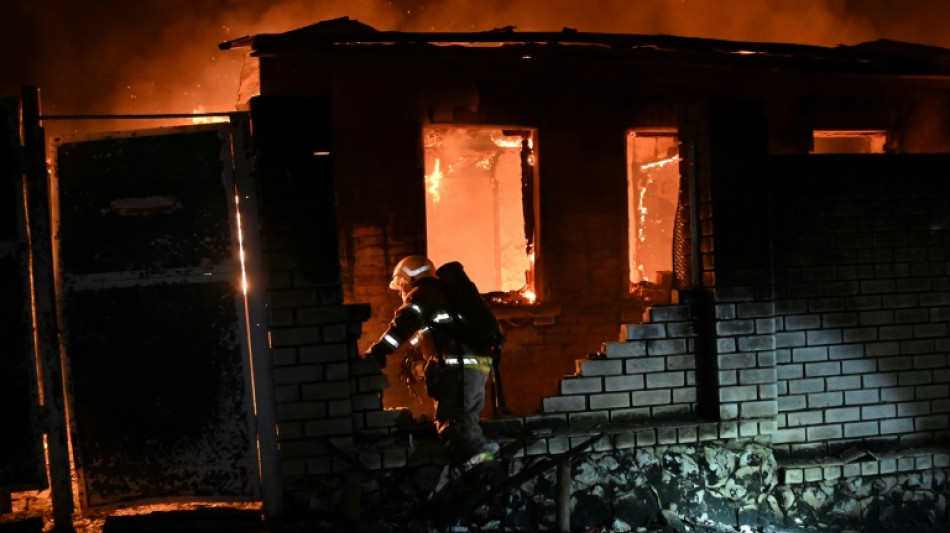
Russian attack on Ukraine's Kharkiv sparks 'river of fire', kills 7 / Photo: SERGEY BOBOK - AFP
An overnight Russian drone attack on a petrol station in Ukraine's second city Kharkiv killed seven people, including three children, local authorities said Saturday.
Fuel from the petrol station quickly spread through the neighbouring street, burning some residents alive and injuring others.
"In five minutes we had a river of fire. We had to run away from home, just run away," said Oleskandr Lagutin, who was injured in the attack.
Local authorities said the fire killed a couple and a family of five.
"My mother-in-law called and said it was burning," said Natalia, a relative of the deceased couple.
"She called back and started screaming that it had spread to the house. We heard the last screams and that was it, she didn't get in touch anymore," she said.
The Kharkiv regional governor Oleg Synegubov said the family included the parents and their seven-year-old, four-year-old and seven-month-old boys.
The woman and boys had sought shelter in the bathroom while the man's body was found in a passage of the house, he said.
- 'Russian madness' -
"These children had not yet seen life, but were killed as a result of Russian madness," Ukrainian President Volodymyr Zelensky said.
He sent his condolences to all the victims of the attack.
"Our anger is absolute. These people will pay," presidential aide Andriy Yermak added.
The head of the investigation of the Kharkiv police, Sergiy Bolvinov, said the victims were all "burned alive".
About 3,800 tons of fuel were stored in the oil depot that was hit, Bolvinov said.
"The whole street turned into a hellish molten mass... the fuel mixed with the snow and started to burn, houses along the street started to catch fire," Bolvinov explained.
At least 50 people were evacuated, local authorities said.
This is the latest in a series of deadly attacks on Kharkiv, a northeastern city taken back from Russian forces in autumn 2022.
The UN human rights mission in Ukraine recorded 17 civilians killed and 168 injured in the city -- a number excluding recent casualties.
Overall, Russia launched 31 drones mainly on the eastern Kharkiv and the southern Odesa regions, of which 23 were destroyed.
Four people were wounded in Odesa, the head of the region's military administration Oleg Kiper said on Telegram.
- 'Close to criminal neglect' -
Ukraine has been facing regular overnight aerial attacks, pushing renewed calls for support.
NATO meanwhile called on Europe to increase its arms production to support Ukraine and prevent "potentially decades of confrontation" with Moscow, ahead of a key meeting of defence ministers in Brussels and the war's second anniversary.
The alliance's secretary general Jens Stoltenberg insisted that "we need to reconstitute and expand our industrial base faster, to increase deliveries to Ukraine and refill our own stocks."
"This means shifting from slow peacetime to high-tempo conflict production," he told the German newspaper Welt am Sonntag.
Western leaders have also called for greater assistance. Germany's Chancellor Olaf Scholz and President Joe Biden urged US lawmakers Friday to approve a long-delayed military aid package for Ukraine, warning that Kyiv could not hold off Russia's invasion without it.
NATO defence ministers will meet in Brussels on Thursday, one week ahead of the second anniversary of Russia's offensive in Ukraine. A meeting of the Ukraine Defense Contact Group will be a key feature of the talks.
F.Cornelis--LCdB