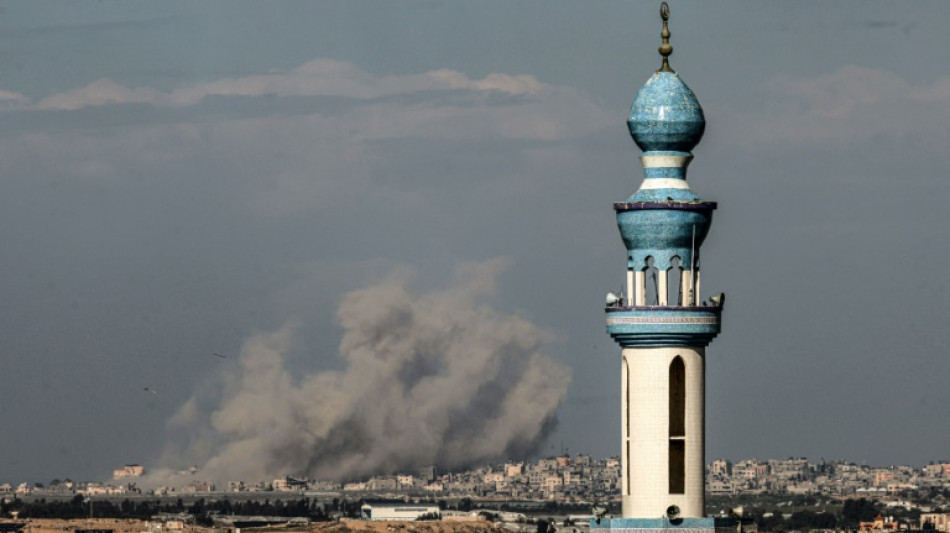
Hamas warns Israel Rafah push may cause casualties in 'tens of thousands' / Photo: SAID KHATIB - AFP
Gaza's Hamas rulers warned on Saturday that Israel's planned army operation in overcrowded Rafah could cause "tens of thousands" of casualties in the city that has become the last refuge for displaced Palestinians.
Israeli Prime Minister Benjamin Netanyahu has ordered the army to set its sights on Rafah, telling military and security officials late Friday to "submit to the cabinet a combined plan for evacuating the population and destroying the battalions" of Hamas in the southern city.
Hamas said in a statement that any military action would have catastrophic repercussion that "may lead to tens of thousands of martyrs and injured if Rafah... is invaded".
Netanyahu's announcement, coming only hours after US President Joe Biden had issued his strongest criticism of Israel's response to the October 7 attack, sparked concern among world leaders and the United Nations.
"The Israeli occupation's move threatens security and peace in the region and the world. This is a blatant violation of all red lines," said the office of Palestinian president Mahmud Abbas.
Jordan's Foreign Minister Ayman Safadi warned "another bloodbath in Gaza cannot be allowed", in a post on X, formerly Twitter.
"An Israeli attack on 1.5 million Palestinians already facing inhumane conditions in Rafah will cause a massacre of innocent people," he wrote, urging the "whole world" to prevent it.
Spain and Germany joined Saudi Arabia in warning of a "humanitarian catastrophe" if the plan went ahead.
"We call for a ceasefire, the release of hostages, respect for international humanitarian law and the entry of aid," Spanish Foreign Minister Jose Manuel Albares posted on X.
The war in Gaza was sparked by Palestinian Islamist group Hamas's unprecedented October 7 attack on Israel, which resulted in the deaths of about 1,160 people, mostly civilians, according to an AFP tally based on official figures.
Vowing to eliminate Hamas, Israel launched a massive military offensive in Gaza that the territory's health ministry says has killed at least 28,064 people, mostly women and children.
Militants seized 250 hostages, 132 of whom are still in Gaza although 29 are presumed dead, Israel has said.
- Biden frustration -
The United States is Israel's main international backer, providing it with billions of dollars in military aid.
The US State Department has said it does not support a ground offensive in Rafah, warning that, if not properly planned, such an operation risks "disaster".
In a sign of growing frustration, Biden issued his strongest criticism of Israel yet on Thursday, describing the retaliation for Hamas's October 7 attack as "over the top".
Biden said there are "a lot of innocent people who are starving... in trouble and dying, and it's got to stop."
But Netanyahu's office said it would be "impossible" to achieve the war's objective of eliminating Hamas while leaving four of its battalions in Rafah.
The Israeli leader, whose coalition government includes far-right ministers, faces calls for an early election and mounting protests over his failure to bring home hostages seized in the attack.
- 'Between life and death' -
Fears are mounting over the fate of more than one million displaced Palestinians who have taken shelter in Rafah, many of them in plastic tents pushed up against the border with Egypt and also hemmed in by the sea.
"We are between life and death," said one of them, Bassel Matar. "We don't know if there will be hope tomorrow for a truce or there will be changes on the ground."
Witnesses reported new strikes on Rafah on Saturday. The health ministry in Hamas-run Gaza said Israeli bombardment killed at least 110 people overnight, including 25 in Rafah.
At the city's Al-Najjar hospital, AFPTV images showed a family gathering around the shrouded bodies of relatives.
Rafah is the last major population centre in the Gaza Strip that Israeli troops have yet to enter and also the main point of entry for desperately needed relief supplies.
Humanitarian organisations have sounded alarm at the prospect of a ground incursion.
The UN children's fund, UNICEF, warned this week against a military escalation in Rafah, saying "thousands more could die in the violence or lack of essential services".
- Diplomatic efforts -
Netanyahu announced the plan for a ground operation in Rafah only days after US Secretary of State Antony Blinken visited Israel seeking a ceasefire and hostage-prisoner exchange.
Hamas negotiators departed Cairo on Friday after what a Hamas source described as "positive and good discussions" with Egyptian and Qatari mediators.
The delegation "is awaiting Israel's response," a Hamas official told AFP on condition of anonymity as he was not authorised to speak on the issue.
Citing US and Egyptian officials, the US news outlet Axios said late Friday that Biden is sending CIA director William Burns to Cairo next week to push for a deal to secure the release of more hostages.
The impact of the war has been felt widely, with violence involving Iran-backed allies of Hamas surging across the Middle East and drawing in US forces, among others.
It came after the Iran-backed Lebanese militant group Hezbollah said Friday it had fired dozens of rockets at an army position in the Israeli-occupied Golan Heights, hours after launching a salvo at northern Israel.
And in Syria, Israeli strikes near Damascus killed three people on Saturday, a war monitor said, adding the targeted neighbourhood hosted villas for top military and civilian officials.
burs-dv/kir
G.Wouters--LCdB