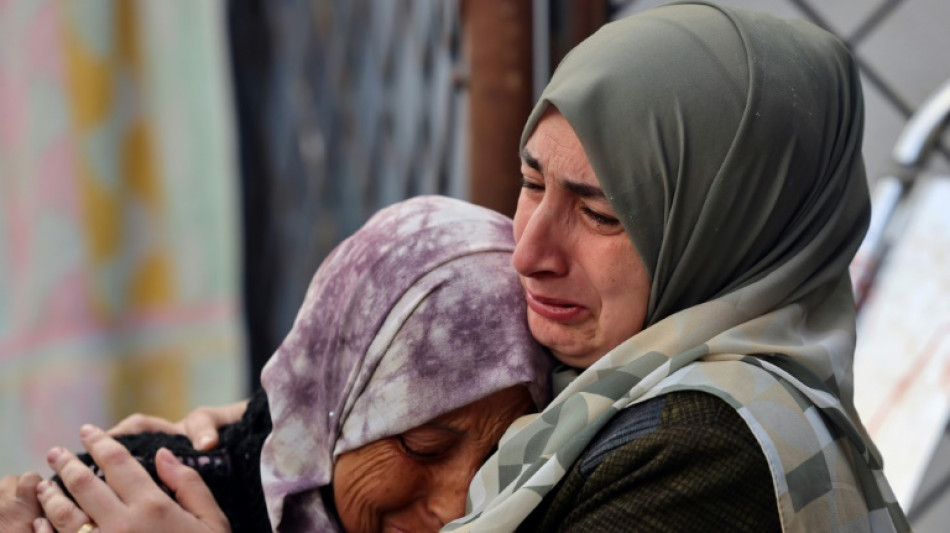
'Hell falling': Fear and grief in Rafah after deadly Israeli raid / Photo: MOHAMMED ABED - AFP
Majed al-Afifi was just 40 days old when he was killed, his uncle told AFP in Rafah where Israeli forces bombed multiple homes while rescuing two Gaza hostages.
"We heard the bombing without warning," said Said al-Hams, 26, in Rafah refugee camp.
His nephew, a twin, "was born exactly 40 days ago and was killed", while their mother was wounded.
The newborn is among around 100 people killed by Israeli forces overnight in Rafah, according to the health ministry in Gaza.
Dozens of Israeli strikes pounded Rafah, where some 1.4 million people have sought refuge during four months of war between Israel and Hamas militants.
While there was jubilation in Israel over the liberation of the two hostages, in Rafah people recounted a fearful night.
"The situation was hell," said Abu Suhaib, who was sleeping dozens of metres from where Israeli forces struck.
"We heard the sound of explosions, like hell falling down on civilians," he told AFP.
The 28-year-old said he heard warplanes firing, shooting and a helicopter landing.
A massive pile of rubble stands where multiple buildings were flattened by Israeli strikes, beside the remains of a four-storey house.
Witnesses said the residents of the house fled two months ago, after the Israeli military warned them it would be bombed.
The aerial bombardment also left five vast craters, at least 10 metres wide and five metres deep, an AFP journalist said.
"I can't tell you how we survived the night," said Abu Abdullah al-Qadi, who was woken by the sound of shooting.
"They killed my cousin, they killed a lot of people with strikes," he told AFP, as dozens gathered by the destroyed buildings.
"They stormed this building and it appears that they freed prisoners -- and then they bombed it," said Qadi.
"They bombed all the houses next to it," he added.
- 'A terrifying night' -
The refugee camp sits in the heart of Rafah, where vast crowds have gathered after following Israeli orders to flee other parts of Gaza.
Despite mounting international alarm at a possible ground invasion of the city, Israeli Prime Minister Benjamin Netanyahu vowed Monday that "continued military pressure" is the only way to free all hostages.
Palestinian militants seized about 250 hostages during their October 7 attack on southern Israel, according to an AFP tally based on official Israeli figures. Israel says around 130 are still in Gaza, though 29 are thought to be dead.
The Hamas attack resulted in the deaths of about 1,160 people, mostly civilians, according to an AFP tally based on official figures.
The relentless offensive by Israel has killed at least 28,340 people in Gaza, mostly women and children, according to the latest health ministry toll.
Fearing an onslaught by ground forces, dozens of families already displaced by the war started packing up their scant belongings on Monday.
"It was a terrifying night," said Alaa Mohammed, from northern Gaza, dismantling a tent in western Rafah.
"What happened at night foreshadows something big happening in Rafah. It seems that the Israeli army will enter Rafah as they announced," said the 42-year-old.
Mohammed started gathering their blankets and mattresses, after a sleepless night, while relatives went in search of transport.
"A lot of families around me undid their tents like us," he said.
"I hope we can find a car or a truck. We called more than one driver we know, but all of them are busy."
A.Gerard--LCdB