Israel rescues two hostages as fear grows of Rafah ground battles / Photo: SAID KHATIB - AFP
Israelis welcomed the rescue early Monday of two hostages from war-torn Gaza, but fears of a looming ground incursion grew among more than a million Palestinians trapped in the territory's far south.
Israeli special forces in a dramatic overnight raid freed two captives held by Hamas militants since the October 7 attack, in Gaza's densely crowded southern city of Rafah near Egypt.
Fernando Simon Marman, 60, and Louis Har, 70, were rescued amid an intense firefight and heavy airstrikes, then airlifted to a hospital where they were declared in good health despite more than four months in captivity.
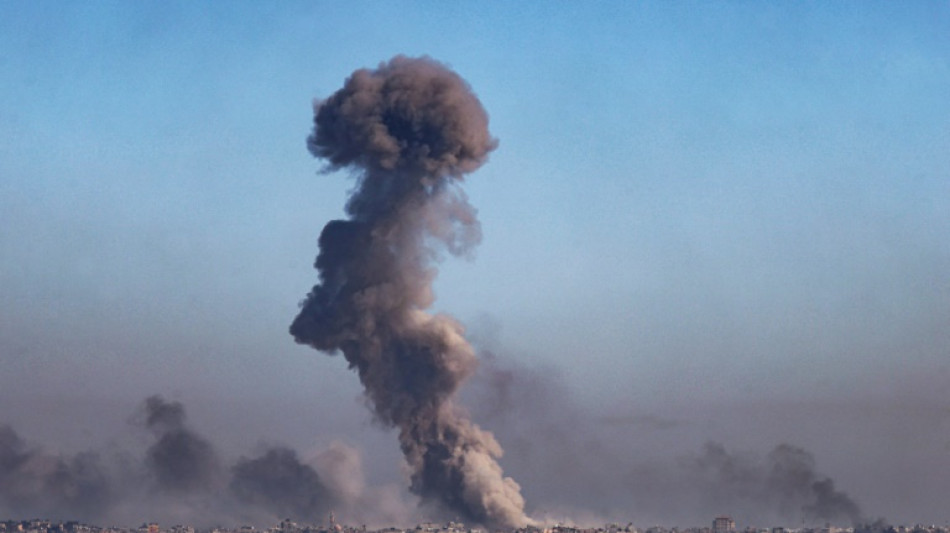
Overnight bombing on Rafah killed around 100 people, including children, said the health ministry of the Hamas-run Gaza Strip, while the Hamas government said 14 houses and three mosques were hit.
Israeli Prime Minister Benjamin Netanyahu hailed the rescue operation and vowed that "only continued military pressure, until complete victory, will result in the release of all our hostages".
About 130 of the original 250 captives taken by Hamas more than four months ago are still believed to be held in Gaza, although Israel presumes 29 of them are dead.
Har's son-in-law praised the rescue of the Argentinian-Israeli men and described an emotional reunion in a hospital near Tel Aviv as "a lot of tears, hugs, not many words".
"Luckily for us, as a family, they were saved tonight. But I must say that the job is not done," said Idan Bejerano. "We are happy today, but we didn't win. It's just another step towards bringing all the other" hostages home, he continued.
As the sun rose over Rafah, local Palestinian residents surveyed the large bomb craters and rubble after the intense overnight battle.
One of them, Abu Suhhaib, said the fighting had made him feel "as if hell had opened".
- Pre-dawn hostage rescue --
Weeks of talks towards a ceasefire and hostage release deal have brought no results yet, and Netanyahu has vowed to send ground troops into the crowded Rafah area to finish his goal of eliminating Hamas, sparking international alarm.
About 1.4 million displaced Palestinians have lived in shelters and tent camps, hemmed into the area near the Egyptian border as the battlefront has moved ever closer from the north.
Aid groups and foreign governments, including Israel's key ally the United States, have voiced deep concern over the potentially disastrous consequences of expanding operations there.
US President Joe Biden told Netanyahu on Sunday that a Rafah advance should not go ahead without a "credible" plan to ensure "the safety" of people sheltering there, the White House said.
Netanyahu had told US broadcaster ABC News the Rafah operation would go ahead and continue until Hamas is eliminated, adding that Israel would provide "safe passage" to civilians trying to leave.
When pressed on where they could go, Netanyahu said: "You know, the areas that we've cleared north of Rafah, plenty of areas there. But, we are working out a detailed plan."
The Israeli military early Monday announced the joint operation of the army, police and Shin Bet security service that freed the two hostages after nearly 130 days in captivity.
A spokesperson from the prime minister's office said the Israeli "forces went up to the second floor of a building in Rafah, broke open the locked building door with an explosive device, shot at nearby points and successfully rescued the abductees".
"At this point, fire was opened from the building and nearby buildings, and a prolonged battle took place, during which dozens of Hamas targets were attacked from the air in order to allow the force to leave the building."
"Many terrorists were killed," said army spokesman Daniel Hagari.
The Palestinian foreign ministry condemned what it called a "massacre" in Rafah and accused Netanyahu of "a mentality of revenge".
The support group Hostages and Missing Families Forum warned that "time is running out for the remaining hostages held captive by Hamas".
"Their lives are at risk with each passing moment. The Israeli government must exhaust every option on the table to release them."
Hamas's military wing heightened fears among families when it said Sunday two hostages had been killed and eight wounded in recent Israeli bombardment, a claim AFP was unable to independently verify.
- 'Security control' -
The bloodiest ever Gaza war broke out after Hamas launched an unprecedented attack on southern Israel on October 7 that resulted in the deaths of about 1,160 people, mostly civilians, according to an AFP tally based on official figures.
Israel has responded with a relentless offensive in Gaza that the territory's health ministry says has killed at least 28,340 people, mostly women and children.
Dozens of hostages were freed by Hamas during a one-week truce in November that also saw the release of more than 200 Palestinian prisoners held in Israeli jails.
Renewed talks for a pause in the fighting have been held in Cairo, with Hamas open to a fresh ceasefire including more prisoner-hostage exchanges, but Netanyahu recently dismissed some of the group's demands as "bizarre".
A Hamas leader told AFP on condition of anonymity that an Israeli push into Rafah "would torpedo the exchange negotiations".
Netanyahu, during a visit to a military base Sunday, stressed that one of Israel's war goals is "the demilitarisation of Gaza".
He said "this requires our security control... over the entire area west of Jordan" -- territory which takes in Israel, the occupied West Bank and the Gaza Strip.
Saudi Arabia and the United Arab Emirates have been among countries that have voiced alarm over the looming Rafah incursion and warned against a "forced" displacement of Palestinians.
Riyadh called for an urgent UN Security Council meeting, while Britain's Foreign Secretary David Cameron said the priority "must be an immediate pause in the fighting to get aid in and hostages out".
burs-jd/fz/jkb
T.Luyten--LCdB