'Tears, hugs' as rescued Gaza hostages back in Israel / Photo: - - Israeli Army/AFP
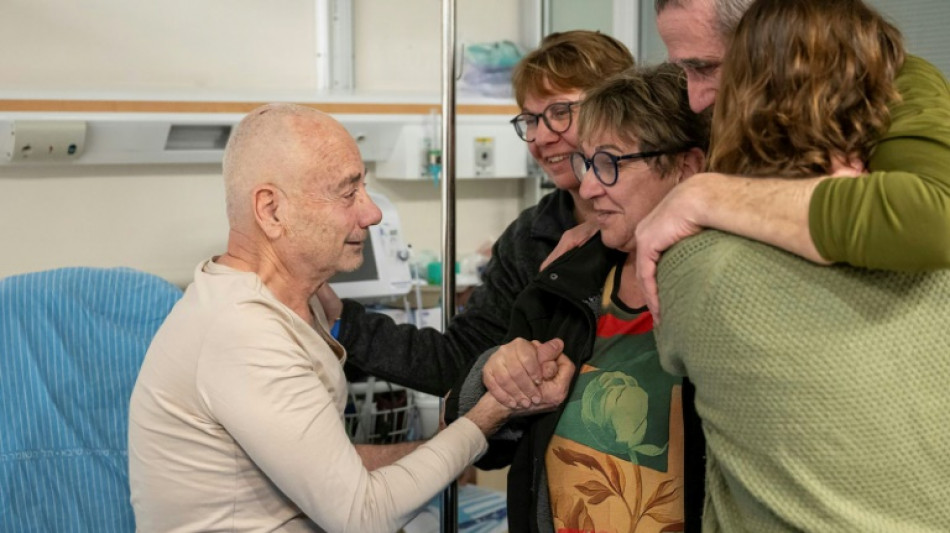
There were hugs and tears at Israel's largest hospital on Monday as two Gaza hostages were reunited with their families after being rescued in a deadly military raid.
Luis Har, 70, and Fernando Simon Marman, 60, embraced relatives at Sheba hospital after being airlifted from Gaza's southern city of Rafah.
AFP journalists in Gaza saw the bodies of some of around 100 Palestinians killed in air strikes accompanying the rescue operation, according to a toll from the health ministry in the Hamas-run territory.
Speaking from the hospital near Tel Aviv where the two rescued men were undergoing medical tests, Har's son-in-law described "a lot of tears, hugs, not many words".
"Luckily for us, as a family, they were saved tonight. But I must say that the job is not done," Idan Bejerano told journalists.
"It's just another step towards bringing all the other" hostages home, he continued.
Bejerano told AFP the family had endured a "tough" and exhausting wait, trying to dispel rumours while militants released videos of some captives.
Dozens of press cameras filled the main hall of Sheba hospital, where patients were wheeled through by medics.
Marman's niece, Gefen Sigal Ilan, said she was still "shaking" from the news of her uncle's rescue.
"When I saw him I couldn't believe he was real," the 36-year-old told AFP.
She said the families of hostages will keep fighting for the release of some 130 captives Israel says remain in Gaza.
"I want to say we will not stop until all hostages are free," said Ilan.
The two men were taken captive from kibbutz Nir Yitzhak in southern Israel, so close to Rafah that the raid to rescue them could be heard from the rural community.
"From two o'clock in the morning, we started hearing booms and noises," said Moshe Schori, the kibbutz manager, adding that "we couldn't sleep".
"Only in the morning we saw on the news that they (Israeli forces) released two people who were in our kibbutz," he added, standing outside the home from which they were snatched on October 7.
- 'Strike a deal' -
Har was a resident of southern Israel's kibbutz Urim, which did not come under attack that day.
One of his friends in Urim, Shabi, who did not provide his surname, said Har is "a simple, quiet guy who smiles all the time".
Talks have been underway for weeks to secure a second truce in the four-month war, which would see more hostages freed in exchange for the release of Palestinian prisoners held in Israel.
Israeli Prime Minister Benjamin Netanyahu has vowed to press on with the fight into Rafah, sparking international alarm for the 1.4 million Palestinians taking refuge there.
One Hamas leader told AFP such a move by Israeli forces would "torpedo" ceasefire negotiations.
A week-long truce in November secured the release of more than 100 Gaza hostages, including several dozen captives who were freed in exchange for 240 Palestinians held in Israel.
Har's partner and Marman's sister, Clara Marman, was among those released during the truce, as were another sister, Gabriela Leimberg, and her 17-year-old daughter Mia Leimberg, according to the Hostages and Missing Families Forum campaign group.
Speaking hours after his Israeli-Argentinian relative was freed, Bejerano urged leaders to "be serious and strike a deal".
"The Israeli people need the deal done. Not yesterday, not tomorrow, today," he said.
- Medical checks -
The Forum also stepped up pressure on Israeli authorities to bring home the remaining captives.
"Their lives are at risk with each passing moment. The Israeli government must exhaust every option on the table to release them," it said in a statement.
Arnon Afek, director of Sheba hospital, said medical checks were being done on the two hostages.
"The time they will stay depends on their (medical) results," he told AFP.
"There are not only physical issues but also psychological issues."
The attack resulted in the deaths of about 1,160 people, mostly civilians, according to an AFP tally based on official figures.
Israel has responded with a relentless offensive in Gaza that has killed at least 28,340 people, mostly women and children, according to the latest toll from territory's health ministry on Monday.
bur-rsc-blb-jd/dcp/ami
G.Wouters--LCdB