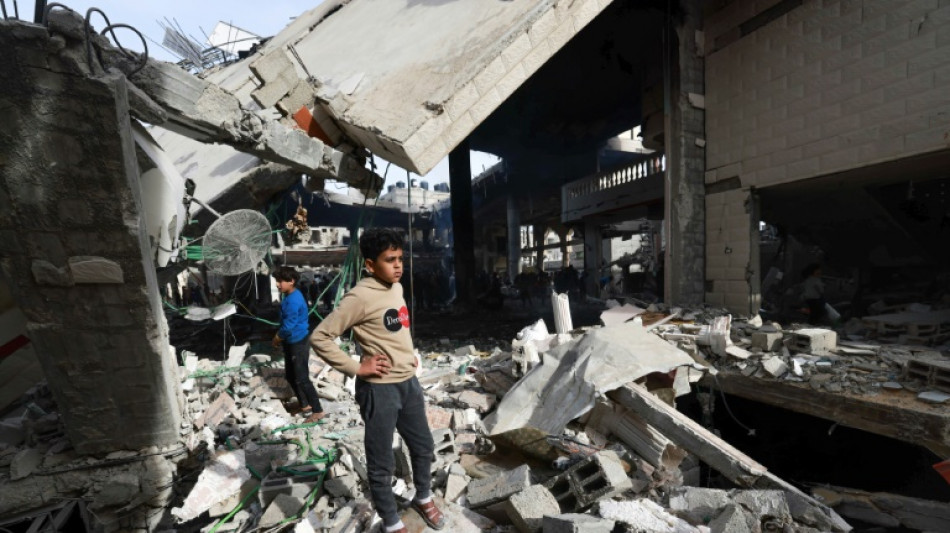
Pressure mounts on Israel for Gaza ceasefire / Photo: MOHAMMED ABED - AFP
Israel faced growing international pressure on Tuesday to agree to a ceasefire with Hamas, as it planned an incursion into the southern Gaza city Rafah where more than a million Palestinians are trapped.
CIA Director William Burns was due in Cairo on Tuesday for a new round of talks on a Qatari-mediated ceasefire that would temporarily halt fighting in exchange for Hamas freeing hostages.
His planned visit comes after Washington and the United Nations warned Israel against carrying out a ground offensive into Rafah without a plan to protect civilians, who say they have nowhere left to go.
"Wherever we go there's bombing, martyrs and wounded," said Iman Dergham, a displaced Palestinian woman.
On a visit to the White House Monday, Jordan's King Abdullah II pushed for a full ceasefire to end the four-month-old war.
"We cannot afford an Israeli attack on Rafah. It is certain to produce another humanitarian catastrophe," said the monarch whose country hosts a large number of Palestinian refugees.
"We cannot stand by and let this continue. We need a lasting ceasefire now. This war must end."
After rejecting Hamas's terms for a truce last week, Israel conducted a predawn raid in Rafah on Monday that freed two hostages and killed around 100 people.
Netanyahu hailed the overnight operation freeing Fernando Simon Marman, 60, and Luis Har, 70, as "perfect", while the Palestinian foreign ministry said the deaths of dozens of Gazans amounted to a "massacre".
The rare rescue mission under heavy air strikes came hours after Netanyahu spoke with US President Joe Biden, who reiterated his opposition to a major assault on Rafah.
But Netanyahu has defied pressure from key ally and military backer Washington, insisting that "complete victory" cannot be achieved until the elimination of the militants' last battalions in Rafah.
While meeting with the units that freed the two hostages, Israeli Defense Minister Yoav Gallant on Monday said there would be "more operations" soon and pledged to see "Gaza destroyed".
"In my opinion, the day is not far."
- No safe place -
The United States has angered some Middle East allies by consistently refusing to back a full ceasefire, with Washington saying it supports Israel's drive to eradicate Hamas and calling for shorter pauses with hostage-prisoner swaps instead.
Biden said Monday his administration was trying to broker a six-week truce and, that while key elements were in place, "gaps" remained.
Once the warring parties agree to the ceasefire, "something more enduring" could be broached, Biden said.
While weeks of talks have yet to bear fruit, a source close to the negotiations told AFP that CIA director Burns was expected in Egypt for more high-level negotiations on Tuesday.
Burns was part of the team that thrashed out the proposed truce in Paris last month.
- No safe place -
Rafah has become a last refuge for over half of Gaza's population, who are pressed up against the Egypt border in makeshift encampments where they face outbreaks of hepatitis and diarrhoea, and a scarcity of food and water.
Netanyahu has said Israel would provide "safe passage" to civilians trying to leave, but foreign governments and aid groups -- as well as Gazans -- wondered where they could go.
"As it is, there is no place that is currently safe in Gaza," said United Nations spokesperson Stephane Dujarric.
When asked about an evacuation mission, he said the UN would "not be party to forced displacement of people".
The UN's human rights chief Volker Turk warned that "an extremely high number of civilians" would likely be killed or injured in a full Israeli incursion into Rafah, which could also spell the end of the "meager" humanitarian aid entering Gaza.
"It's almost famine here, we're almost out of flour in the north region," said a man in northern Gaza's Beit Lahia. "We can't even find food and drinks for the children."
- 'Time is running out'-
Israel's operation to free the two hostages left Rafah with bomb craters and piles of rubble.
The United States said it was deeply concerned by the reports that around 100 Palestinians, including women and children, were killed in the early Monday raid.
The State Department also called for Israel to investigate the "heartbreaking" death of six-year-old Gazan Hind Rajab.
Her body was recovered on Saturday along with two relatives and two Red Crescent workers who went to find her after her family's car came under fire while trying to flee an Israeli advance on Gaza City.
"I will question before God on Judgment Day those who heard my daughter's cries for help and did not save her," Hind's mother Wissam Hamada told AFP.
At least 28,340 people, mostly women and children, have died in Israel's relentless bombardment and ground offensive in Gaza, according to the Hamas-run health ministry.
Militants also seized about 250 foreign and Israeli captives from southern Israel, around 130 of whom Israel says are still held in Gaza including 29 who are presumed dead.
The Hostages and Missing Families Forum campaign group warned that "time is running out for the remaining hostages", urging the Israeli government to "exhaust every option on the table to release them".
burs-lb/kma
P.Verhoeven--LCdB