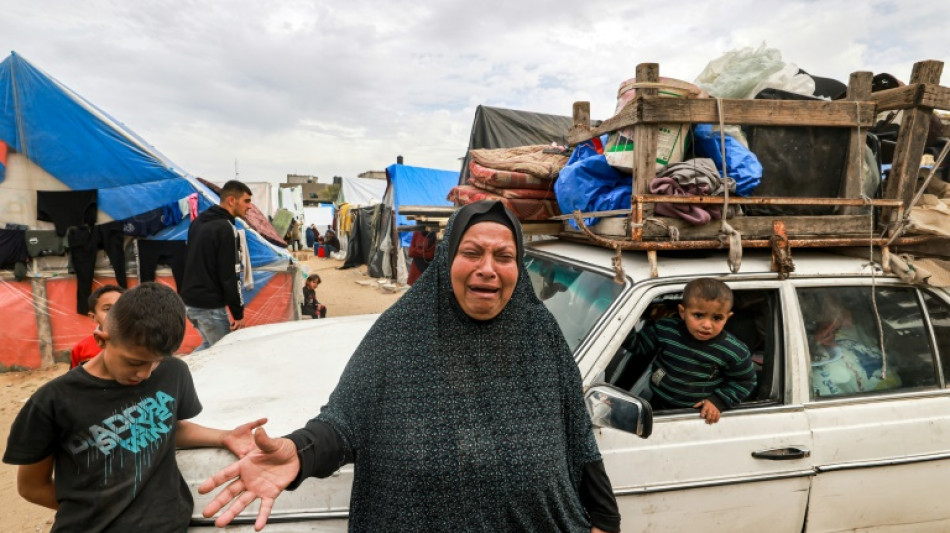
Hamas heads to Cairo truce talks as Rafah braces for Israeli assault / Photo: MOHAMMED ABED - AFP
Negotiations to pause the Israel-Hamas war and free the remaining hostages headed into a second day in Cairo on Wednesday, as displaced Gazans braced for an expected Israeli assault on their last refuge of Rafah.
A Hamas source told AFP that a delegation was headed to the Egyptian capital to meet Egyptian and Qatari mediators, after Israeli negotiators held talks with the mediators on Tuesday.
Turkish President Recep Tayyip Erdogan, an outspoken critic of Israel's conduct of the Gaza war, was also due in Cairo Wednesday for talks with President Abdel Fattah al-Sisi.
CIA Director William Burns had joined Tuesday's talks with David Barnea, head of Israel's Mossad intelligence service, which Egyptian media said had been mostly "positive".
US National Security Council spokesperson John Kirby described the negotiations as "constructive and moving in the right direction".
Mediators are racing to secure a pause to the fighting before Israel proceeds with a full-scale ground incursion into the Gaza Strip's far-southern city of Rafah, where more than 1.4 million Palestinians are trapped.
The potential for mass civilian casualties has triggered urgent appeals, even from close allies, for Israel to hold off sending troops into the last major population centre they have yet to enter in the four-month war.
Key ally the United States has said it will not back any ground operation in Rafah without a "credible plan" for protecting civilians.
Rafah is the main entry point for desperately needed relief supplies and UN agencies have warned of a humanitarian disaster if an assault goes ahead.
UN humanitarian chief Martin Griffiths said any military operation "could lead to a slaughter".
Terrified civilians have been locked in a desperate search for safety.
"My three children were injured, where can I go?" Dana Abu Chaaban asked at the city's border crossing with Egypt, where she was hoping to be allowed across with her bandaged-up sons.
- 'Let us cross' -
Pressure has grown on Egypt to open its border to Palestinian civilians, hundreds of thousands of whom have sought shelter in makeshift camps by the border where they face outbreaks of hepatitis and diarrhoea and a scarcity of food and water.
But it remains closed to Gazans.
"For 100 days we enter the crossing and beg them to let us cross, or to do anything to help us," Habiba Nakhala said.
US President Joe Biden has said civilians in Rafah "need to be protected", calling them "exposed and vulnerable".
But Israeli Prime Minister Benjamin Netanyahu has said "complete victory" cannot be achieved without the elimination of Hamas's last battalions in Rafah.
As the truce talks go on in Cairo, the Israeli military has kept up its bombardment of Gaza. The health ministry in the Hamas-run territory said Wednesday that 104 people had been killed overnight.
Late Tuesday, the military released a video it said was from a security camera and showed Gaza's Hamas chief Yahya Sinwar and family members escaping through a tunnel days after the October 7 attack that launched the war.
"The hunt will not stop until he is captured alive or dead," Israeli army spokesperson Daniel Hagari told reporters.
Some Gazans in Rafah were already packing up their belongings in readiness to move but others vowed to stay put, fearing even greater misery in the bombed out hometowns they fled.
Ahlam Abu Assi said she "would rather die" in Rafah than return to the famine-like conditions facing relatives who stayed in Gaza City.
"My son and his children have nothing to eat. They cook a handful of rice and save it for the next day," she told AFP. "My grandson cries from hunger."
- Hostages -
The Hamas attack that launched the war resulted in the deaths of about 1,160 people in Israel, mostly civilians, according to an AFP tally based on Israeli official figures.
At least 28,473 people, mostly women and children, have been killed in Israel's response, according to the health ministry.
Around 130 of an estimated 250 people taken hostage by Palestinian militants during the attack are believed to remain in Gaza. Israel says 29 of them are presumed dead.
Asked by reporters whether he believes the Americans among the hostages were still alive, National Security Council spokesperson Kirby said: "We don't have any information to the contrary."
burs-lb/kir
G.Wouters--LCdB