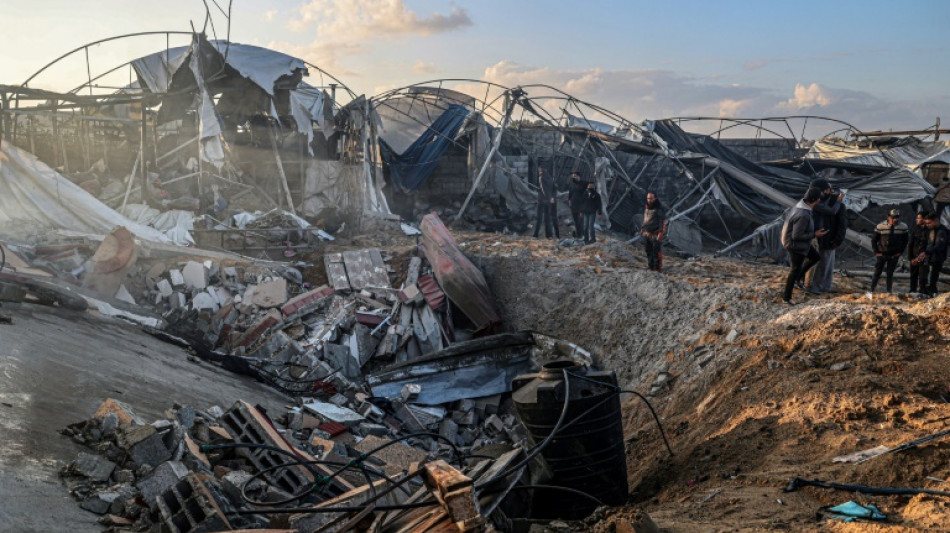
Israel pounds Gaza ahead of UN truce vote / Photo: SAID KHATIB - AFP
Israel hit Gaza with new air strikes on Tuesday as world powers grappled with how to broker a ceasefire ahead of a UN Security Council vote.
The United Nations sounded the alarm over the humanitarian situation in the besieged territory, warning that food shortages could lead to an "explosion" of preventable child deaths.
Four months of relentless fighting have flattened much of the Palestinian territory, pushed 2.2 million people to the brink of famine and displaced three-quarters of the population, according to UN estimates.
"How many of us have to die... to stop these crimes?" Ahmad Moghrabi, said a Palestinian doctor in southern Gaza's main city, Khan Yunis.
"Where is the humanity?"
Global powers trying to navigate a way out of the spiralling crisis have so far come up short, with a push later Tuesday for a UN ceasefire resolution facing an expected US veto.
After months of struggling for a united response, all EU members except Hungary called Monday for an "immediate humanitarian pause".
They also urged Israel not to invade Gaza's southernmost city Rafah, where nearly 1.5 million Palestinians are sheltering.
The city, the last untouched by Israeli ground troops, is also the main entry point for desperately needed relief supplies via neighbouring Egypt.
Israel's strikes on the city are hampering humanitarian operations, while the food supply is disrupted by regular border closures, according to the UN's agency for Palestinian refugees, UNRWA.
The scarcity of food and water has left children and women across the strip suffering a steep rise in malnutrition, the United Nations children's fund warned Monday.
One-in-six children in northern Gaza are now acutely malnourished, UNICEF said, a situation poised to "compound the already unbearable level of child deaths".
- 'Flat out reject this'-
Despite repeated calls to spare Rafah, Israel has set a Ramadan deadline for a ground incursion, should Hamas militants not free scores of Israeli hostages held since the October 7 attacks by then.
"If by Ramadan the hostages are not home, the fighting will continue everywhere to include the Rafah area," said war cabinet member Benny Gantz.
The Muslim holy month is expected to start around March 10.
International mediators have been scrambling to avert the assault and its feared mass civilian casualties.
At the United Nations Security Council, two rivalling ceasefire proposals have been put forward.
The first, drafted by Algeria, demands an immediate humanitarian ceasefire and "unconditional release of all hostages".
It met swift opposition from key Israel backer the United States, which tabled an alternative draft.
That text, seen by AFP on Monday, emphasises "support for a temporary ceasefire in Gaza as soon as practicable".
It also expresses concern for Rafah, warning that a major ground offensive "would result in further harm to civilians" and displacement.
According to a diplomatic source, this draft stands little chance of being adopted as written, and risks a Russian veto.
While Washington has pressed a truce-for-hostages deal, weeks of talks involving US, Egyptian and Qatari mediators have failed to reach an agreement.
Hamas has threatened to walk away from negotiations unless more aid gets into Gaza, while Israeli Prime Minister Benjamin Netanyahu has rejected Hamas's demands as "delusional".
He vehemently opposed calls for negotiations to include recognition of a Palestinian state.
"We flat out reject this," he said in a video statement on Monday, saying it would "endanger the existence of the State of Israel."
Over the weekend, Israeli protesters attempted to block aid trucks at the Egypt-Gaza border to escalate pressure for the release of hostages.
In Jerusalem, protesters marched to Netanyahu's house, accusing him of abandoning the hostages.
"There is no other way to get these people back without a deal," said protester Eli Osheroff.
- Dying of hunger or bombing -
The war started when Hamas launched its unprecedented attack on October 7 that left about 1,160 people dead in southern Israel, mostly civilians, according to an AFP tally of Israeli figures.
Hamas militants also took about 250 hostages -- 130 of whom remain in Gaza, including 30 presumed dead, according to Israel.
Israel's retaliatory campaign has killed at least 29,092 people, mostly women and children, according to the latest count by the territory's health ministry.
For weeks, Israel has concentrated its military operations in Khan Yunis, the hometown of Hamas's leader in the territory Yahya Sinwar, the alleged architect of the October 7 attack.
Early Tuesday, witnesses said overnight air strikes and fighting had mostly hit Khan Yunis and the east of Gaza City.
"Missiles are falling on us. How much more can a human can deal with that?" said Ayman Abu Shammali after his wife and daughter were killed in a strike Zawayda, in central Gaza.
"People in the north are dying from hunger while we here (are) dying from bombing."
Israel said the claims were "despicable and unfounded".
burs-lb/ser
X.Hardy--LCdB