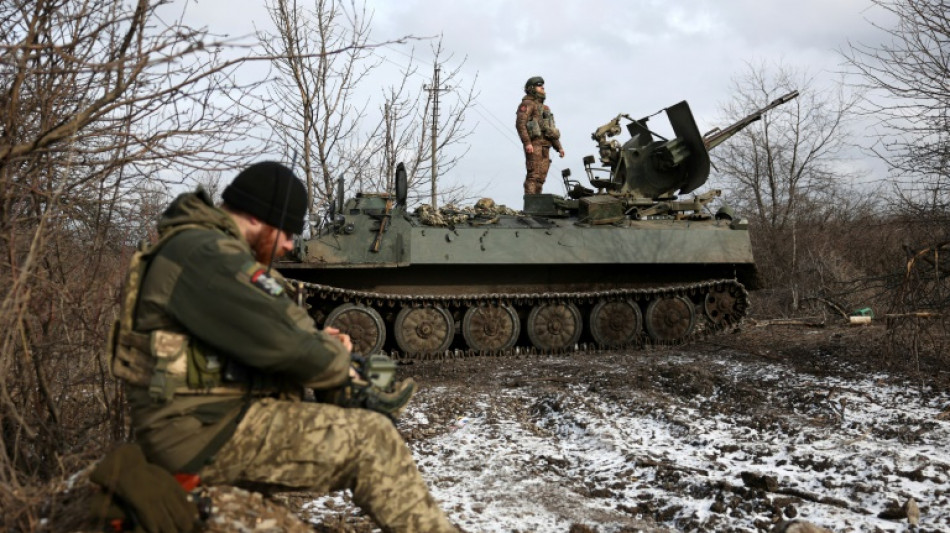
US to level more sanctions as Russia claims fresh gains in Ukraine / Photo: Anatolii STEPANOV - AFP
The United States plans to impose sanctions Friday on more than 500 targets involved in Russia's war in Ukraine, as Moscow claims fresh battlefield advances two years after its invasion.
Ukraine, grappling with hold-ups to much-needed Western military aid, has been pushed back from the front line in recent months.
Already outgunned, Kyiv is rationing ammunition as political wrangling in Washington, Ukraine's biggest ally, stalls a critically needed $60-billion aid package.
Russia has for months been ramping up arms production and driving massive resources into its renewed offensive, exacting an enormous human toll.
"There are no more tears, our country has been going through what has been happening for two years now," Oleksandra Terekhovych said as Ukraine endures another winter at war. "We live with horror inside of us."
The Russian defence ministry on Thursday announced the capture of Pobeda ('victory' in Russian), a frontline village about five kilometres (three miles) west of Donetsk city.
Last week, it said it had seized the former Ukrainian stronghold of Avdiivka.
With no end to the war in sight, Ukraine's army is struggling with recruitment as well as depleted resources.
US President Joe Biden has voiced "confidence" that Congress will soon push through new war aid, while his administration revealed sanctions to be doled out Friday.
The US Treasury Department said the measures would hit "Russia, its enablers, and its war machine".
Since Russian troops poured across the border on February 24, 2022, Washington and its allies have imposed a host of sanctions, targeting Moscow's revenue and military-industrial complex.
Earlier Thursday, the US government marked the looming second anniversary of the invasion with charges against a series of wealthy Russians to help cut the "flow of illegal funds that are fueling" Moscow's war.
- Static front line -
Two years after President Vladimir Putin launched the biggest war in Europe since World War II, "Russia cannot accept the existence of any independent Ukraine," the US-based Institute for the Study of War said in its latest assessment of the conflict.
But for more than a year, the front line has barely moved.
Kyiv has managed to hold a thin bridgehead on the eastern bank of the Dnipro River in the southern Kherson region, but its forces have not progressed inland.
"Russians are concentrating their main activity on the Donetsk region," Ukraine's senior commander in the area, Oleksandr Tarnavsky, said Thursday.
During a briefing, he said Ukraine was "holding back enemy forces" in Pobeda, but did not explicitly refute Moscow's claim of having captured the village.
As Russia claimed advances in the east, Ukraine said its forces had struck a Russian training ground in the south, on the eastern bank of the Dnipro.
The strike, which took place Wednesday, targeted a range where Russian storm troops were training, military spokeswoman Nataliya Gumenyuk said.
Ukraine carried out a separate strike on a training ground near the Russian-controlled town of Volnovakha in the eastern Donetsk region on Tuesday, resulting in numerous casualties.
Russia did not officially acknowledge that strike, but authorities in one region said they were looking into reports of casualties among the 36th Motorised Rifle Brigade.
This week, tensions on the border with neighbouring Poland also further threatened Ukraine's war effort.
Polish farmers have blocked deliveries as they protest Ukrainian competition and farm imports, prompting warnings from Kyiv.
Ukrainian President Volodymyr Zelensky said he instructed officials to go to the border on Friday to resolve the issue, which "unfortunately, adds to the threats to the supply of weapons to our guys at the front."
burs-lb/cwl
Y.Bernard--LCdB