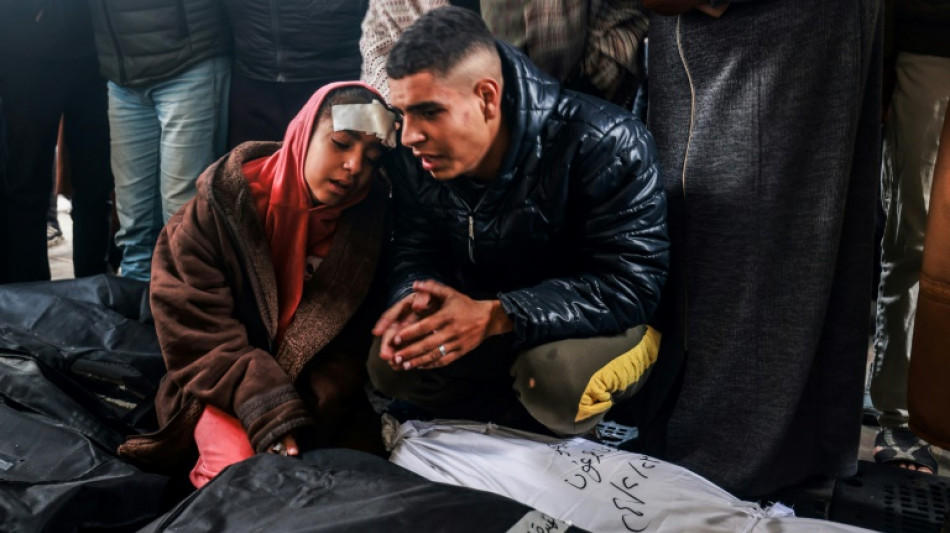
Southern Gaza hit as Israeli spy chief reportedly heads to new talks / Photo: MOHAMMED ABED - AFP
Israeli air strikes targeted homes in the southern Gaza Strip, witnesses said on Friday, adding to what aid groups describe as an increasingly hopeless humanitarian situation despite efforts towards new truce talks.
Israeli media reported a delegation led by David Barnea, head of the Mossad intelligence agency, was heading to Paris for new truce discussions in the war with Hamas militants.
His trip follows what the health ministry in Hamas-run Gaza said was the death of more than 100 people over the previous day.
Israeli bombardment obliterated one house and left a gaping hole in the earth east of Rafah, on the border with Egypt, where about 1.4 million Gazans have converged in a futile search to escape the fighting.
"We were sleeping in our house when we heard the sound of a missile," said Abdul Hamid Abu el-Enein. "We rushed to the site and found people martyred and injured" in the strike which "completely erased" the two-storey home.
Witnesses reported several other houses targeted during the night, and an AFP reporter described heavy air strikes in the city of Khan Yunis several kilometres (miles) to the north, as well as in Rafah itself.
Israel's military said fighting, including with drone strikes and sniper fire, continued in the western Khan Yunis area.
More than four months of relentless fighting and bombardment have flattened much of Gaza and pushed its population of around 2.4 million to the brink of famine as disease spreads, according to the United Nations.
The UN humanitarian agency OCHA has blamed "limitations on the entry of aid" as well as the combat and growing insecurity for severely hampering assistance.
The war started after Hamas's unprecedented October 7 attack which resulted in the deaths of about 1,160 people in Israel, mostly civilians, according to an AFP tally of official figures.
Hamas militants also took hostages, 130 of whom remain in Gaza including 30 presumed dead, according to Israel.
- 'Appalled' -
Israel's retaliatory campaign, aiming to destroy Hamas, has killed at least 29,514 people, mostly women and children, according to the latest count by Gaza's health ministry.
The toll has seen pressure grow on the administration of US President Joe Biden to rein in its ally Israel -- which it provides with billions of dollars in military aid.
On Tuesday, Washington for a third time vetoed a UN Security Council resolution calling for an immediate ceasefire in Gaza.
The vote came as Israel threatens to move troops into Rafah, a plan which has sparked widespread international alarm.
The head of the Doctors Without Borders (MSF) charity, Christopher Lockyear, told the Council he was "appalled by the willingness of the United States to use its powers as a permanent Council member to obstruct efforts to adopt the most evident of resolutions. One demanding an immediate and sustained ceasefire."
Washington's ambassador to the UN Linda Thomas-Greenfield said she could not support a resolution that "put sensitive negotiations" in jeopardy.
Brett McGurk, White House coordinator for the Middle East and North Africa, held talks this week with Israeli Defence Minister Yoav Gallant in Tel Aviv, after meeting with other mediators in Cairo.
Hamas chief Ismail Haniyeh was in the Egyptian capital for truce talks earlier in the week, the group said.
The Israeli defence ministry said the discussion with McGurk covered returning hostages, "operational developments in Hamas strongholds in central and southern Gaza, and humanitarian aid efforts", as well as "the "importance of dismantling remaining Hamas battalions".
Washington's National Security Council spokesman John Kirby told journalists that so far the discussions were "going well".
Israeli media reported on Friday that Barnea would travel on Friday with Ronen Bar, chief of the Shin Bet domestic security agency, for the talks in Paris.
Barnea and his US counterpart from the CIA helped broker a week-long truce in November that saw the release of 80 Israeli hostages in exchange for 240 Palestinian prisoners held in Israeli jails.
Benny Gantz, a member of Israel's war cabinet, this week spoke of "the first signs that indicate the possibility of progress" toward a new hostage release deal.
- 'Animals have better lives' -
For Gazans struggling to survive, any deal that could lead to greater aid flows and a halt to fighting cannot come soon enough.
"Even animals have better lives than us," said Zarifa Hamad, 62, a displaced woman living in northern Gaza's Jabalia refugee camp.
Fierce gun battles occurred in the neighbouring Zeitun district, where tanks were deployed, according to witnesses.
The army said helicopters were in action to support "targeted raids" in the area.
Aid agencies say the humanitarian situation is particularly acute in Gaza's north.
In a letter to the United Nations General Assembly, he said UNRWA "has reached a breaking point", as donors freeze funding, Israel exerts pressure to dismantle the agency and humanitarian needs soar.
UNRWA employs around 30,000 people working in the occupied territories, Lebanon, Jordan and Syria.
Several leading donors have suspended funding to UNRWA in response to Israeli allegations that some of its staff participated in the October 7 attack on Israel.
The UN fired the employees accused by Israel and has begun an internal probe of UNRWA, but Lazzarini said Israel has provided no evidence against the 12 it accuses.
In a statement on Wednesday, the head of OCHA, Martin Griffiths, joined the chiefs of almost 20 other UN and external aid groups in an appeal for "an immediate ceasefire," restoration of UNRWA funding, and other measures "so that we can provide, at the very least, the bare essentials" including drinking water and food.
K.Cox--LCdB