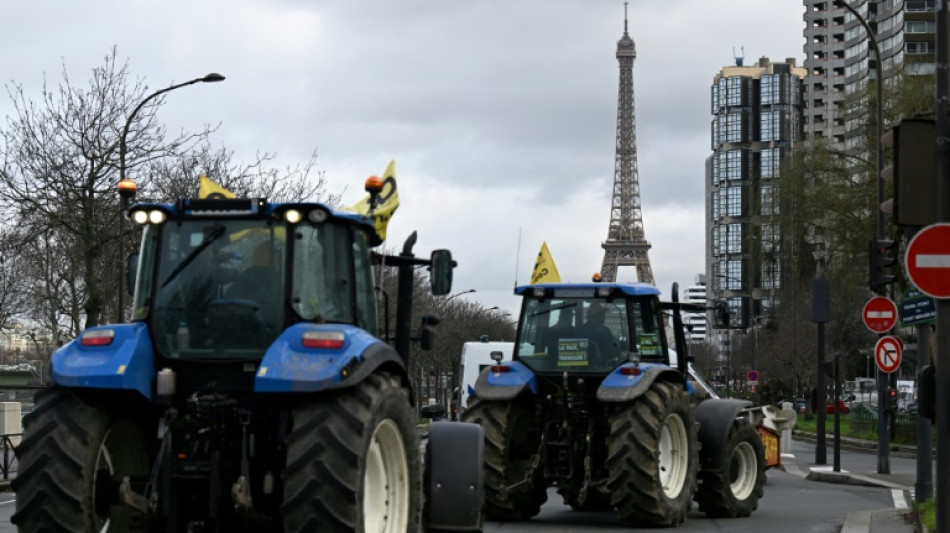
France, Poland lead new wave of European farmer anger / Photo: MIGUEL MEDINA - AFP
French and Polish farmers led a new surge of agricultural anger in Europe on Friday, taking tractors into major cities and blocking roads to demand lighter regulation and taxation.
Farmers across the continent have been protesting for weeks over what they say are excessively restrictive environmental rules, competition from cheap imports from outside the European Union and low incomes.
Tractors rolled into Paris as farmers sought to pile pressure on French President Emmanuel Macron on the eve of a flagship annual agricultural show which has turned into a major political event.
Promises of reforms by the government in response to January's protests have failed to placate the farmers, who were due to discuss their grievances with Macron at the Salon de l'Agriculture on Saturday before the president cancelled the planned debate.
"We're really not being listened to, because we're really being taken for pawns," Nicolas Bongay, president of a farmers' union in the rural Doubs department, told AFP.
"It's very, very hard for everyone. We came here not to go away... we're staying."
French farmers have continued to block roads, set fire to tyres and lay siege to supermarkets, saying they need more measures.
Farmers in Spain have also held mass protests this week.
- Ukraine PM snubbed -
In eastern Europe, Polish officials snubbed a delegation led by Ukraine's prime minister on Friday seeking to resolve tensions caused by weeks-long Polish farmer protests at their border.
Polish farmers have vowed to block a key road linking Poland and Germany from Sunday.
Polish farmers have blocked crossing points at the Ukrainian border to denounce what they say is unfair competition from their war-torn neighbour's cheaper produce.
Polish authorities said they had never agreed to a border meeting over the demonstrations, which Ukraine says threaten its exports and are holding up deliveries of crucial weapons for its two-year war against Russia.
"Unfortunately, Polish government officials did not come," said Ukrainian Prime Minister Denys Shmygal.
"But we publicly appealed to them, gave our proposals, and will continue this work."
Polish Prime Minister Donald Tusk's chief of staff told AFP Warsaw had not sent a delegation because a meeting "makes no sense at the moment".
The two sides were "far" from a deal to end the showdown, said Jan Grabiec, and "there is not yet a Ukrainian proposition that allows to hope for an end to the deadlock".
On Friday, Polish police said grain from Ukraine had been spilled on a Polish railway close to the border -- the second such incident this week.
EU ministers are to meet in Brussels on Monday to discuss new European Commission proposals aiming to change regulations at the heart of the discontent, for example reducing the number of checks on produce.
burs-imm/tw
D.Moerman--LCdB