Israel discusses next steps in truce talks as Gaza desperation deepens / Photo: MOHAMMED ABED - AFP
Israel's war cabinet has discussed the next steps for negotiations towards a hostage deal and ceasefire in its war with Hamas, as concern deepens over the increasingly desperate situation faced by civilians in the devastated Gaza Strip.
An Israeli delegation that had travelled to Paris for fresh talks on a hostage deal returned to brief the country's war cabinet on Saturday night, according to an official and local media reports.
National security adviser Tzachi Hanegbi said in a televised interview shortly before the meeting that the "delegation has returned from Paris -- there is probably room to move towards an agreement".
Prime Minister Benjamin Netanyahu said the meeting would discuss the "next steps in the negotiations".
Local media later reported that the meeting had concluded with the cabinet agreeing to send a delegation to Qatar in the coming days to continue the talks.
As with a previous week-long truce in November that saw more than 100 hostages freed, Qatar, Egypt and the United States have been spearheading efforts to secure a deal.
Domestic pressure on the government to bring the captives home has also steadily mounted, with thousands gathering in Tel Aviv Saturday night at what has come to be known as "Hostages Square" to demand swifter action.
"We keep telling you: bring them back to us! And no matter how," said Avivit Yablonka, 45, whose sister Hanan was kidnapped on October 7.
Anti-government protesters were also out in Tel Aviv, blocking streets and calling for Netanyahu's government to step down as authorities deployed water cannon and mounted officers in a bid to disperse them.
"They are not choosing the right path for us. Whether it's (the) economy, whether it's peace with our neighbours," 54-year-old software company CEO Moti Kushner said of the government, adding "it looks like they never want to end the war".
- Increasing desperation -
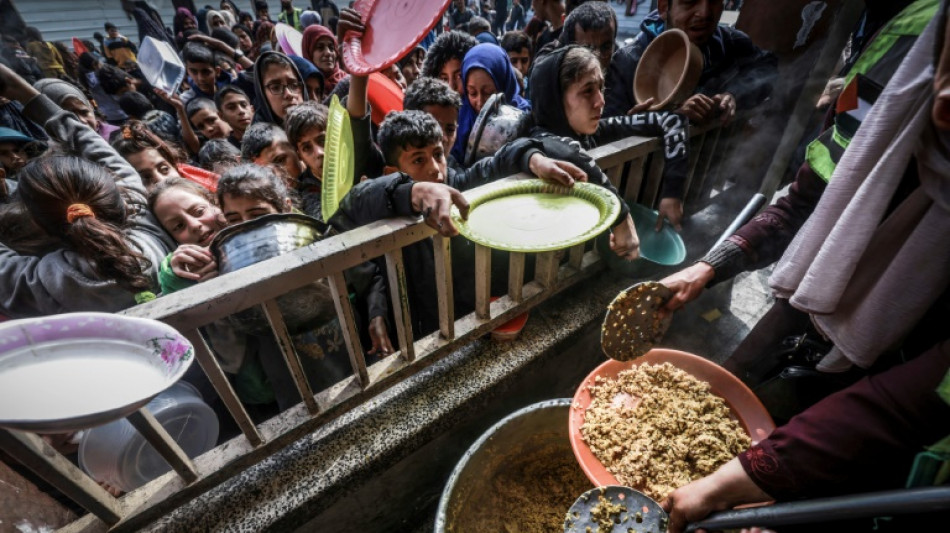
After more than four months of shortages inside the besieged Gaza Strip, the World Food Programme said this week its teams had reported "unprecedented levels of desperation", while the United Nations warned that 2.2 million people were on the brink of famine.
In northern Gaza's Jabalia refugee camp, bedraggled children held out plastic containers and battered cooking pots for what little food was available.
Supplies are running out, with aid agencies unable to get into the area because of the bombing, while the trucks that do try to get through face frenzied looting.
"We the grown-ups can still make it, but these children who are four and five years old, what did they do wrong to sleep hungry and wake up hungry?" one man said angrily.
Residents have resorted to eating scavenged scraps of rotten corn, animal fodder unfit for human consumption and even leaves.
The health ministry said on Saturday that a two-month-old baby identified as Mahmud Fatuh had died of "malnutrition" in Gaza City.
Save the Children said the risk of famine would continue to "increase as long as the government of Israel continues to impede the entry of aid into Gaza".
Israel has defended its track record on allowing aid into Gaza, saying that 13,000 trucks carrying relief supplies had entered the territory since the start of the war.
The war began after Hamas's unprecedented October 7 attack, which resulted in the deaths of about 1,160 people in Israel, mostly civilians, according to an AFP tally of official figures.
Hamas militants also took hostages, 130 of whom remain in Gaza, including 30 presumed dead, according to Israel.
Israel's retaliatory offensive has killed at least 29,606 people, mostly women and children, according to a Saturday tally from Gaza's health ministry.
The ministry said early Sunday that another 98 people had been killed overnight, with the Hamas media office reporting strikes along the length of the territory, from Beit Lahia in the north to Rafah in the south.
- More Rafah strikes -
An AFP reporter said there had been a number of air strikes on Saturday evening in Rafah, a city along the territory's southern border with Egypt where hundreds of thousands of Gazans have fled to escape fighting elsewhere.
The presence of so many civilians packed into the area has sparked concerns over Israeli plans for troops to finally push into the city, the last major urban centre they have yet to enter.
Despite the concerns, including from key ally the United States, Netanyahu signalled Saturday night that the expected push had not been abandoned, adding that "at the beginning of the week, I will convene the cabinet to approve the operational plans for action in Rafah, including the evacuation of the civilian population from there".
"Only a combination of military pressure and firm negotiations will lead to the release of our hostages, the elimination of Hamas and the achievement of all the war's goals," he added.
Netanyahu this week unveiled a plan for post-war Gaza that envisages civil affairs being run by Palestinian officials without links to Hamas.
The plan has been rejected by both Hamas and the Palestinian Authority in the Israeli-occupied West Bank, and drawn criticism from Washington.
burs-smw/mtp
H.Vermeulen--LCdB