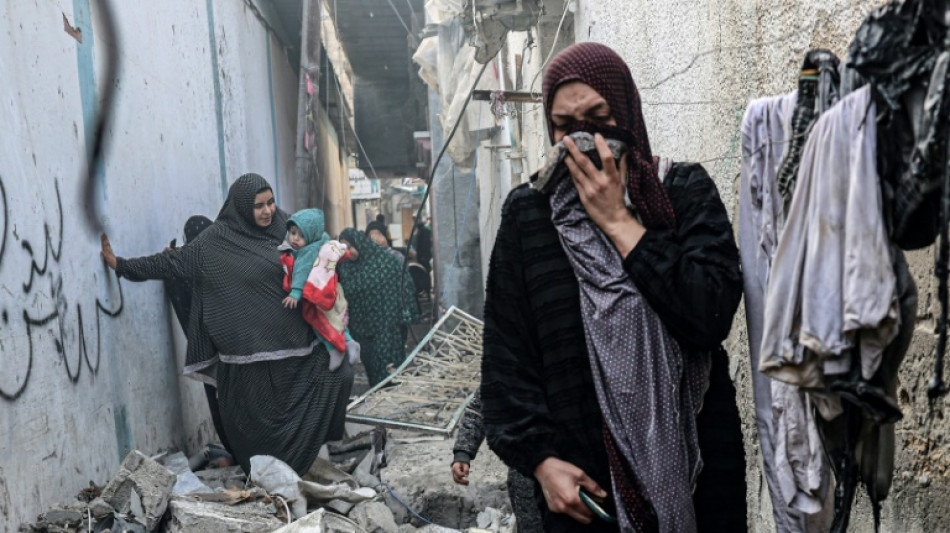
Hunger grips north of war-torn Gaza amid ongoing truce talks / Photo: SAID KHATIB - AFP
Dire food shortages sent hundreds of Palestinians fleeing northern Gaza on Sunday as Israel's war against Hamas raged on despite stuttering efforts towards a ceasefire and hostage release deal.
Desperate families in the north of the besieged war zone have been forced to scavenge for food as fighting and looting have stopped humanitarian aid trucks from reaching the devastated area.
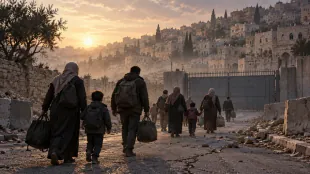
Hundreds fled northern Gaza Sunday and headed south whichever way the could, walking down garbage-strewn roads between the blackened shells of bombed-out buildings, said an AFP correspondent.
"I came on foot from north Gaza," said one of them, Samir Abd Rabbo, 27, who arrived with his one-year-old daughter at the Nuseirat camp in the central Gaza Strip.
"I can't describe the kind of starvation spreading there."
Without milk, he said, he had tried to feed his baby girl bread made from animal feed, which she was unable to digest. "Our only hope is God, there is nobody else to help."
Israeli forces meanwhile kept striking targets across the Palestinian territory and battling Hamas militants in heavy urban combat centred on the southern city of Khan Yunis.
The army said "troops killed a number of terrorists and located weapons" and "apprehended terrorists who had attempted to escape by hiding amongst the civilians".
Close to the main battlefront, in the far-southern Rafah region, alarm has grown among 1.4 million Palestinians of a looming ground invasion feared to bring more mass civilian casualties.
The war started by the October 7 Hamas attack on southern Israel has ground on well into a fifth month and sent the death toll rapidly surging towards 30,000, according to the health ministry in the Hamas-run territory.
- Ceasefire talks -
Talks have been held for weeks with the goal of reaching a temporary truce, to exchange Hamas's hostages for Palestinian prisoners held in Israeli jails, and to step up aid deliveries.
US, Arab and other mediators have voiced hope a deal can be reached before the start of the Muslim holy month of Ramadan on March 10 or 11, depending on the lunar calendar.
An Israeli delegation returned Saturday from the latest round of closed-door talks in Paris, also involving Egyptian and Qatari mediators hoping to bridge remaining differences.
Israel's national security advisor, Tzachi Hanegbi, said "there is probably room to move towards an agreement".
Media reports suggest both sides are weighing a six-week halt to fighting and the initial exchange of dozens of female, underage and ill hostages for several hundred Palestinian detainees.
Hamas has so far also insisted on a full withdrawal of Israeli forces from Gaza, a demand Netanyahu has dismissed as "delusional".
An Israeli team will this week head to Qatar for further talks, media reports said, but Israel also ramped up the pressure by warning again that it will eradicate Hamas.
Prime Minister Benjamin Netanyahu said he would convene the cabinet early in the week "to approve the operational plans for action in Rafah, including the evacuation of the civilian population from there".
"Only a combination of military pressure and firm negotiations will lead to the release of our hostages, the elimination of Hamas and the achievement of all the war's goals," he added.
- Scavenging for food -
Israeli warnings of a Rafah ground invasion have sparked deep concern, and questions about where the Palestinians now living there would flee to in the devastated territory.
UN and other aid agencies have repeatedly warned that "nowhere is safe" in Gaza.
Neighbouring Egypt has kept its border closed to a mass refugee flight, arguing it will not help facilitate any Israeli operation to push Palestinians out of Gaza.
But satellite images show it has also built a walled enclosure next to Gaza, in an apparent effort to brace for the arrival of large numbers of refugees.
Gaza's humanitarian crisis has meanwhile spiralled, with the UN World Food Programme reporting "unprecedented levels of desperation".
Some residents have resorted to eating scavenged scraps of rotten corn, animal fodder, the meat of slaughtered horses, and even leaves from trees.
The health ministry said Saturday that a two-month-old baby named Mahmud Fatuh had died of "malnutrition" in Gaza City.
In northern Gaza's Jabalia refugee camp, bedraggled children held out plastic containers and cooking pots for what little food was available.
In AFP TV footage, protesters were seen holding signs that read "our children are starving".
One man said angrily that "we, the grown-ups, can still make it, but these children who are four and five years old, what did they do wrong to sleep hungry and wake up hungry?"
- Protests in Tel Aviv -
The war broke out after Hamas's unprecedented October 7 attack, which resulted in the deaths of about 1,160 people in Israel, mostly civilians, according to an AFP tally of official figures.
Hamas militants also took about 250 hostages, 130 of whom remain in Gaza, including 30 presumed dead, according to Israel.
Israel's retaliatory offensive has killed at least 29,606 people, mostly women and children, according to the latest tally issued Saturday by Gaza's health ministry.
The ministry said early Sunday that another 98 people had been killed overnight, with the Hamas media office reporting strikes along the length of the territory.
Inside Israel, public pressure has grown on Netanyahu -- both from the desperate families of hostages, and from a resurgent anti-government protest movement.
Thousands again rallied in Tel Aviv's "Hostages Square" Saturday night to demand swifter action.
Nearby, protesters were blocking streets and calling for Netanyahu's government to step down as police deployed water cannon and mounted officers to disperse them.
"They are not choosing the right path for us, whether it's the economy, whether it's peace with our neighbours," charged one protester, software company CEO Moti Kushner, 54.
"It looks like they never want to end the war."
burs-jd/fz/jsa
G.Hendrickx--LCdB