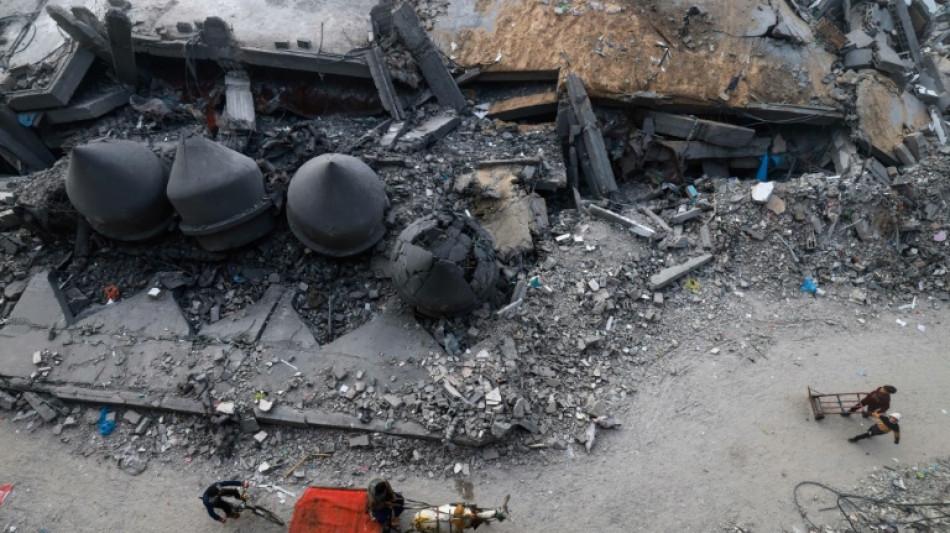
Israeli military proposes 'plan for evacuating' Gaza civilians / Photo: MOHAMMED ABED - AFP
Israel's military proposed a plan for evacuating civilians from the Gaza Strip, Prime Minister Benjamin Netanyahu's office announced Monday, after he said a ground invasion of the Palestinian territory's southern city Rafah was necessary for "total victory".
Foreign governments and aid organisations have repeatedly expressed fears that such an operation will inflict mass civilian casualties.
More than 1.4 million Palestinians -- most of them displaced from elsewhere -- have converged on the last Gazan city untouched by Israel's ground troops.
It is also the entry point for desperately needed aid, brought in via neighbouring Egypt.
Israel's military "presented the War Cabinet with a plan for evacuating the population from areas of fighting in the Gaza Strip, and with the upcoming operational plan", a statement in Hebrew from Netayahu's office said Monday.
The statement did not give any details about how or where the civilians would be moved.
The announcement comes after Egyptian, Qatari and US "experts" met in Doha for talks also attended by Israeli and Hamas representatives, state-linked Egyptian media reported, the latest effort to secure a truce before the Muslim holy month of Ramadan.
Israel's ally the United States said ongoing mediation efforts produced "an understanding" towards a ceasefire and hostage release, while a Hamas source said the group insisted on the withdrawal of Israeli forces.
But Netanyahu -- who has dismissed the withdrawal demand as "delusional" -- said a ground invasion of Rafah would put Israel within weeks of "total victory" over Hamas, whose October 7 attack triggered the war.
"If we have a (truce) deal, it will be delayed somewhat, but it will happen," he said of the ground invasion in an interview with CBS Sunday.
"It has to be done because total victory is our goal and total victory is within reach -- not months away, weeks away, once we begin the operation."
Amid a spiralling humanitarian crisis, the main UN aid agency for Palestinians urged political action to avert famine in Gaza.
"Famine can still be avoided through genuine political will to grant access and protection to meaningful assistance."
The UN has said it faces restrictions, particularly on aid deliveries to northern Gaza.
- 'No aid' -
Nearly five months into the war, desperate families in Gaza's north have been forced to scavenge for something to eat.
"We have no food or drink for ourselves or our children," Omar al-Kahlout told AFP, as he waited near Gaza City for aid trucks to arrive.
"We are trapped in the north and there is no aid reaching us -- the situation is extremely difficult."
Hundreds of Palestinians headed south whichever way they could, walking down garbage-strewn roads between the blackened shells of bombed-out buildings, said an AFP correspondent.
Israeli forces continued striking targets across the Palestinian territory and battling militants in heavy urban combat centred on the southern city of Khan Yunis, near Rafah.
The Israeli military campaign has killed at least 29,692 people in Gaza, mostly women and children, according to the Hamas-run territory's health ministry.
The war broke out after Hamas's unprecedented attack, which killed about 1,160 people in Israel, mostly civilians, according to an AFP tally of official figures.
- 'Expanding the conflict' -
Militants also took about 250 Israeli and foreign hostages, 130 of whom remain in Gaza, including 31 presumed dead, according to Israel.
Israel's army confirmed Sunday the death of soldier Oz Daniel, 19, whose "body is still held captive by Hamas", according to the Hostages and Missing Families Forum, which said he was killed on the day of the attack.
Mediators have voiced hope that a temporary truce and a hostage-prisoner exchange can be secured before the start of Ramadan on March 10 or 11, depending on the lunar calendar.
Jordan's King Abdullah II warned fighting during the holy month "will increase the threat of expanding the conflict", according to a royal statement.
Qatar's Emir Sheikh Tamim bin Hamad Al-Thani, whose country hosts Hamas leaders and had helped broker a one-week truce in November, is due in Paris this week, the French presidency said.
Media reports suggest the warring parties are weighing a six-week halt to fighting and the initial exchange of dozens of female, underage and ill hostages for several hundred Palestinian detainees held by Israel.
- Hezbollah threat -
Across from overcrowded Rafah, neighbouring Egypt has kept its border closed, saying it will not help facilitate any operation to push Palestinians out of Gaza.
But satellite images show it has built a walled enclosure next to Gaza, in an apparent effort to brace for the possible arrival of large numbers of refugees.
Inside Israel, pressure has grown on Netanyahu from families of hostages demanding swifter action, and resurgent anti-government protests.
Defence Minister Yoav Gallant said there would be no let-up in action against Hamas's powerful Lebanese ally Hezbollah, whose militants have traded near-daily fire with Israeli forces since early October.
Both Hamas and Hezbollah are backed by Israel's enemy Iran.
"If anyone thinks that when we reach a deal (with Hamas)... it will ease what is happening here -- they are wrong," he said.
burs-dhc/lb
B.Hendrix--LCdB