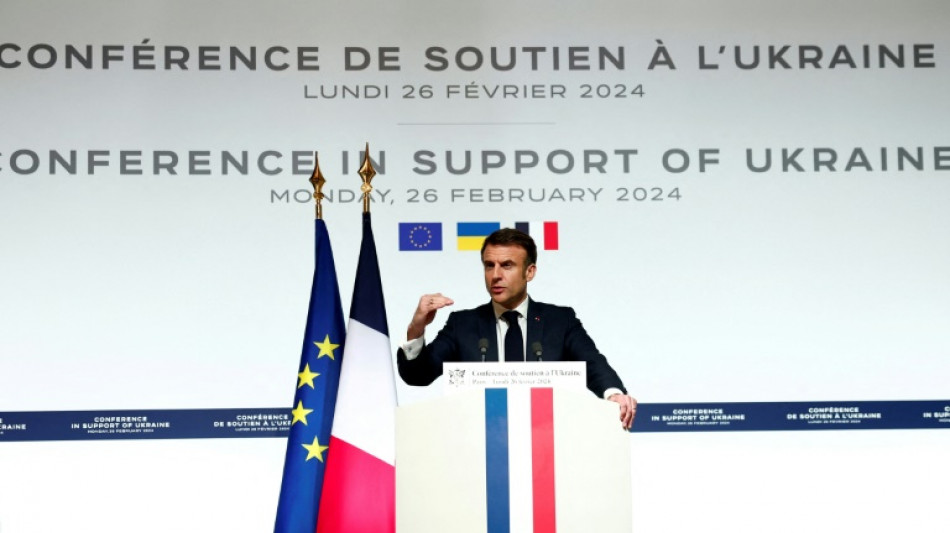
EU leaders reject sending troops to Ukraine / Photo: GONZALO FUENTES - POOL/AFP
French President Emmanuel Macron faced uneasy reactions from European allies and a warning from the Kremlin on Tuesday after he refused to rule out the dispatch of Western ground troops to Ukraine in its fight against the Russian invasion.
Macron said after a conference of European leaders on Monday that "everything that is necessary" must be done to ensure the defeat of Russia, including deploying troops.
The Kremlin warned of the "inevitability" of confrontation between NATO and Russia if troops from the alliance were deployed in the conflict, which would break a major taboo the West has so far been reluctant to challenge.
Macron hosted the conference just over two years to the day after Russia invaded Ukraine -- seeking to rally greater support for Kyiv, which faces increasing battlefield challenges and dwindling munition stocks.
He painted a grim picture of Russia under President Vladimir Putin, arguing there had been a "change of posture" even in recent months that had seen a hardening of its stance both domestically and in Ukraine.
While there was "no consensus" on the sending of Western ground troops to Ukraine, "nothing should be ruled out. We will do whatever it takes to ensure that Russia cannot win this war," Macron added.
- 'Not at war with Russia' -
Macron had refused to say more about France's position, citing the need for "strategic ambiguity" but saying the issue was mentioned "among the options".
"We are convinced that the defeat of Russia is indispensable to security and stability in Europe," Macron said.
Slovak Prime Minister Robert Fico, accused by critics of being too cosy with Moscow, said after the meeting that there was disunity on the issue among European leaders.
"There are countries that are ready to send their own soldiers to Ukraine, there are countries that say never –- Slovakia is among them -- and there are countries that say that this proposal should be considered," he said.
Prime Minister Ulf Kristersson of Sweden, which is set to join NATO, poured cold water on the idea, saying "it's not on the cards at all for the moment".
German Chancellor Olaf Scholz said in a tetchy message on X: "We agreed that everyone must do more for Ukraine in Paris yesterday. Ukraine needs weapons, ammunition and air defence. We are working on it. It is clear: there will be no ground troops from European countries or NATO."
Kremlin spokesman Dmitry Peskov said that, if NATO troops appeared in Ukraine, "we (would) need to speak not about a possibility but of the inevitability" of confrontation.
"This is absolutely not in the interests of these countries, they should be aware of this," he added.
A NATO official, who spoke on condition of anonymity, emphasised "there are no plans for NATO combat troops on the ground in Ukraine" despite the "unprecedented military support" from the alliance.
The Italian government said support for Ukraine did not include sending troops.
"When we talk about sending troops, we must be very cautious because we must not make people think we are at war with Russia," said Italian Foreign Minister Antonio Tajani.
"We are not at war with Russia," he said.
But the United Kingdom issued a somewhat more circumspect reaction, with Prime Minister Rishi Sunak's spokesman saying there were no plans for a "large-scale" troop deployment to Ukraine.
- 'Belligerence threshold' -
It is understood that any Western troops eventually sent to Ukraine would have no mandate to fight Russian forces but work on priorities outlined by Macron in his news conference, including de-mining, securing neighbouring countries such as Moldova and thwarting cyberattacks.
"We are not talking about soldiers on the front line, in combat, but about specific activities, far from the front," said Rym Momtaz, consultant research fellow at the International Institute for Strategic Studies (IISS).
But in parliament, Macron came under fire from far-right figurehead Marine Le Pen who accused him of "taking a further step towards belligerence, posing an existential risk to 70 million French people".
French Foreign Minister Stephane Sejourne told lawmakers that while new actions to support Ukraine such as demining and arms production could require a military presence on Ukrainian territory, this would not break "any belligerence threshold".
"It's our future, Europe's future that is at stake. We must have the possibility to do without (the United States), not out of defiance, pessimism or fear but because it depends on us," said Macron.
B.Janssens--LCdB